
Cancer is like an unpredicted storm coming into a family—noise, discomfort, and most of the time fright. The question of what would be the most terrible thing that could happen is quite commonly raised among Indian families. Besides the disease, it seems the overwhelming financial burden is what scares them the most. However, there is a glimpse of hope among such apprehensions. Through the past ten years, the Government of India has done a commendable job in creating a safety net comprising an array of cancer treatment schemes which are either free or subsidized, thereby making sure that no one has to go through cancer by themselves or stop their treatment because of a lack of money.
This is the narrative of the lives that these schemes change and the way Government with schemes intervenes in the patients’ journey to get the assistance they are entitled to.
Confused about treatment options?
Get a free second opinion from our oncologists
India’s largest health insurance scheme, covering:
Many radiotherapy, chemotherapy, and surgery packages are completely cashless.
Under the Health Minister’s Discretionary Grant
A lifeline for individuals with no other insurance coverage.
For patients below poverty line (BPL)
The scheme was created to ensure no BPL family has to mortgage their future for treatment.
Many states offer additional support:
Each state has its own additional benefit pool, especially for radiotherapy and pediatric cancers.
Although preventive in nature, it supports:
Early detection makes treatment less costly and more successful.
Cancer care isn’t just medical—it’s emotional, mental, and financial.
Cancer treatment in India can be financially overwhelming, but the good news is that nearly every state offers free or highly subsidized cancer care through dedicated government schemes. Along with national programs such as Ayushman Bharat (PM-JAY) and Health Ministry’s Non-Communicable Disease (NCD) initiatives, many Indian states have launched their own cancer-specific financial support schemes.
This blog provides a state-wise breakdown to help patients and caregivers identify where to access free cancer treatment.
Megha Health Insurance Scheme (MHIS)
Cancer treatment is expensive, but in India, no patient should be denied care because they cannot afford it.
The government’s initiatives are helping thousands start treatment on time—and survive.
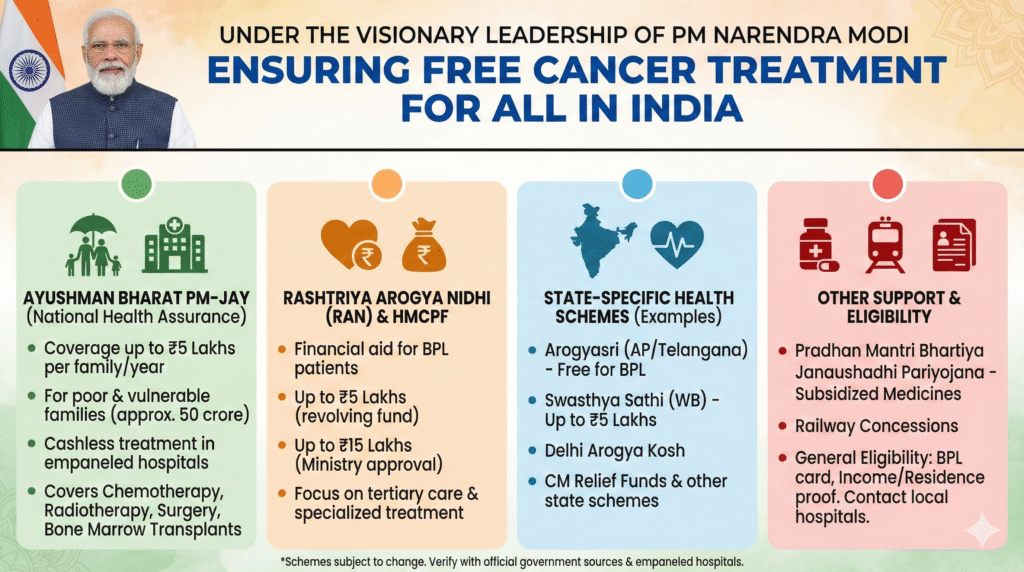
India provides a wide range of government support programs to ensure that cancer treatment is not only accessible but also affordable to the general population. The Ayushman Bharat PM-JAY initiative offers a maximum of ₹5 lakh per family and facilitates a cancer treatment that does not require the handing over of money directly to the patient at hospitals that are empaneled. Besides, the Health Minister’s Cancer Patient Fund and Rashtriya Arogya Nidhi are the two major sources that provide financial help to the economically weaker sections of the society and the patients living below the poverty line. Different states have their own state government schemes, for example, Delhi Arogya Kosh, Swasthya Sathi in West Bengal, and Tamil Nadu’s CMCHIS, which provide support to the patients undergoing chemotherapy, radiotherapy, and surgeries. In the same way, CGHS and ECHS are the two schemes that provide cancer treatment benefits to the government employees, pensioners, and armed forces personnel. Besides, preventive and early detection measures get a boost through the NPCDCS program, which helps in the identification of cancer at an early stage when the chances of cure are higher. To make patients aware of these resources, this guide gives them the necessary help.
The question of affordability of cancer treatment in India is answered in the affirmative by the government, thanks to a network of national and state-level schemes that provide almost free or highly subsidized oncology care. Various national level schemes like Ayushman Bharat (PM-JAY), the Health Minister’s Cancer Patient Fund (HMCPF), and Rashtriya Arogya Nidhi (RAN) provide financial assistance, cashless treatment, and support for the most life-saving cancer drugs, especially for BPL families. Moreover, most states have cancer care programs. For instance, Andhra Pradesh’s Dr. YSR Aarogyasri and Telangana’s Aarogyasri Scheme cover ₹5–10 lakh and provide cashless treatment, whereas Tamil Nadu’s CMCHIS and Karnataka’s Arogya Karnataka help in free or subsidized chemo, radiation, and cancer surgeries. Similarly, Kerala’s KASP, Maharashtra’s MJPJAY, Gujarat’s MA Vatsalya, and Rajasthan’s Chiranjeevi Scheme cover a wide range from ₹2–10 lakh for comprehensive cancer care. While Uttar Pradesh, Punjab, Haryana, Delhi, Himachal Pradesh, and Jammu & Kashmir offer free treatment through state programs supported by PM-JAY benefits that mostly help in expensive surgeries and pediatric cancers, the eastern and northeastern states of Bihar, Odisha, Assam, Meghalaya, Tripura, Nagaland, Mizoram, Arunachal Pradesh, and Sikkim provide free diagnostics, chemotherapy, radiotherapy, and other cancer services through schemes like PM-JAY, BSKY, BSSY, Atal Amrit Abhiyan, MHIS, and regional cancer care networks. In brief, India’s union and state government programs, in tandem, are a safety net for the cancer patients and fairly close to universal health coverage. They eliminate the possibility of a financial catastrophe accompanying the access to basic cancer treatments for patients, whatever their income and geographical location may be.
.webp)
Get expert guidance instantly
Tell us about your condition and we will help you find the right care.
Get expert guidance instantly
Share a few details and our medical team gets back to you within 4 hours with the next steps.

Tell us what you are facing and our medical team will guide you to the right doctors, hospitals and treatment.
Free Review, No Commitment
Free assessment with no pressure to proceed.
Trusted by 100,000+ Patients
Across 125+ countries worldwide
500+ Top Partner Hospitals
Globally accredited medical facilities
5000+ Expert Specialists
Senior doctors across major specialties.
Making quality healthcare accessible to patients worldwide
Everything you need to know about choosing the right hospital, doctor and treatment plan.