
Explore prostate cancer treatment in Germany, including advanced diagnosis, robotic surgery, radiation therapy, and immunotherapy. Treatment costs start from €15,000, and localized prostate cancer has a 5-year survival rate of over 99%.
Reply in 4 hours · Plan and quote in 2 days · 100% confidential
Germany is a leading destination for prostate cancer treatment, offering personalized, guideline-based care supported by the German S3 Guideline for Prostate Cancer. Treatment plans are tailored according to the cancer stage, Prostate-Specific Antigen (PSA) level, Gleason score, overall health, and patient preferences.
Patients have access to advanced diagnostics, including multiparametric MRI (mpMRI) and PSMA PET/CT, as well as methods such as robotic-assisted surgery, precision radiation therapy, hormone therapy, chemotherapy, active surveillance, and PSMA-targeted radioligand therapy (Lutetium-177 PSMA). According to the American Cancer Society, “The 5-year relative survival rate exceeds 99% for localized and regional prostate cancer.”
Germany’s multifaceted cancer centers and evolved technologies make it a preferred choice for both domestic and international patients seeking comprehensive prostate cancer care.
Other than being internationally recognised for its high standards in prostate cancer diagnosis and care. Cancer care in Germany is guided by the German S3 Guideline for Prostate Cancer. Which not only recommends treatment based on factors such as cancer stage, PSA level, Gleason score, overall health, and patient preferences.
Patients also get access to advanced medical technologies, multidisciplinary cancer teams, and comprehensive support throughout their journey.
Some of the key reasons to choose Germany for prostate cancer care include:
Prostate cancer develops when abnormal cells in the prostate gland grow uncontrollably and form a tumor. It is the second most commonly diagnosed cancer among men worldwide, with approximately 1.5 million new cases diagnosed in 2022, according to the International Agency for Research on Cancer (IARC) GLOBOCAN 2022.
While many prostate cancers grow slowly, some are aggressive and can spread beyond the prostate. Early-stage prostate cancer often causes no noticeable symptoms, making regular screening and timely diagnosis crucial for men at increased risk. The risk increases with age, family history, older men aged 50 years and above.
After prostate cancer is diagnosed, the doctors use prostate cancer staging and the prostate cancer TNM scheme to assess how much the disease has progressed. This helps determine the best treatment approach.
For example:
The main types of prostate cancer include:

Prostate cancer is generally classified into four stages:
According to the National Cancer Institute’s SEER Program, “About 70% of prostate cancers are diagnosed while still localized to the prostate, emphasizing the importance of early detection and timely treatment.”
The exact causes of prostate cancer are not yet known. But what we do know is that a few things increase the risk of getting it. These include:
Understanding these risks, and responding with early screening, can dramatically improve your prognosis.
The diagnosis of prostate cancer is done through a series of methods, which includes
It is important to note that not everyone diagnosed with prostate cancer requires immediate treatment. The most appropriate approach depends on the cancer stage, PSA level, Gleason Grade Group, overall health, life expectancy, symptoms, and individual preferences. According to the German S3 Guideline, treatment decisions should be personalized to achieve the best possible outcomes while maintaining quality of life.
It is generally recommended for:
Men with low-risk, localized prostate cancer may not need immediate treatment and can often be safely managed with active surveillance, involving regular PSA tests, imaging, and follow-up examinations to monitor the disease.
Prostate cancer care in Germany is tailored to each patient’s individual diagnosis. According to the German S3 Guideline for Prostate Cancer, doctors recommend treatment based on several factors, including the stage of the cancer, PSA level, Gleason Grade Group, risk category, age, overall health, symptoms, and patient preferences. A multidisciplinary team works together to develop personalized medical care that offers the best possible outcomes while preserving quality of life whenever possible.
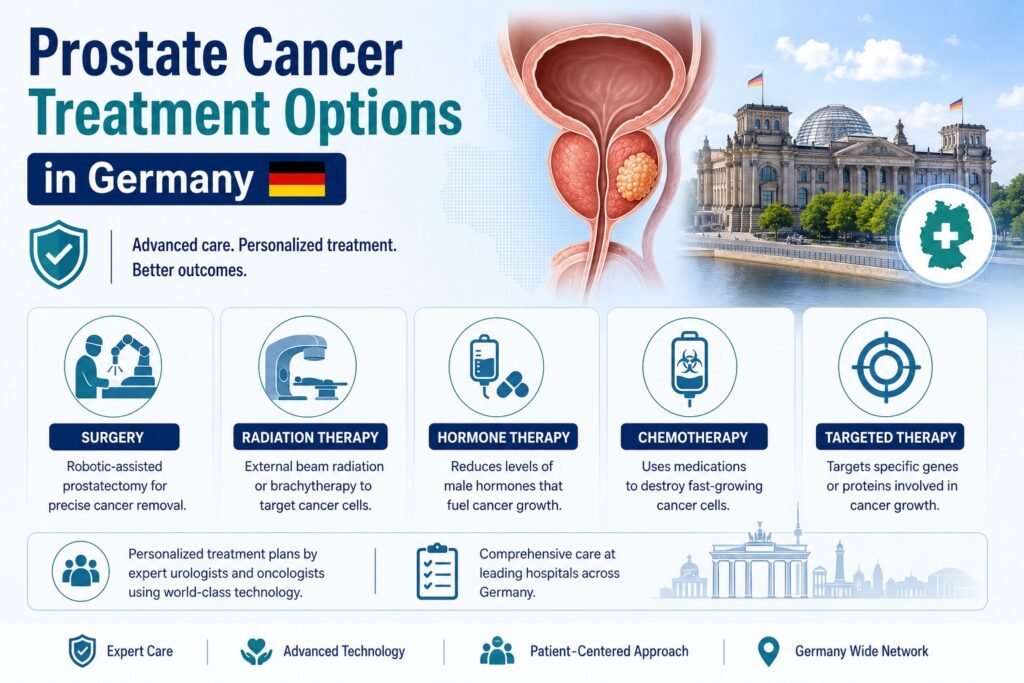
The main treatment options available in Germany include:
Active surveillance is recommended for many patients with low-risk, localized prostate cancer that is unlikely to grow or spread quickly. Instead of immediate treatment, patients undergo regular PSA testing, imaging, and follow-up examinations to monitor the cancer.
Surgery is commonly recommended for localized and selected locally advanced prostate cancer.
Many German hospitals perform robot-assisted radical prostatectomy using minimally invasive techniques to remove the prostate while aiming to preserve urinary continence and erectile function whenever appropriate.
Radiation therapy may be used as a primary treatment for localized or locally advanced prostate cancer or after surgery if there is a risk of recurrence. Therapeutic options include external beam radiation therapy (EBRT), intensity-modulated radiation therapy (IMRT), image-guided radiation therapy (IGRT), stereotactic body radiation therapy (SBRT), and brachytherapy for selected patients. These have been discussed below in detail.
Hormone therapy reduces testosterone levels to slow the growth of prostate cancer cells. It is commonly used for locally advanced, recurrent, or metastatic prostate cancer, often in combination with radiation therapy or other systemic ways.
Chemotherapy is generally recommended for advanced or metastatic prostate cancer, in cases when the disease no longer responds adequately to hormone therapy. It helps slow disease progression and relieve symptoms.
Patients with specific genetic alterations, may benefit from targeted therapies. Molecular profiling helps identify patients who are eligible for these personalized available therapies.
Germany is among the countries offering Lutetium-177 PSMA radioligand therapy for eligible patients with advanced or Stage IV prostate cancer. This targeted treatment delivers radiation directly to prostate cancer cells expressing PSMA while minimizing damage to surrounding healthy tissue.
Palliative care focuses on relieving symptoms, managing treatment-related side effects, maintaining quality of life, and providing supportive care throughout the patient’s journey .
Germany uses advanced technology in diagnosing and treating prostatic cancer in order to increase accuracy in diagnosis, making treatment strategies , and improving results. Technology aids specialists in initial detection, precise targeting of tumors, and minimizing damage to healthy tissues around the tumor area. Some of these are discussed below:
Multiparametric MRI (mpMRI) combines multiple imaging techniques to provide detailed images of the prostate. It helps detect clinically significant tumors, assess the extent of the disease, guide targeted biopsies, and support active surveillance.
This advanced biopsy technique combines pre-recorded MRI images with real-time ultrasound to accurately target suspicious areas within the prostate. Compared with standard biopsy methods, it improves the detection of clinically significant prostate cancers while reducing unnecessary tissue sampling.
PSMA PET/CT is a highly sensitive imaging technology used to detect prostate cancer.
It determines whether cancer has spread, and identifies recurrent disease after treatment. It also helps doctors determine whether patients are eligible for PSMA-targeted therapies.
Many German hospitals perform robot-assisted radical prostatectomy using the da Vinci Surgical System. The technology provides enhanced precision, improved visualization, and greater surgical control,
This may help reduce blood loss, shorten recovery time, and preserve urinary continence and erectile function whenever possible.
German cancer centers use advanced radiation technologies such as Intensity-Modulated Radiation Therapy (IMRT), Image-Guided Radiation Therapy (IGRT), Stereotactic Body Radiation Therapy (SBRT), and brachytherapy.
The goal is to deliver highly targeted radiation while minimizing exposure to nearby healthy tissues.
Lutetium-177 PSMA radioligand therapy is an innovative targeted treatment for eligible patients with PSMA-positive metastatic castration-resistant prostate cancer (mCRPC). The therapy delivers radiation directly to cancer cells expressing PSMA, helping control the disease while reducing damage to surrounding healthy tissue.
A patient-centric model for prostate cancer care is developed, integrating the latest scientific knowledge with tailored plans. This ensures that the patients get evidence-based care, innovative technology, and effective coordination of care in order to maintain their quality of life.
Key benefits include:
Prostate cancer is one of the most treatable cancers when detected early. Survival largely depends on the stage of the disease at diagnosis, the cancer’s risk category, and how well it responds to treatment. According to the Centre for Cancer Registry Data (ZfKD), prostate cancer is the most commonly diagnosed cancer among men in Germany, highlighting the importance of timely diagnosis and access to specialized care.
Although prostate cancer can occur at any stage, patients who get diagnosed early on generally have a much better prognosis than those with advanced or metastatic disease.
| Stage at Diagnosis | 5-Year Relative Survival Rate* |
| Localized (confined to the prostate) | >99% |
| Regional (spread to nearby tissues or lymph nodes) | >99% |
| Distant (metastatic) | ~38% |
| Overall (all stages combined) | ~98% |
Source: American Cancer Society (based on SEER data).
Prompt diagnosis of prostate cancer often causes no noticeable symptoms, which is why regular screening and prompt evaluation of urinary changes are important, particularly for men at higher risk. Detecting prostate cancer before it spreads increases the likelihood of successful treatment and may allow patients to benefit from less invasive treatment options.
Some common warning signs include:
There is no fixed cost for prostate cancer treatment in Germany, as expenses vary according to each patient’s diagnosis and treatment needs. Leading cancer centers in Berlin, Munich, Heidelberg, and Freiburg provide extensive prostate cancer care, with costs differing based on treatment complexity and duration. The estimates below reflect private healthcare costs for international patients. While public healthcare systems such as Germany’s statutory health insurance and the UK’s NHS may cover eligible residents, international patients generally receive treatment through private or self-funded services. Compared with private treatment in the UK and the US, Germany often offers advanced prostate cancer care at competitive prices.
Estimated Cost of Prostate Cancer Treatment in Germany
| Treatment | Estimated Cost (EUR) |
| Initial Consultation & Diagnostic Evaluation | €500–€2,000 |
| Multiparametric MRI (mpMRI) | €500–€1,200 |
| Prostate Biopsy | €1,500–€3,500 |
| Robot-Assisted Radical Prostatectomy | €15,000–€25,000 |
| Radiation Therapy (Complete Course) | €8,000–€18,000 |
| Hormone Therapy | €300–€2,000/month* |
| Chemotherapy | €3,000–€10,000 per cycle* |
| Lutetium-177 PSMA Therapy | €8,000–€15,000 per cycle* |
*Actual costs vary depending on the treatment regimen and the number of cycles required.
Note: Many German hospitals provide detailed treatment strategy and cost estimates before treatment begins, helping international patients plan their medical journey.
| Country | Estimated Treatment Cost |
| Germany | €15,000–€50,000 |
| United Kingdom | €20,000–€60,000 (private care) |
| United States | €40,000–€120,000+ |
Factors That Influence Treatment Costs
Before starting treatment patients are encouraged to obtain an approximate cost and treatment regime. As costs vary based on an individual’s clinical needs.
There are also several renowned hospitals in Germany that offer comprehensive care for prostate cancer. Offering advanced diagnostic facilities and options for treatment like surgery, radiotherapy, and special support for localized, advanced, and metastatic prostate cancer.
| Hospital | City | Key Prostate Cancer Services |
|---|---|---|
| University Hospital Heidelberg | Heidelberg | Advanced prostate cancer diagnosis, robotic-assisted surgery, precision radiation therapy, PSMA PET/CT imaging, multidisciplinary care |
| Charité – Universitätsmedizin Berlin | Berlin | Comprehensive prostate cancer treatment, minimally invasive surgery, advanced imaging, systemic therapies, multidisciplinary tumor board care |
| Ludwig Maximilian University Hospital (LMU Hospital) | Munich | Robotic-assisted prostatectomy, radiation oncology, hormone therapy, chemotherapy, personalized rehabilitation |
| Freiburg University Hospital | Freiburg | Advanced diagnostics, minimally invasive surgery, precision radiation therapy, targeted therapies, rehabilitation, and follow-up care |
Germany provides a well organised treatment pathway for international patients seeking prostate cancer care. Dedicated international patient teams assist with medical reviews, travel arrangements, treatment collaboration, and follow-up to ensure a seamless experience.
Step 1: Submit Your Medical Records
Share your PSA test results, prostate biopsy and pathology reports, Gleason Grade Group, MRI or PSMA PET/CT scans (if available), previous treatment records, and any relevant medical history. Specialists review these documents to understand the stage and risk of the cancer before recommending treatment.
Step 2: Receive a Clinical Care Plan
A multidisciplinary team evaluates your case and prepares a tailored strategy based on the cancer stage, PSA level, Gleason score, overall health, and treatment goals. You will also receive an estimated treatment duration and cost.
Step 3: Apply for a German Medical Visa
Once you decide to proceed, the hospital issues an official invitation letter and treatment confirmation to support your German medical visa application. International patient coordinators may also assist with appointment scheduling, accommodation options, interpreter services, and airport transfers where available.
Step 4: Arrive in Germany and Begin Treatment
After arriving, you meet your treating specialists and complete any additional investigations if required. Depending on your diagnosis, treatment approach may include active surveillance, robotic-assisted radical prostatectomy, radiation therapy, hormone therapy, chemotherapy, or Lutetium-177 PSMA radioligand therapy.
Step 5: Recovery and Discharge
Following treatment, your medical team monitors your recovery, manages any treatment-related side effects, and provides detailed discharge instructions before you return home.
Step 6: Follow-Up Care
Before leaving Germany, you receive a comprehensive medical summary, pathology results (if surgery was performed), medication plan, and recommendations for PSA monitoring, follow-up imaging, and future consultations. Many hospitals also offer virtual follow-up appointments and coordinate ongoing care with your local doctor.
The recovery process after prostate cancer treatment continues well beyond your hospital stay. Regular follow-up appointments help assess treatment response, monitor PSA levels, manage any long-term side effects, and support your return to everyday activities.
If you or someone you care about is dealing with a prostate cancer diagnosis, remember this: Germany has some of the world’s most advanced and effective treatment options. Whether you need surgery, state-of-the-art radiation, or access to cutting-edge clinical trials, they offer personalized care plans designed for the best possible outcome.
And with Cancer Rounds by your side, navigating this journey becomes simpler, smoother, and far less stressful.
Contact Cancer Rounds today to start planning your treatment journey. Our team is here to help you find the best hospitals for prostate cancer treatment in Germany, connect you with leading doctors, and ensure you receive world-class care from start to finish.
A prostate cancer diagnosis is never easy, but the choice of where you get treatment can change everything. Germany offers a powerful combination of medical excellence, advanced tech, and genuinely patient-focused care, that means not just hope, but real results. And with the right support, your healing journey can start right now.
Prostate cancer can often be successfully treated, particularly when it is diagnosed at an early stage before it has spread beyond the prostate. Many patients with localized prostate cancer achieve excellent long-term outcomes with methods such as active surveillance, surgery, or radiation therapy. Even when the disease is more advanced, modern methods including hormone therapy, chemotherapy, targeted therapies, and Lutetium-177 PSMA radioligand therapy for eligible patients can help control the cancer, relieve symptoms, and improve quality of life. The most appropriate treatment depends on the stage of the disease, PSA level, Gleason Grade Group, overall health, and individual treatment goals.
Germany is recognized for its evidence-based approach to prostate cancer care, following internationally accepted clinical guidelines and offering access to advanced diagnostic and treatment technologies. Many hospitals provide multidisciplinary care, where urologists, oncologists, radiation specialists, radiologists, and nuclear medicine experts work together to create personalized treatment plans. International patients also benefit from dedicated support services, including medical record reviews, collaboration, interpreter assistance, and follow-up planning, making the patient journey more convenient and organized.
The length of stay depends on the type of treatment you receive. Patients undergoing robotic-assisted prostate surgery generally remain in Germany for several weeks, allowing time for surgery, recovery, and follow-up assessments. Radiation therapy usually requires multiple treatment sessions over several weeks, while hormone therapy and some systemic treatments may involve shorter visits. Patients receiving Lutetium-177 PSMA therapy may need multiple treatment cycles scheduled over several months. Your treating hospital will provide an estimated treatment timeline before you travel.
Yes. Many German hospitals offer remote second-opinion services for international patients. After reviewing your PSA results, biopsy and pathology reports, MRI or PSMA PET/CT scans, and previous treatment records, specialists can evaluate your diagnosis and recommend suitable management options . This allows patients to better understand their condition, explore alternative treatment approaches, and make informed decisions before traveling to Germany.
Patients should prepare all relevant medical records before traveling. These typically include PSA test results, biopsy and pathology reports, Gleason Grade Group, MRI or PSMA PET/CT imaging, previous treatment records, current medications, and details of any existing medical conditions. You will also need a valid passport, medical visa (if required), and any documents requested by the treating hospital. Having complete medical information allows specialists to evaluate your condition more efficiently and avoid unnecessary repeat investigations.
Lutetium-177 PSMA radioligand therapy is generally recommended for eligible patients with PSMA-positive metastatic castration-resistant prostate cancer (mCRPC) after appropriate clinical evaluation. Before treatment, doctors typically perform PSMA PET/CT imaging to confirm that the cancer cells express the PSMA protein, which enables the targeted therapy to work effectively. Eligibility also depends on previous methods, overall health, kidney function, blood counts, and individual clinical factors. Your specialist will determine whether this therapy is appropriate for your condition.
After completing treatment, patients receive a detailed medical summary outlining the treatment performed, pathology findings (if applicable), medications, and recommendations for ongoing care. Regular PSA testing is usually required to monitor treatment response and detect any signs of recurrence. Depending on your treatment, follow-up may also include imaging studies or consultations with your local healthcare provider. Many German hospitals also offer remote follow-up consultations to discuss recovery, review test results, and answer any ongoing questions.
The cost of prostate cancer treatment in Germany depends on several factors, including the stage of the disease, the type of treatment required, the hospital, and the duration of care. Patients undergoing surgery, radiation therapy, or advanced treatments such as Lutetium-177 PSMA therapy may have different overall costs depending on their clinical care plan. Most German hospitals review medical records before providing international patients with a detailed treatment plan, estimated costs, and expected treatment timeline, helping them plan their medical journey with greater confidence.
Published By
.webp)
Global Patient Care, Redefined
The CancerRounds Medical Content Team specialises in creating accurate, clear and patient-focused healthcare content. Our content is written by medically trained writers, medically reviewed, and based on reputable medical sources to support informed healthcare decisions.
Get expert guidance instantly
Share a few details and our medical team gets back to you within 4 hours with the next steps.

Tell us what you are facing and our medical team will guide you to the right doctors, hospitals and treatment.
Free Review, No Commitment
Free assessment with no pressure to proceed.
Trusted by 100,000+ Patients
Across 125+ countries worldwide
500+ Top Partner Hospitals
Globally accredited medical facilities
5000+ Expert Specialists
Senior doctors across major specialties.
Making quality healthcare accessible to patients worldwide
Everything you need to know about choosing the right hospital, doctor and treatment plan.