



Best Spinal Tumour Treatment Doctors in India

Dr. Rajagopalan Krishnan

Dr. Vidyadhara S.

Dr. Puneet Girdhar

Dr. Hitesh Garg


Dr. Vikas Tandon


Dr. Charanjit Singh Dhillon

Dr. Vishal Peshattiwar

Dr. H. S. Chhabra

Dr. Navaladi Shankar

Dr. M.L. Bansal


Dr. Manoj Miglani


Dr. Anil Mishra


Dr. Prakash P kotwal
What Patients with Spinal Tumour Worry About Most
A spinal tumour diagnosis is overwhelming. Patients worry about paralysis, about whether the tumour is cancer, about how long they have, and about who is the right specialist (a spine surgeon, a neurosurgeon, an oncologist, or all three). Tumours of the spine fall into three groups: extradural (most often metastatic from another cancer), intradural extramedullary (such as meningioma or schwannoma), and intramedullary (such as ependymoma or astrocytoma). The honest position is that primary benign tumours like meningioma and schwannoma are often cured by complete surgical removal. Metastatic tumours are managed by a combined neurosurgery, radiation oncology, and medical oncology team with strong functional outcomes when caught before paralysis.
How Spinal Tumour Is Diagnosed
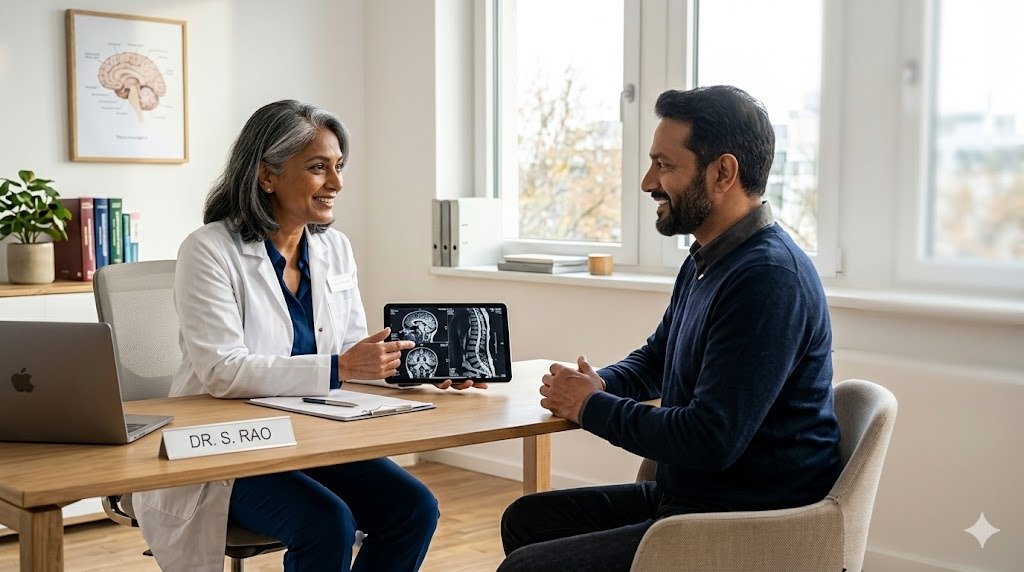
Magnetic resonance imaging with contrast of the whole spine is the cornerstone investigation. It identifies the tumour location, compartment, enhancement pattern, and any cord compression. Computed tomography helps assess bone involvement and surgical planning. A staging workup is done for suspected metastases (chest, abdomen, and pelvis computed tomography, positron emission tomography scan, bone scan, and tumour markers). Biopsy is needed for tissue diagnosis in most cases, often percutaneous computed tomography-guided. Neurological assessment with the American Spinal Injury Association scale and the Frankel grading documents the baseline.
Treatment Options for Spinal Tumour in India
For benign intradural tumours like meningioma and schwannoma, complete microsurgical excision through a laminectomy or laminoplasty is curative in over ninety percent. Intramedullary tumours like ependymoma are removed with intraoperative neuromonitoring and ultrasonic aspirator. For metastatic spinal cord compression, the Spine Instability Neoplastic Score and the Tokuhashi or Tomita score guide whether to do separation surgery, instrumented fusion, or palliative radiation alone. Stereotactic body radiation therapy with the CyberKnife or TrueBeam linear accelerator is highly effective for metastatic disease. Vertebroplasty and kyphoplasty are used for painful collapse. Chemotherapy and targeted therapy follow the primary cancer plan. Centres at All India Institute of Medical Sciences, Tata Memorial, Apollo, Fortis Memorial Research Institute, Medanta, BLK-Max, and Manipal handle the full pathway.
Recovery, Success Rates, and Follow-Up
Benign tumours like meningioma and schwannoma have over ninety percent local control at ten years after complete excision and ninety-five percent cure rates for schwannoma. Ependymoma has eighty to ninety percent local control after gross total resection. Metastatic disease has variable survival based on the primary cancer type but separation surgery with stereotactic body radiation therapy gives over eighty percent local control at one year. Neurological recovery depends on the duration of compression before surgery, with the best outcomes when surgery is done within twenty-four to forty-eight hours of progressive deficit. Follow-up magnetic resonance imaging at six months, one year, and then yearly is standard.
How to Choose the Right Spine Surgeon for Spinal Tumour
Choose a centre with a multidisciplinary tumour board where neurosurgery, spine surgery, medical oncology, and radiation oncology review every case together. Ask whether intraoperative neuromonitoring is used routinely, whether stereotactic body radiation therapy is offered in-house, and what the published surgical morbidity is. For metastatic disease, a clear plan that fits the patient’s life expectancy and goals is more important than the most aggressive operation.
Support for International Patients
Cancer Rounds arranges the medical visa invitation letter, accommodation suited to mobility limitations, airport pickup, and multilingual support in eleven plus languages. Patients arrive from Nigeria, Bangladesh, Kenya, Iraq, Ethiopia, Oman, and the United Arab Emirates. The case manager handles the second opinion, full multidisciplinary tumour board review, oncology coordination, the operation scheduling, intensive care arrangements, and a one-year teleconsult follow-up.
Frequently Asked Questions
Will I be paralysed?
Outcomes depend on the duration and degree of cord compression before surgery. With early diagnosis and prompt surgery, most patients preserve or recover function. Late presentation with established paralysis has lower recovery.
Is spinal cord meningioma curable?
Yes. Complete microsurgical excision cures over ninety percent of spinal meningiomas with low recurrence at ten years.
How long is the hospital stay?
Five to seven days for intradural extramedullary tumours, seven to ten days for intramedullary tumours, and three to five days for vertebroplasty or kyphoplasty.
Is stereotactic body radiation therapy a real alternative to surgery for spinal metastases?
For radioresistant tumours and selected oligometastatic spine disease, stereotactic body radiation therapy gives over eighty percent local control at one year and is often combined with separation surgery.
Will I need chemotherapy?
Metastatic disease follows the chemotherapy plan of the primary cancer. Primary spinal tumours are usually managed by surgery with or without radiation; chemotherapy is added only for selected subtypes.
How urgently does surgery need to be done?
Progressive neurological deficit needs decompression within twenty-four to forty-eight hours. Stable presentations are operated within one to two weeks after staging is complete.