
CAR-T cell therapy cost varies hugely by country. In the US, the product alone lists at roughly $400,000 to $475,000, and a full treatment episode often passes $800,000. Germany’s negotiated product prices sit around €320,000 to €360,000. India’s home-grown CAR-T costs a fraction of that, around ₹40 lakh. Eligibility, approved uses and time abroad matter as much as price, so start with a specialist review.
Confused about treatment options?
Get a free second opinion from our oncologists
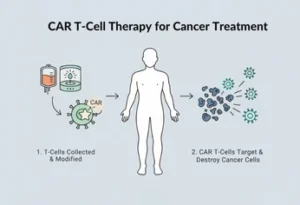
The American Cancer Society describes CAR-T cell therapy as a type of immunotherapy that modifies a patient’s own T cells to help them recognize and attack cancer cells. During treatment, T cells are collected from the patient’s blood, genetically modified in a laboratory to carry chimeric antigen receptors (CARs), and then multiplied before being infused back into the body.
Before the infusion, patients usually receive lymphodepleting chemotherapy to make room for the modified cells and help them work effectively. Because CAR-T can cause serious reactions, including cytokine release syndrome (CRS) and neurological side effects, patients require close monitoring after treatment. CAR-T is currently used for certain blood cancers, including some leukemias, lymphomas, and multiple myeloma, with research continuing into other cancers.
CAR-T cell therapy is expensive because it involves a highly personalized and complex manufacturing process rather than a conventional off-the-shelf medicine.
This means that a patient’s T cells must be collected, genetically modified, expanded in a specialized laboratory, tested for quality, and returned to the hospital for infusion.
The total cost may also include lymphodepleting chemotherapy, hospitalization, intensive monitoring, and management of potential complications such as cytokine release syndrome and neurological toxicities. Although current research has highlighted the potential for cost savings through more efficient CAR-T manufacturing and treatment models, the final price can vary considerably by country, CAR-T product, healthcare system, and hospital.
CAR-T cell therapy costs about $400,000 to $475,000 for the product in the US, with total treatment often above $800,000. In Germany, negotiated product prices run around €320,000 to €360,000, plus hospital costs. India’s home-grown CAR-T was expected to cost about ₹40 lakh (roughly $50,000) at launch.
Here’s how the three countries compare side by side:
| United States | Germany | India | |
| CAR-T product price | $373,000 to $475,000 list price (2021); about $400,000 (2024) | About €320,000 to €360,000 (2026) | About ₹40 lakh for home-grown CAR-T (2023 to 2024); imported products about ₹5 crore (2021) |
| Total treatment cost | Mean of about $809,800 per episode in commercial claims (2026) | Over €300,000 per treatment (2021), with hospital care on top of the product | No published commercial total; ask for a written quote |
| Wait from cell collection to infusion | Commonly 6 to 8 weeks for commercial products | Commonly 6 to 8 weeks for commercial products | About 9 days in one hospital-made trial (2024) |
| Time to stay near the centre after infusion | About 4 weeks | About 4 weeks | About 4 weeks |
These figures cover different years and products, so treat them as ranges, not quotes. Your own price depends on the product you need, how your body reacts, and how long you stay in hospital.
Myths remain about who can receive it, how effective it is, and its side effects. Contrary to common belief, CAR T-cell therapy is not limited to a last-resort treatment, does not work for every type of cancer, and does not guarantee a permanent cure. Age alone does not rule out treatment, and while side effects such as cytokine release syndrome (CRS) can occur, they can often be managed with close monitoring and established treatments.
The cost of CAR-T cell therapy varies significantly between the United States, India, and Germany, but comparing the quoted therapy price alone can be misleading. The final cost may include T-cell collection, laboratory manufacturing, lymphodepleting chemotherapy, CAR-T infusion, hospitalization, monitoring, and management of complications. For patients traveling abroad, accommodation, transportation, visas, and extended stays can also add to the total.
The United States generally has the highest CAR-T treatment costs among the three countries. The expense reflects the price of commercially manufactured CAR-T products as well as the specialized infrastructure required for cell collection, manufacturing, administration, and monitoring. Treatment may also involve substantial hospital and physician costs, particularly if complications such as cytokine release syndrome or neurological toxicities require additional care.
In the US, CAR-T products list at roughly $373,000 to $475,000, and the full treatment episode is far higher. Commercial insurance claims show an average episode cost of about $809,800, and around 15% of episodes cost more than $1.1 million.
The product makes up most of that bill, but not all of it. Younger patients aren’t cheaper to treat either. A 2024 study of US children and young adults with leukaemia found a median cost of $620,500 over 90 days. Inpatient care made up about 71% of that total.
Few international patients travel to the US for CAR-T, mainly because of these costs. We include it here because it’s the global benchmark. When you see a price elsewhere, this is the figure it’s usually compared against.
However, the amount a patient actually pays can be very different from the overall treatment cost because insurance coverage, deductibles, co-insurance, and reimbursement arrangements can significantly affect out-of-pocket expenses. CAR-T therapy is available at numerous specialized centers across the US for patients who meet the requirements for an approved therapy.
India has become an important destination for lower-cost CAR-T treatment, particularly following the development of indigenous CAR-T therapies. One of the most significant developments has been NexCAR19, an India-developed CAR-T therapy for certain B-cell cancers. The National Cancer Institute describes NexCAR19 as India’s first homegrown CAR-T therapy and notes its development through collaboration between IIT Bombay and Tata Memorial Centre.
The development of locally manufactured CAR-T products can substantially change the cost structure compared with imported therapies. Indian treatment costs may also be lower because of differences in manufacturing, hospital, and healthcare delivery expenses. However, the price varies according to the CAR-T product, cancer indication, hospital, and treatment pathway.
India’s first home-grown CAR-T therapy was approved in October 2023 and was expected to cost about start From ₹40 lakh, roughly $50,000 . That’s close to one-tenth of the US product price. The saving comes mainly from manufacturing the cells in India rather than importing a finished product.
The early results are encouraging. In the two Indian trials behind the approval, about two in three evaluable patients responded, and around half went into complete remission. None of the 53 evaluable patients had the neurological side effects seen with many other CAR-T products, and only 5% had a severe immune reaction.
For international patients, the quoted treatment cost should not be considered the complete budget. Medical evaluation, cell collection, hospitalization, monitoring, accommodation, travel, and the possibility of a longer stay should all be considered when estimating the total cost of CAR-T treatment in India.
Germany has established CAR-T treatment programs and provides access to authorized CAR-T therapies for eligible patients with certain blood cancers. Treatment is delivered through specialized centers with the infrastructure required for cell collection, administration, and close monitoring.
The cost of CAR-T therapy in Germany ranges from €300,000 to over €450,000 ($330,000 to $490,000) per treatment course vary according to the specific product, cancer indication, treatment center, and whether the patient is covered by the German healthcare system or is seeking treatment as an international self-paying patient. Research from the German Cancer Research Center (DKFZ) has also highlighted the potential for considerable savings through changes to CAR-T manufacturing and treatment approaches, demonstrating that manufacturing models can have an important influence on overall costs.
International patients should also consider expenses beyond the treatment itself, including diagnostic assessments, hospital stay, accommodation, transportation, and follow-up care. Access to a particular CAR-T therapy also depends on medical eligibility and the treatment center’s ability to accept the patient.
For international patients, the key question is not just “What is the cost of CAR-T?” but rather “What is the total expense of safely undergoing CAR-T treatment, from evaluation to follow-up?” The variation in CAR-T costs among these countries is affected by more than just the price of the therapy itself. Factors such as manufacturing expenses, the type of CAR-T product, hospital infrastructure, specialized care, inpatient monitoring, and the management of complications related to treatment can all influence the final cost.
India’s introduction of homegrown CAR-T therapies is particularly significant due to its lower treatment prices. Conversely, the United States has a higher-cost healthcare system characterized by commercially manufactured therapies. Germany occupies a middle ground, offering established access to CAR-T therapies while having treatment costs that vary based on the specific product, healthcare facility, and whether the patient is covered by insurance or paying out-of-pocket.
When comparing CAR-T cell therapy between countries, looking at the price of the CAR-T product alone does not give the full picture. Total Cost of Care (TCOC) considers the expenses involved throughout the patient’s treatment journey from evaluation and cell collection to lymphodepletion, CAR-T infusion, hospitalization, monitoring, complication management, and follow-up. Economic evaluations of CAR-T have shown that these additional healthcare resources can contribute substantially to the overall cost of treatment.
For international patients, TCOC can be even broader. In addition to medical expenses, patients may need to budget for medical consultations before travel, visas, flights, accommodation, local transportation, companion expenses, and an extended stay near the treatment center. These costs can make an apparently cheaper treatment option more expensive than expected.
Therefore, when comparing CAR-T treatment in the US, India, and Germany, patients should ask hospitals for a detailed estimate covering the complete treatment pathway rather than comparing the quoted CAR-T therapy price alone.
The listed price for CAR-T cell therapy might not encompass all costs associated with the treatment, especially for patients who are traveling from other countries. Research on the costs of CAR-T therapy emphasizes the need to factor in expenses related to hospitalization, supportive care, monitoring, and the management of complications that may arise from the treatment when evaluating the total financial impact.
A lower initial quote does not necessarily mean a lower total cost of care; for example, it can indicate that the cost includes only the procedure and not the whole hospitalisation, diagnostics, etc. Ask for a detailed treatment estimate and clarify what is included, what may be charged separately, and how unexpected complications would be handled in writing.
When considering a treatment center overseas, be sure to inquire if the quoted price covers:
Before choosing between the US, India, and Germany for CAR-T therapy, patients should consider the following questions:
Ultimately, it’s essential to compare costs with clinical appropriateness and the entire treatment journey. While a lower price may seem appealing, it should not compromise access to the right CAR-T product, experienced care, management of complications, or dependable follow-up.
CAR-T is approved only for certain blood cancers, and usually only after other treatments have failed. The approved uses include B-cell acute lymphoblastic leukaemia, several types of large B-cell lymphoma, mantle cell lymphoma, follicular lymphoma, chronic lymphocytic leukaemia and multiple myeloma.
Each cancer has its own rules about earlier treatments. In the US, for example, follicular lymphoma usually needs two earlier lines of treatment first. Multiple myeloma needs four or more, including specific drug classes. Rules in Europe and India are similar but not identical, and they change as new approvals arrive.
Your body also needs to be strong enough. Doctors check your heart, lung and organ function before agreeing to treatment.
The quickest way to know if you qualify is to have your records reviewed. An online cancer second opinion can confirm whether CAR-T is an option, and in which country.
Considering CAR-T cell therapy abroad? CancerRounds can help you compare treatment options in the US, India, and Germany, understand estimated costs and what they include, and navigate the practical aspects of international treatment. From reviewing your medical records to identifying suitable treatment centers and planning your stay, our team can help you make a more informed decision based on your medical needs, not cost alone.
Explore your CAR-T treatment options with CancerRounds today.
CAR-T cell therapy in the US can cost several hundred thousand US dollars, depending on the CAR-T product, cancer type, hospital, and additional care required. The final amount can also increase with hospitalization or treatment of complications. For insured patients, out-of-pocket costs may be substantially different from the total treatment price.
CAR-T treatment in India is generally less expensive than in the US, although costs vary by CAR-T product, hospital, cancer indication, and treatment requirements. Indigenous therapies such as NexCAR19 have helped make CAR-T more accessible at a lower cost for eligible patients.
CAR-T treatment costs in Germany vary according to the therapy used, treatment center, indication, and whether the patient is insured or paying privately. International patients should also account for accommodation, travel, and the additional monitoring period when calculating their total expenses.
One important factor is the availability of indigenous CAR-T products, which can have a different manufacturing and pricing structure from commercially manufactured therapies used in other countries. Differences in hospital, staffing, and healthcare costs also contribute to the overall price difference.
CAR-T therapy may be covered by health insurance when it is medically appropriate and meets the insurer’s coverage requirements. However, coverage, deductibles, co-insurance, and out-of-pocket limits vary between plans. Patients should confirm their coverage and expected personal expenses before treatment.
A CAR-T treatment estimate may include the CAR-T product, T-cell collection, laboratory processing, lymphodepleting chemotherapy, infusion, hospitalization, monitoring, and supportive care. Patients should ask whether complication management and follow-up are included or billed separately.
International patients may need to budget for medical consultations, diagnostic tests, visas, flights, accommodation, local transportation, companion expenses, and an extended stay near the treatment center. Emergency or additional hospital care can also increase the final cost.
Yes. Germany has specialized centers providing CAR-T therapy for eligible patients with certain blood cancers. International patients should first confirm their medical eligibility, the availability of the appropriate CAR-T product, acceptance of international patients, and the arrangements for treatment and follow-up.
Traveling abroad for CAR-T treatment requires careful medical and logistical planning. Because patients need close monitoring after infusion and may develop complications such as cytokine release syndrome or neurological toxicities, they should have access to appropriate specialist and emergency care and a clear follow-up plan before traveling.
Compare the total cost of care, not just the quoted CAR-T price. Consider the therapy and its manufacturing, cell collection, chemotherapy, hospitalization, monitoring, complication management, follow-up, travel, accommodation, and length of stay. Most importantly, confirm that the proposed CAR-T product is appropriate for your cancer and treatment history.
Not always. Some quotes cover only the CAR-T product, while others include the hospital stay, chemotherapy and follow-up. Always ask for an itemised written quote, and compare it with typical cancer treatment costs in Germany if you’re weighing countries.
.webp)
Get expert guidance instantly
Tell us about your condition and we will help you find the right care.

November 14, 2025
February 17, 2024
January 4, 2024

February 21, 2022
Get expert guidance instantly
Share a few details and our medical team gets back to you within 4 hours with the next steps.

Tell us what you are facing and our medical team will guide you to the right doctors, hospitals and treatment.
Free Review, No Commitment
Free assessment with no pressure to proceed.
Trusted by 100,000+ Patients
Across 125+ countries worldwide
500+ Top Partner Hospitals
Globally accredited medical facilities
5000+ Expert Specialists
Senior doctors across major specialties.
Making quality healthcare accessible to patients worldwide
Everything you need to know about choosing the right hospital, doctor and treatment plan.