
Cancer. The word alone carries a weight of fear and uncertainty. For decades, treatments have revolved around aggressive strategies like chemotherapy and radiation, often taking a heavy toll on the patient’s body alongside the cancer. But what if your own body held the key to fighting this formidable disease? This isn’t science fiction; it’s the reality, immunotherapy for cancer treatment is a revolutionary approach that’s fundamentally changing the landscape of cancer care.
At Cancer Rounds, we believe in shedding light on cutting-edge advancements and empowering our readers with accurate, patient-centric information. Immunotherapy isn’t just a new drug; it’s a paradigm shift, harnessing the incredible power of your immune system to recognise, target, and destroy cancer cells. This means not only a potential for more effective and lasting remissions but also, for many, a better quality of life with fewer severe side effects.
Confused about treatment options?
Get a free second opinion from our oncologists
Think of your immune system as an incredibly sophisticated internal army, constantly patrolling for threats. It’s equipped with a vast arsenal of cells and proteins designed to identify and eliminate anything foreign or abnormal – from bacteria and viruses to cells that have gone rogue, like cancer.
But cancer cells are masters of disguise. They’ve learned clever tricks to make themselves “invisible” to this vigilant army or to switch off the very immune cells meant to destroy them. Immunotherapy works by ripping off these disguises and re-arming your immune system, giving it the tools it needs to launch a powerful, targeted attack.
The concept isn’t entirely new. As far back as the late 19th century, Dr. William B. Coley observed that injecting heat-inactivated bacteria could, in some cases, control soft tissue and bone sarcomas. While primitive by today’s standards, “Coley’s toxins” were an early hint at the immune system’s anti-cancer potential. Fast forward to the 21st century, and scientific breakthroughs have allowed us to unlock this potential with unprecedented precision.
Unlike traditional treatments that act like blunt instruments, immunotherapy offers a more nuanced strategy. It empowers rather than overwhelms. Here’s a closer look at its main mechanisms of immunotherapy:
The term “immunotherapy” is broad, encompassing several distinct approaches, each with its own unique way of engaging the immune system.
Imagine your immune cells, specifically T-cells, as highly trained soldiers. They have “checkpoints” – molecules that act as a safety mechanism, preventing them from attacking healthy cells. Cancer cells often hijack these checkpoints, effectively pressing the “stop” button on T-cells that are attempting to attack them.
Immune checkpoint inhibitors are drugs designed to block these “stop” signals. By doing so, they “release the brakes” on the T-cells, allowing them to recognise and aggressively target the cancer.
QUICK FACT: The first immune checkpoint inhibitor, Ipilimumab (targeting CTLA-4), received FDA approval in 2011 for advanced melanoma. This marked a turning point, ushering in a new era of cancer treatment. Since then, drugs targeting PD-1 and PD-L1 (like Pembrolizumab and Nivolumab) have shown remarkable success across a growing list of cancers, including non-small cell lung cancer, kidney cancer, bladder cancer, and head and neck cancers.
MYTH BUSTER: Many believe immunotherapy is a universal cure. While groundbreaking, it’s not universally effective. Only an estimated 12-30% of all cancer patients will benefit from immune checkpoint inhibitor treatment, depending on the cancer type. However, for those who do respond, the results can be truly life-changing.
Let’s look at the CheckMate-067 clinical trial, which investigated nivolumab and ipilimumab in advanced malignant melanoma. Around two-thirds of patients receiving nivolumab (alone or in combination) had ongoing responses five years after starting treatment, with about a fifth achieving a complete remission – virtually unheard of in this aggressive cancer before immunotherapy.
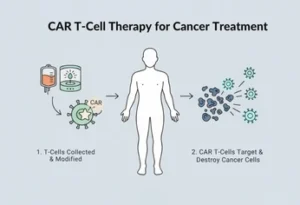
Chimeric Antigen Receptor (CAR) T-cell therapy takes personalisation to an entirely new level. It involves extracting a patient’s own T-cells, genetically engineering them in a laboratory to produce special receptors (CARs) that specifically recognise and bind to antigens on cancer cells. These “supercharged” CAR T-cells are then multiplied in vast numbers and infused back into the patient.
The Process: A Multi-Week Journey
QUICK FACT: CAR T-cell therapy has achieved astounding complete response rates of over 80% in some patients with specific blood cancers like B-cell acute lymphoblastic leukaemia (ALL) in children and young adults, and certain aggressive lymphomas. It’s often planned as a single, long-lasting treatment.
Limitations: Currently, CAR T-cell therapy is primarily effective for blood cancers. Its application in solid tumours is challenging due to the complex tumour microenvironment, which can prevent CAR T-cells from reaching their targets effectively, and variable antigen expression.
Immunotherapy is fundamentally altering the cancer treatment paradigm in several crucial ways:
QUICK FACT: In advanced melanoma, five-year survival rates have climbed from less than 10% before immunotherapy to over 35-50% with its advent. For non-small cell lung cancer, adding pembrolizumab to chemotherapy has significantly extended survival times compared to chemotherapy alone, with two-year survival rates rising from 27% to 46% in patients with intermediate PD-L1 expression.
Despite its remarkable successes, immunotherapy isn’t a magic bullet and comes with its own set of challenges:
The field of immunotherapy is dynamic and rapidly advancing. The future promises even more sophisticated and personalised approaches:
The decision to pursue immunotherapy is a complex one, made in close consultation with your oncology team. Factors such as your specific cancer type and stage, the presence of certain biomarkers (like PD-L1 or MSI-H), and your overall health and any pre-existing autoimmune conditions will all play a crucial role.
At Cancer Rounds, we recognise that navigating cancer treatment options can be overwhelming. Immunotherapy has undeniably transformed cancer care, offering a powerful beacon of hope for countless individuals. While ongoing research continues to refine these treatments, making them more effective, accessible, and less burdensome, the fundamental principle remains: empowering your own body to fight cancer is a testament to the incredible resilience of the human spirit. The journey to a cure is ongoing, but with immunotherapy, we are closer than ever to truly outsmarting this disease.
.webp)
Get expert guidance instantly
Tell us about your condition and we will help you find the right care.

November 14, 2025
February 17, 2024
January 4, 2024
Get expert guidance instantly
Share a few details and our medical team gets back to you within 4 hours with the next steps.

Tell us what you are facing and our medical team will guide you to the right doctors, hospitals and treatment.
Free Review, No Commitment
Free assessment with no pressure to proceed.
Trusted by 100,000+ Patients
Across 125+ countries worldwide
500+ Top Partner Hospitals
Globally accredited medical facilities
5000+ Expert Specialists
Senior doctors across major specialties.
Making quality healthcare accessible to patients worldwide
Everything you need to know about choosing the right hospital, doctor and treatment plan.
