
Yes, it may be possible to cure lung cancer, especially when it’s caught early and treated promptly. But whether it can actually be cured depends on things like the stage of the cancer, its type, and how well it responds to treatment.
Lung cancer is one of the most commonly diagnosed cancers worldwide. And one of the top questions people ask is “Can lung cancer be cured?”
The honest answer is, it depends. Why? Because while lung cancer is curable in many cases, there are also cases where the chances of curing it drops significantly or becomes next to impossible. Don’t lose hope though because treatments today can often control the cancer for years, reduce symptoms and help people live longer with a good quality of life.
In this article, we’ll explain when lung cancer is curable, when it becomes difficult to cure, what affects the chances of recovery and the treatments available at every stage.
Confused about treatment options?
Get a free second opinion from our oncologists
Lung cancer happens when cells in the lungs start growing in an abnormal and uncontrolled way.
Normally, lung cells follow instructions stored in the DNA, they grow, perform their function and eventually die. In cancer, a mutation in the DNA disrupts this system. The cells start growing uncontrollably and clump together to form a mass, which we call a tumor.
As the tumor grows, it starts taking up more space inside the lungs and can interfere with how they work, making it harder to breathe properly.
This tumor usually remains inside the lungs. But if it continues growing, some cancer cells can break away and travel through the bloodstream or lymphatic system to other parts of the body. This process is called metastasis and it is what makes advanced lung cancer much harder to treat.
Yes. There are two main types of lung cancer: Non-Small Cell Lung Cancer (NSCLC) and Small Cell Lung Cancer (SCLC). It is mainly divided based on how the cancer cells look under a microscope.
This is the most common type and makes up to about 85% of all lung cancer cases.
NSCLC (Non-Small Cell Lung Cancer) is the less aggressive one and generally grows and spreads more slowly than small cell lung cancer. Because of this, if it is found early enough, surgery may completely remove this type of cancer, giving many patients a chance for a cure.
There are three main subtypes:
Each starts from different lung cells but is usually treated similarly depending on its stage.
Small cell lung cancer, also called oat cell carcinoma because the cells look small, round and flat like rolled oats under a microscope, make up the remaining 10-15% of cases and it’s the far more aggressive type.
SCLC grows extremely quickly and usually spreads outside the lungs before symptoms are even noticeable. Because of this, surgery is rarely an option and treatment usually involves chemotherapy and radiation.
Although it responds well to treatment at first, it also has a higher chance of returning later.
| Feature | NSCLC | SCLC |
|---|---|---|
| Percentage of lung cancer cases | ~85% | ~15% |
| Growth speed | Usually slower | Very fast |
| Chance of surgery | Often possible if caught early | Rarely possible |
| Spread | Slower | Early spread is common |
| Common treatment | Surgery, radiation, chemotherapy, targeted therapy, immunotherapy | Chemotherapy, radiation, immunotherapy |
| Overall prognosis | Generally better | Usually poorer |
The signs and symptoms of lung cancer can vary from person to person depending on the type and stage of the cancer. Early lung cancer symptoms can be difficult to notice, while advanced lung cancer symptoms become more obvious as the cancer spreads.
Common symptoms include:
The tricky part? Early-stage lung cancer often shows no symptoms at all or symptoms are so mild that they get brushed off. This is a big reason why so many cases aren’t caught until later, we’ll get into this more below.
Lung cancer is divided into different stages based on how far it has spread. In general, staging is the single biggest factor in how treatable (and curable) it is.
For NSCLC, staging runs from Stage 0 to Stage 4 using the TNM (Tumor-Nodes-Metastasis) system, which looks at tumor size, whether lymph nodes are involved and whether it’s metastasized:
| Stage | What it means | Can it usually be cured? |
| Stage 0 Lung Cancer | Cancer is only present in the innermost lining of the airway and has not spread into deeper lung tissue | Very high chance |
| Stage I Lung Cancer | Small tumor which is limited to the lung | Often curable |
| Stage II Lung Cancer | Larger tumor or Cancer has spread to nearby lymph nodes | Many patients can still be cured |
| Stage III Lung Cancer | Cancer spreads to nearby tissues or to more lymph nodes | Cure is possible for some patients with combined treatment |
| Stage IV Lung Cancer | Cancer spreads to distant organs | Usually not considered curable, but treatable |
SCLC uses a simpler two-tier system since it’s usually caught later and progresses fast:
Yes, but only in some cases.
Whether lung cancer can be cured completely mainly depends on:
Out of these, the stage at diagnosis matters the most.
If it is Stage 0 or Stage 1 lung cancer (Early stage lung cancer), there’s a good chance it can be cured. Treatment usually looks like:
Even Stage 2 lung cancer and Stage 3 lung cancer can sometimes still be cured, though treatment gets more intense and usually combines:
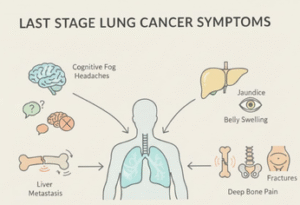
By Stage 4 lung cancer (Advanced or Metastatic Lung Cancer), the cancer has already spread to other parts of the body like the brain, liver, bones or adrenal glands.
At this point, a cure is much less likely. But that doesn’t mean there’s no hope. Treatment shifts to:
Newer treatments like targeted therapy and immunotherapy, have helped a lot of people live longer than was possible even ten years ago.
Lung cancer survival rates vary depending on how early the cancer is diagnosed and the type of lung cancer.
Since staging systems differ between the two types, researchers also use a broader classification (localized, regional, distant) to track outcomes across all lung cancers.
Here’s what survival looks like by stage, based on data from the American Cancer Society and the National Cancer Institute’s SEER program:
| Stage | NSCLC 5-year survival | SCLC 5-year survival |
| Localized (Cancer is only in the lung) | ~67% | ~34% |
| Regional (Cancer has spread to nearby lymph nodes or nearby tissues) | ~40% | ~20% |
| Distant (Cancer has spread to other organs) | ~12% | ~4% |
The pattern is clear: the earlier it’s caught, the better the odds. That gap between 65% and 12% survival for NSCLC alone tells you almost everything about why early detection matters so much.
So if finding lung cancer early gives the best shot at a cure, why doesn’t that happen more often?
Early detection gives the best shot at a cure, but lung cancer is often caught late because it usually doesn’t show obvious symptoms early on. By the time symptoms show up, the cancer may have already spread.
Some of the main reasons include:
Not every case of lung cancer can be prevented or cured but there’s a lot you can do to lower your risk.
Some of the biggest risk factors:
You can’t control every risk factor, but you can cut your chances by:
The good news? It’s never too late to quit smoking. No matter how long you’ve smoked, quitting will always lower your risk of lung cancer from that point on. It also protects the people around you by cutting their exposure to second-hand smoke and it improves your overall health too.
1) Can lung cancer be cured completely or only treated?
Yes, but only sometimes. If it’s found early, before it spreads, surgery can sometimes remove all visible cancer. Once it’s spread to distant parts of the body, a full cure isn’t likely anymore, though treatment can still help keep it in check.
2) What are the first signs of lung cancer?
Early on, there usually aren’t any symptoms. When they do show up, the common ones are a cough that won’t go away, shortness of breath, chest pain, coughing up blood, fatigue or chest infections that keep coming back.
3) How is lung cancer diagnosed?
It usually starts with a chest X-ray or CT scan. If something looks off, doctors may follow up with a PET scan, bronchoscopy or biopsy to confirm it and pin down the type and stage.
4) Who should get screened for lung cancer?
Mainly people at high risk, especially heavy smokers and some former smokers. The go-to test is a low-dose CT (LDCT) scan, which can catch lung cancer before any symptoms show up.
5) How fast does lung cancer spread?
It depends on the type. NSCLC usually grows and spreads slower and can take months or even years to reach an advanced stage. SCLC is one of the fastest-growing types and can spread much quicker, sometimes within just weeks or months if left untreated.
6) What is metastatic lung cancer?
It means the cancer has spread beyond the lungs, to places like the brain, liver, bones or adrenal glands. Also called Stage 4 and it’s usually harder to cure at this point.
7) Can non-smokers get lung cancer?
Yes. Non-smokers can still develop lung cancer from things like radon exposure, second-hand smoke, air pollution, workplace chemicals like asbestos or certain inherited genetic changes.
.webp)
Get expert guidance instantly
Tell us about your condition and we will help you find the right care.
January 5, 2026


February 25, 2022
Get expert guidance instantly
Share a few details and our medical team gets back to you within 4 hours with the next steps.

Tell us what you are facing and our medical team will guide you to the right doctors, hospitals and treatment.
Free Review, No Commitment
Free assessment with no pressure to proceed.
Trusted by 100,000+ Patients
Across 125+ countries worldwide
500+ Top Partner Hospitals
Globally accredited medical facilities
5000+ Expert Specialists
Senior doctors across major specialties.
Making quality healthcare accessible to patients worldwide
Everything you need to know about choosing the right hospital, doctor and treatment plan.