
A medical visa for Turkey lets international patients enter the country for hospital-based treatment, and most applicants need one unless their nationality qualifies for Turkey’s e-Visa. The core requirement is a hospital invitation letter, alongside travel insurance, proof of funds, and a completed application submitted at least a month before travel. Requirements shift slightly by home country, so check your specific embassy’s checklist early. Cancer Rounds prepares the invitation letter and reviews your full file before submission, so nothing holds up your treatment date.
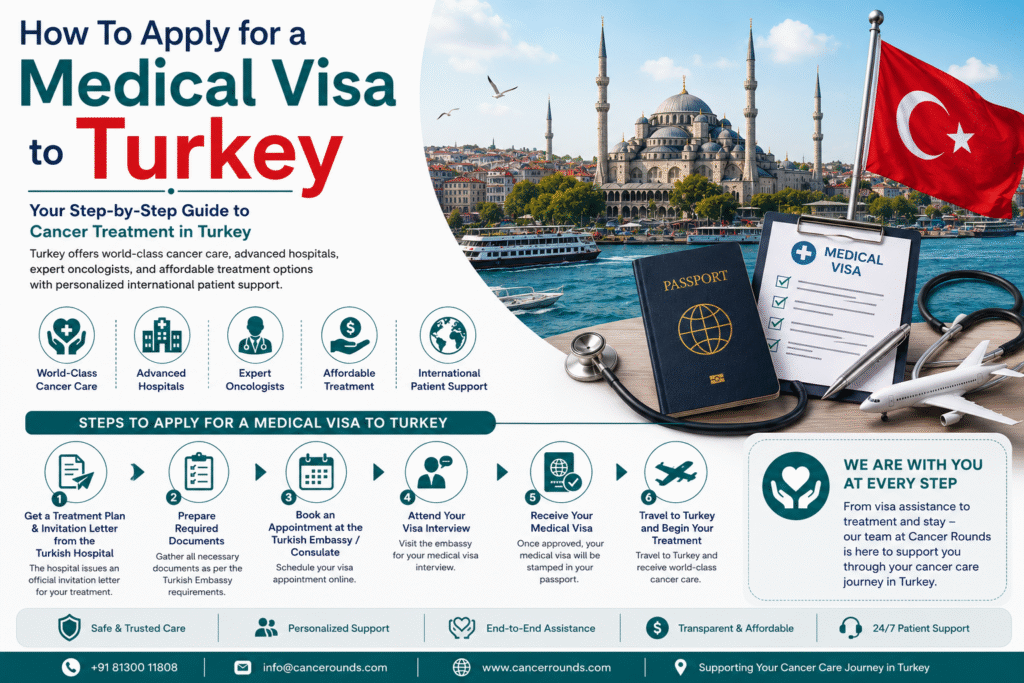
Getting a treatment date confirmed at a hospital in Turkey is a relief. Then the visa paperwork lands on your desk, and the relief turns into a new kind of stress. A medical visa for Turkey is the document that lets you legally enter the country for hospital treatment, and it is not the same as a standard tourist visa. Some nationalities skip it entirely through Turkey’s e-Visa system. Others need to apply through their nearest Turkish embassy, submit a folder of paperwork, and sometimes attend an interview. The exact list changes depending on where you live, but the backbone of the process (hospital invitation letter, insurance, proof you can support yourself, and a clear travel purpose) stays the same everywhere.
This guide walks through who needs a visa, what the hospital needs to send you, how the application works step by step, and where applications commonly stall.
Confused about treatment options?
Get a free second opinion from our oncologists
Before the visa paperwork, it helps to know why so many cancer patients end up choosing Turkey in the first place. A few reasons come up again and again:
A medical visa for Turkey is a travel authorisation that lets a patient enter the country specifically to receive treatment at a Turkish hospital. It differs from a tourist e-Visa because it requires proof of a confirmed treatment plan, usually in the form of a hospital invitation letter, and it is processed through Turkey’s Directorate General of Migration Management rather than the automated e-Visa system.
Turkey has spent the past decade building up its health tourism sector, and the government treats international patients as a distinct traveller category. That means the visa process is set up to check that you have a real hospital appointment waiting, not just a plan to see a doctor once you land. Some countries have visa-free access or e-Visa access for short tourist stays, but treatment that runs longer than a standard tourist stay, or that needs documented proof of medical purpose, usually pushes you into the medical visa track instead.
Whether you need a medical visa depends entirely on your passport. Citizens of countries with an e-Visa or visa-free arrangement with Turkey can often enter without a dedicated medical visa for short stays, while citizens of countries without that arrangement need to apply at a Turkish embassy or consulate before travel.
For applicants who do need to go through an embassy, the checklist tends to be detailed. Rwandan nationals applying through the Turkish Embassy in Kigali, for example, are asked for biometric photos, six months of bank statements, paid travel insurance, proof of accommodation, a booked flight, a police clearance certificate, a medical report from a state hospital, and a hospital invitation letter from Turkey, on top of the standard application form. Cancer treatment almost always falls into this longer-stay, documentation-heavy category, since chemotherapy cycles, radiotherapy courses, or transplant recovery periods run well past a typical two-week tourist visit. If you are not sure which category applies to you, the safest move is to check your nationality against Turkey’s current e-Visa list before you assume either way.
Turkey’s private healthcare sector has grown a group of large hospital networks built specifically around international patients. Names you’ll come across often include:
Hospital groups and their accreditation status change over time, and Cancer Rounds works with a specific set of partner hospitals rather than every name on this list. Confirm current partnerships and accreditation directly with your case manager before treating this as a final choice.
The document list varies by country, but most applications draw from the same pool. Having these ready before you start saves weeks.
Some embassies also ask for a police clearance certificate, particularly for longer stays. None of this is meant to slow you down on purpose. Embassies want to see that a real hospital is expecting you and that you can support yourself while you’re there. Cancer Rounds’ case managers build a checklist specific to your country and hospital, so you’re not guessing which version of the list applies to you.
How document requirements shift by country (illustrative)
| Requirement | Confirmed for Rwanda (Kigali Embassy) | General Pattern Elsewhere |
| Bank statement history | 6 months | Usually 3-6 months, confirm locally |
| Biometric photos | 2 photos, 5×5 cm | Size and count vary by embassy |
| Police clearance certificate | Required | Required by some embassies, not all |
| Employment/company letter | Required if employed | Common but not universal |
| Medical report from home doctor | Required, from a state hospital | Usually required, source hospital may vary |
| Interview appointment | Booked online in advance | Standard practice across most embassies |
Treat the Rwanda column as your confirmed baseline and the general pattern column as a starting expectation only. Your case manager checks the exact list for your embassy before you start collecting documents.
A hospital invitation letter comes from the international patient office of the treating hospital, once your treatment plan and dates are confirmed. It states your name, diagnosis category, planned procedure or treatment course, expected dates of admission, and a contact person at the hospital, and most embassies treat it as the single most important document in the whole application.
You don’t request this letter directly from the hospital in most cases. It’s issued once your medical reports have been reviewed and a treatment plan is set, which is exactly the stage where a case manager earns their keep. At Cancer Rounds, this letter gets requested as soon as your treating oncologist confirms your plan, so it’s ready before you need to book your embassy appointment rather than after.
Every embassy runs its own version of this process at its own pace, so treat the above as the general shape rather than a fixed timeline for your specific country.
Most embassies recommend applying at least one month before your planned travel date, since medical visa applications go through an extra approval step with Turkey’s Directorate General of Migration before the embassy can issue the visa. Processing that involves a government body on top of the embassy naturally takes longer than a standard tourist visa.
If your treatment date is already set, work backward from it. Book your interview appointment as soon as your hospital invitation letter is ready, not after you’ve collected every other document, since appointment slots themselves can take time to open up. A month of buffer also gives you room to fix a missing document without pushing your treatment date.
Visa fees for Turkey are not a single flat number. They depend on your nationality, the entry type you apply for, and the reciprocity arrangement between Turkey and your home country.
Fee by entry type (confirmed example: Rwanda, via the Turkish Embassy in Kigali)
| Entry Type | Fee (USD) | Refundable if Denied? |
| Single Entry | $60 | No |
| Single Transit | $60 | No |
| Double Transit | $120 | No |
Only this Rwanda example is a confirmed figure, drawn from an official embassy document. The embassy medical visa route applies to longer treatment stays and its fee is set by each Turkish embassy individually, so it varies by country. Your case manager can confirm the exact current fee for your specific passport before you pay anything, so nothing gets paid twice over a wrong number.
Estimated visa fees and processing times by country
| Country | Estimated Visa Fee (USD) | Typical Processing Time |
| United Kingdom | Visa-exempt for eligible stays | 24-72 hours |
| United States | $185-$200 | 24-72 hours |
| Canada | $60-$80 | 24-72 hours |
| Australia | $60-$80 | 24-72 hours |
| Saudi Arabia | $60-$90 | 1-3 business days |
| United Arab Emirates | $190-$208 | 1-3 business days |
| India | $60-$100 | 3-14 business days |
| Germany | Visa-exempt for eligible stays | Not applicable |
| France | Visa-exempt for eligible stays | Not applicable |
These figures have not yet been independently confirmed against Turkey’s official embassy or consular fee schedules, so treat them as a starting reference rather than a final number. Confirm the exact current fee and processing time with your nearest Turkish embassy or consulate, or ask your case manager to verify it for your specific passport, before you rely on it for travel planning.
A few points hold true across nationalities:
Official e-Visa and visa-on-arrival fees by country
Turkey’s Ministry of Foreign Affairs also publishes a separate fee schedule for e-Visa applications and visa-on-arrival at Turkish airports. This applies to short-stay tourist-type entry for eligible passport holders, not to the embassy medical visa route described above, but it’s useful if your treatment plan involves a short scoping visit Official Turkey e-Visa Portal: https://www.evisa.gov.tr/en/ or consultation before your main admission. These figures come from an official schedule dated 10 November 2014, effective 1 May 2014, so treat them as historical reference and confirm current pricing on Turkey’s e-Visa portal before you rely on them.
| Country | E-Visa Fee | Visa on Arrival Fee |
| Antigua-Barbuda | $20 | $30 / €25 / £20 |
| Armenia | $15 | $25 / €20 / £15 |
| Australia | $60 | $70 / €50 / £45 |
| Austria | $20 | $30 / €25 / £20 |
| Bahamas | $20 | $30 / €25 / £20 |
| Bahrain | $80 | $70 / €50 / £45 |
| Barbados | $20 | $30 / €25 / £20 |
| Belgium | $20 | $30 / €25 / £20 |
| Canada | $60 | $70 / €50 / £45 |
| Croatia | $20 | $30 / €25 / £20 |
| Dominica | $20 | $30 / €25 / £20 |
| Dominican Republic | $20 | $30 / €25 / £20 |
| Greek Cypriot Administration of Southern Cyprus | $20 | $30 / €25 / £20 |
| Grenada | $60 | $60 / €45 / £35 |
| Haiti | $20 | $30 / €25 / £20 |
| Hong Kong (BN(O)) | $20 | $30 / €25 / £20 |
| Indonesia | $25 | $35 / €27 / £22 |
| Ireland | $20 | $30 / €25 / £20 |
| Jamaica | $20 | $30 / €25 / £20 |
| Kuwait | No fee | No fee |
| Maldives | $20 | $30 / €25 / £20 |
| Malta | No fee | No fee |
| Mauritius | $20 | $30 / €25 / £20 |
| Mexico | No fee | $30 / €25 / £20 |
| Netherlands | $20 | $30 / €25 / £20 |
| Norway | $20 | $30 / €25 / £20 |
| Oman | $60 | $60 / €45 / £35 |
| Poland | $20 | $30 / €25 / £20 |
| Portugal | $20 | $30 / €25 / £20 |
| Qatar | $28 | $30 / €25 / £20 |
| Saudi Arabia | $60 | $60 / €45 / £35 |
| South African Republic | No fee | No fee |
| Spain | $20 | $30 / €25 / £20 |
| St. Lucia | $20 | $30 / €25 / £20 |
| St. Vincent and the Grenadines | $20 | $30 / €25 / £20 |
| United Arab Emirates | $60 | $60 / €45 / £35 |
| United Kingdom | $20 | $30 / €25 / £20 |
| United States | $20 | $30 / €25 / £20 |
If your nationality isn’t listed here, or if your stay is longer than a short tourist visit, the embassy medical visa route (with its own fee, as in the Rwanda example above) is the one that applies to you. Your case manager can confirm which route fits your situation before you pay any fee.
Most delays trace back to a handful of avoidable gaps. A missing or unclear hospital invitation letter is one of the most common, since it’s the document that proves your medical purpose. Incomplete financial proof, expired insurance, or a bank statement that doesn’t cover the full six-month window an embassy asks for can also stall a file.
A motivation letter that’s vague about the treatment or destination hospital raises questions an interviewer then has to ask in person, which slows things down. Mismatched dates between your flight booking, hospital letter, and insurance coverage are another frequent snag; if your insurance ends before your treatment does, expect a question about it. Cancer Rounds reviews your full document folder against your specific embassy’s checklist before you submit, so gaps like these get caught while there’s still time to fix them.
A Turkey medical visa isn’t complicated once you know what’s expected of you: a solid hospital invitation letter, your financial and insurance proof in order, and enough lead time to absorb any hiccups along the way. The requirements shift depending on your passport, so confirm your specific country’s checklist rather than assuming it matches someone else’s experience.
If you’re planning cancer treatment in Turkey and want your visa handled alongside your treatment plan, book a consultation with a Cancer Rounds case manager. We’ll get your hospital invitation letter moving and check your document folder before you ever walk into an embassy appointment.
Q.1 Do I need a visa to enter Turkey for cancer treatment?
It depends on your nationality. Some passport holders qualify for Turkey’s e-Visa or visa-free entry for short stays, while others need to apply for a medical visa through a Turkish embassy before travelling. Cancer treatment often runs longer than a standard tourist stay, which usually places it in the medical visa category.
Q.2 What documents does the hospital need to provide for my Turkey medical visa?
The hospital provides the invitation letter, the single document embassies rely on most. It confirms your diagnosis category, planned treatment, and expected dates, and it’s issued once your treatment plan is set by your treating team.
Q.3 How much does a Turkey medical visa cost?
Visa fees vary by entry type and by the embassy processing your application. Fees for single entry are typically different from double or transit entries, and they are generally non-refundable if the application is denied. Check the current fee schedule with your nearest Turkish embassy or consulate.
Q.4 Can my visa be denied even with a hospital invitation letter?
Yes. The invitation letter supports your application, but embassies still review your full document set, including proof of funds, insurance, and travel plans. A denial usually comes down to a gap somewhere else in the file rather than the invitation letter itself.
Q.5 Does my companion or caregiver need a separate visa?
Yes, anyone travelling with you, including a caregiver or family member, needs their own visa application and their own supporting documents, unless they qualify for e-Visa or visa-free entry under their own passport.
Q.6 How is a medical visa different from a Turkey tourist e-visa?
A tourist e-Visa is a fast, automated approval meant for short leisure stays and doesn’t require proof of medical treatment. A medical visa requires a hospital invitation letter and is processed through Turkey’s migration authority, which takes longer but permits the longer stays that treatment often requires.
.webp)
Get expert guidance instantly
Tell us about your condition and we will help you find the right care.
Get expert guidance instantly
Share a few details and our medical team gets back to you within 4 hours with the next steps.

Tell us what you are facing and our medical team will guide you to the right doctors, hospitals and treatment.
Free Review, No Commitment
Free assessment with no pressure to proceed.
Trusted by 100,000+ Patients
Across 125+ countries worldwide
500+ Top Partner Hospitals
Globally accredited medical facilities
5000+ Expert Specialists
Senior doctors across major specialties.
Making quality healthcare accessible to patients worldwide
Everything you need to know about choosing the right hospital, doctor and treatment plan.