
Best Treatment for Prostate Cancer in Early Stages

Posted: 2025-07-30T11:54:36+00:00
Updated: 2025-09-03T07:40:24+00:00
Medically Reviewed by: Dr. Nishtha Kalra

Prostate cancer is one of the most prevalent cancers affecting Indian men, with its incidence steadily rising, especially in urban areas and among men over the age of 50. A diagnosis can be a daunting experience, but if your cancer has been caught in its early stages, there is every reason for optimism. When diagnosed at Stage I or Stage II, the cancer is localised—meaning it hasn’t spread beyond the prostate gland—and is often highly curable. An early diagnosis opens up a wide range of effective treatment options available right here in India. However, this choice can feel overwhelming. The “best” treatment is not a one-size-fits-all solution; it’s a highly personalized decision that depends on the specifics of your cancer, your age, your overall health, and what matters most to you in terms of your future quality of life.

This comprehensive guide will walk you through the most effective treatment options for early-stage prostate cancer. We’ll explore everything from vigilant monitoring to definitive treatments like surgery and radiation, helping you and your loved ones understand the path ahead and work with your medical team to make a confident, well-informed decision.

Confused about treatment options?

Get a free second opinion from our oncologists

What Exactly Is Early-Stage Prostate Cancer?

Early-stage prostate cancer refers to Stage I and Stage II disease. The key characteristic is that the tumour is confined entirely within the prostate gland. There are usually no visible symptoms at this age and hence, routine health checks ups are a key to diagnosis at an early stage of prostate cancer.

  • Stage I: The tumour is typically small in Stage I prostate cancer and cannot be felt during a Digital Rectal Exam (DRE). It is often found incidentally due to an elevated PSA test or during surgery for an enlarged prostate. The cancer cells are usually slow-growing (low Gleason score).
  • Stage II: The tumour is larger in Stage II prostate cancer and may be felt during a DRE, but it is still confined to the prostate. The cells might be slightly more aggressive (higher Gleason score) or the PSA level may be higher than in Stage I.

The prognosis for localised prostate cancer is excellent. With access to modern healthcare, the 5-year relative survival rate is nearly 100% in Stage I prostate cancer and Stage II prostate cancer, meaning most men will go on to live a full and healthy life.

Factors That Will Shape Your Treatment Decision

Before diving into the treatments for prostate cancer in early stages, it’s crucial to understand what influences the recommendations from your oncologist and urologist.

  • Cancer Risk Group (Gleason Score, PSA, and Stage): This is the most critical factor. Your doctor will classify your cancer as low, intermediate, or high risk. A low-risk cancer (e.g., Gleason score 6, PSA < 10) is very unlikely to cause harm for many years, making a less aggressive approach viable. A higher-risk cancer will prompt a recommendation for definitive treatment.
  • Age and Life Expectancy: A younger, healthy man with decades of life ahead may be encouraged towards curative treatment. For an older man, especially with other health issues (comorbidities), the risks of treatment may outweigh the benefits.
  • Overall Health: Your fitness for treatment matters. A patient with significant heart or lung conditions may not be a suitable candidate for major surgery, making radiation a safer option.
  • Your Personal Values and Quality of Life Priorities: This is where you play the most important role. The primary side effects of treatment—urinary incontinence and erectile dysfunction (ED)—can significantly impact daily life. Your willingness to accept these risks versus your anxiety about the cancer will guide your choice.

Best Treatment Options for Early-Stage Prostate Cancer

The best treatment options for early-stage prostate cancer include active surveillance, surgery (radical prostatectomy), and radiation therapy, which offer excellent outcomes for most patients. The choice depends on individual risk factors, health status, and patient preferences, with all three approaches shown to provide similar cancer control in the early stages. A personalized treatment plan from a qualified urologist or oncologist ensures the best outcome. Always consult a healthcare professional for guidance.

Let’s break down the most common and effective approaches foprostate cancer treatment available in leading Indian hospitals.
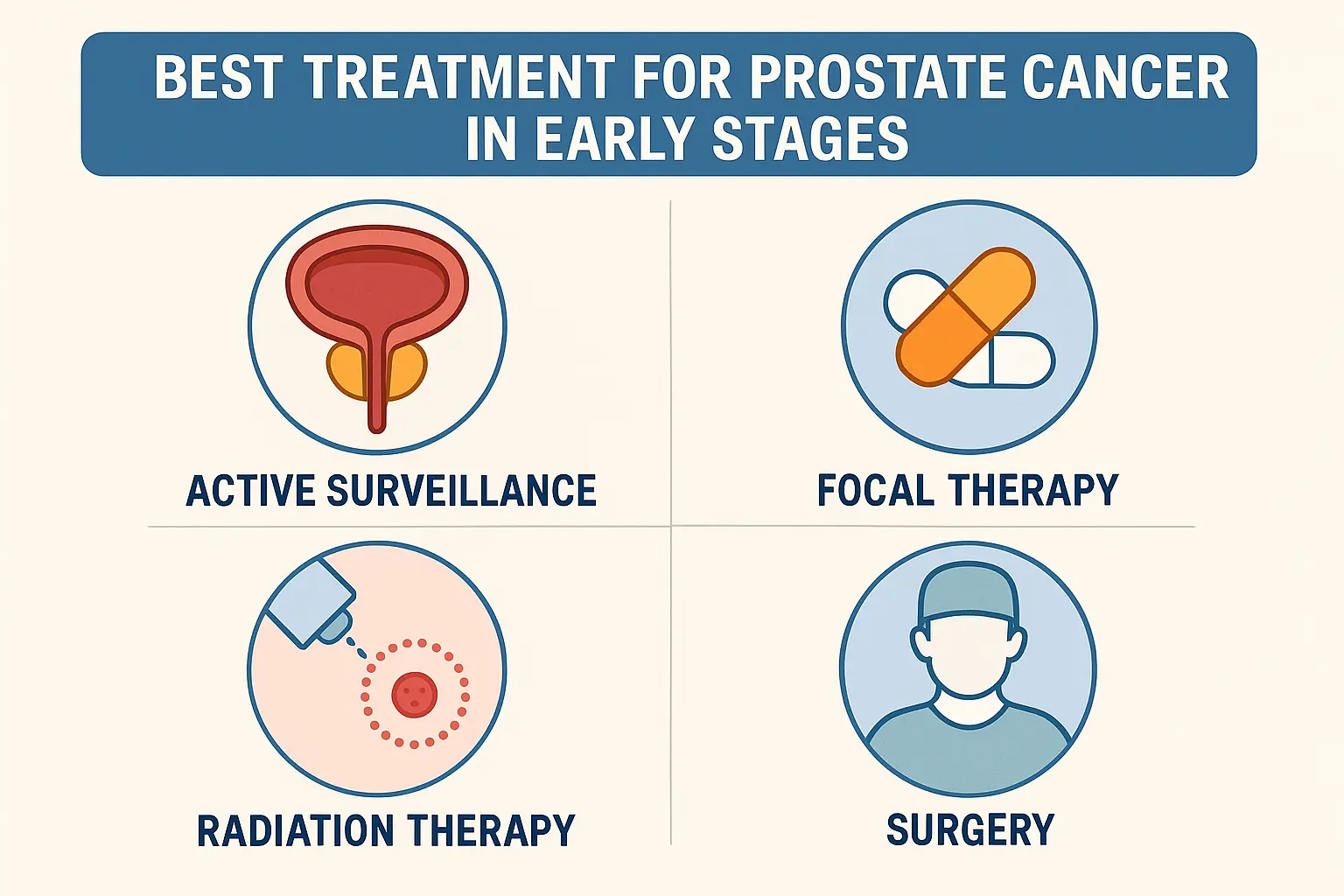
Best Treatment for Prostate Cancer in Early Stages

Active Surveillance

Active Surveillance for prostate cancer treatment is not “doing nothing”; it is a proactive strategy to closely monitor low-risk cancer, allowing you to avoid or significantly delay treatment and its side effects. It has become the preferred approach for many men with low-risk disease worldwide, including in India.

  1. Who It’s For: Primarily for men with low-risk (and some very favourable intermediate-risk) prostate cancer.
  2. What It Involves: A strict schedule of regular PSA blood tests (every 3-6 months), annual Digital Rectal Exams (DREs), and periodic prostate biopsies or mpMRI scans (every 1-3 years) to check for any changes.
  3. Pros:
    • Completely avoids the side effects of surgery or radiation.
    • Preserves urinary, bowel, and sexual function, maintaining quality of life.
    • Treatment can be started at any time if the cancer shows signs of progressing, without losing the chance for a cure.
  4. Cons:
    • Can cause anxiety, as you are living with an untreated cancer.
    • Requires a lifelong commitment to regular check-ups and tests.
    • There is a very small risk that the cancer could grow and spread between check-ups.

Surgery

Surgery (Radical prostatectomy) is a definitive treatment for prostate cancer at an early stage that aims to cure the cancer by completely removing the prostate gland.

  1. Who It’s For: Healthy men with localised prostate cancer (from low to high risk) who want the cancer physically removed and have a long life expectancy.
  2. Types of Surgery:
    • Robotic-Assisted Laparoscopic Prostatectomy: This is the state-of-the-art technique and is increasingly available in major metropolitan hospitals across India. The surgeon uses a sophisticated robotic system for enhanced precision and control through small keyhole incisions, leading to less blood loss and a quicker recovery from the early stage prostate cancer.
    • Open Surgery: Involves a single larger incision. It is still a very effective procedure for treatment of prostate cancer, though less common now where robotic facilities exist.
  3. Pros:
    • Offers a high chance of a cure by removing the entire tumour.
    • Provides precise staging information from the removed tissue.
    • Once removed, your PSA should drop to undetectable levels, offering peace of mind.
  4. Cons:
    • It is a major surgery with risks like infection and bleeding.
    • Urinary Incontinence: Most men experience some leakage initially, but with pelvic floor exercises, a majority regain good control. However, a small percentage have persistent issues.
    • Erectile Dysfunction (ED): This is a very common long-term side effect. Even with nerve-sparing techniques, many men will require support to achieve erections post-surgery.

Radiation Therapy

Radiation therapy uses high-energy rays to destroy cancer cells while preserving the prostate gland itself. It is an equally effective curative option to surgery.

  1. Who It’s For: Men at all risk levels with localised cancer. It’s an excellent alternative for those who are not good surgical candidates or who wish to avoid surgery for prostate cancer.
  2. Types of Radiation:
    • External Beam Radiation Therapy (EBRT): Highly focused radiation beams are delivered from a machine over several weeks of daily outpatient visits. Advanced techniques like IMRT and VMAT are available in top Indian cancer centres for prostate cancer treatment.
    • Brachytherapy (Internal Radiation): Tiny radioactive “seeds” are implanted directly into the prostate in a one-time procedure, killing the cancer from within.
  3. Pros:
    • Highly effective and non-invasive (EBRT) or minimally invasive (Brachytherapy).
    • Avoids the risks of major surgery and anaesthesia.
    • Recovery is generally quicker than surgery.
  4. Cons:
    • Bowel Problems: Irritation of the rectum can cause diarrhoea or urgency. These issues are usually temporary but can become chronic for some.
    • Urinary Problems: Frequent or urgent urination is common but typically resolves.
    • Erectile Dysfunction (ED): The risk of ED after radiation is lower initially but tends to increase gradually over the years.

Focal Therapy

Focal therapy is a newer, minimally invasive treatment that targets and destroys only the cancerous part of the prostate.

  1. Who It’s For: Highly selective cases, typically men with a small, single, low-risk tumour.
  2. Types: High-Intensity Focused Ultrasound (HIFU) or Cryotherapy.
  3. Pros: Aims for far fewer side effects.
  4. Cons: Its long-term effectiveness is still being studied. It is not yet a standard first-line treatment and is often performed within a clinical trial or at highly specialised centres.

Making the Right Choice: The Importance of a Second Opinion

Choosing between these excellent options can be tough. It is highly recommended that you consult with both a urological surgeon and a radiation oncologist. You can also consult our Cancer Rounds team for the proper counselling and assistance for prostate cancer treatment. Each specialist will provide a detailed perspective. Hearing both sides empowers you to weigh the pros and cons for yourself.

Your decision should be a shared one, made with your family and your medical team, aligning the best medical evidence with what you value most for your future.

Conclusion

An early-stage prostate cancer diagnosis is a serious matter, but it is far from life threatening. The treatments available in India today are world-class and incredibly effective. Whether you choose the path of careful monitoring with Active Surveillance or definitive treatment with surgery or radiation, you have excellent options for a long and healthy life. Take your time, gather information, speak to the experts, and choose the path that feels right for you.

CancerRounds Logo

CancerRounds Medical Content Team

The CancerRounds Medical Content Team specialises in creating accurate, clear and patient-focused healthcare content. Our content is written by medically trained writers, medically reviewed, and based on reputable medical sources to support informed healthcare decisions.

✓ Medically reviewed by board-certified oncologists

Get expert guidance instantly

Chat Now

Have a Question About Your Treatment?

Tell us about your condition and we will help you find the right care.

    Get expert guidance instantly

    Chat Now

    Talk to a Specialist

    Share a few details and our medical team gets back to you within 4 hours with the next steps.
      ✨ YOUR MEDICAL TRAVEL PARTNER

      Find the Right Care for Your Condition

      Tell us what you are facing and our medical team will guide you to the right doctors, hospitals and treatment.

      Free Review, No Commitment

      Free assessment with no pressure to proceed.

      👥

      Trusted by 100,000+ Patients

      Across 125+ countries worldwide

      🏥

      500+ Top Partner Hospitals

      Globally accredited medical facilities

      👨‍⚕️

      5000+ Expert Specialists

      Senior doctors across major specialties.

      Our Impact So Far

      Making quality healthcare accessible to patients worldwide

      5000+
      Specialists
      500+
      Partner Hospitals
      100,000+
      Patients Served
      24/7
      Support

      What Our Patients Say

      ★★★★★

      " So thankful to Cancer Rounds and Dr. Gaurav Dixit. Your care and support helped me heal and regain strength during my lymphoma treatment."

      O
      Ms. Octavie
      Vanuatu
      ★★★★★

      " I’m so grateful to Cancer Rounds and the doctors at Fortis Noida. Your support gave me strength during my cancer treatment."

      M
      Ms. Musonda Mkandawire
      Zambia
      ★★★★★

      " A heartfelt thank you to Dr. Hari Goyal and Cancer Rounds for helping me fight cancer with strength and dignity."

      E
      Mr. Edward
      Nigeria
      ★★★★★

      " Deep thanks to Vaidam Health and the wonderful doctors who cared for my mom. You gave us peace and support when we needed it most."

      S
      Ms. Suman
      ★★★★★

      " Forever grateful to Cancer Rounds and Dr. Priya Tiwari for supporting me through chemo. Your care means everything."

      M
      Ms. Meliana
      Vanuatu
      ★★★★★

      " So grateful to Cancer Rounds and Dr. Sudip Raina for helping me through my breast cancer journey. I'm healing, hopeful, and feeling like myself again!"

      M
      Ms. Mimmie
      Namibia
      ★★★★★

      " Big thanks to Cancer Rounds and Dr. Rahul Bhargava for helping me beat Multiple Myeloma. Feeling stronger and hopeful every day!"

      H
      Mr. Hukum Singh
      India
      ★★★★★

      " Grateful to Cancer Rounds and Dr. Rahul Bhargava for helping me fight Multiple Myeloma with strength, hope, and the right care."

      K
      Mr. Kanwaldeep Singh
      India
      ★★★★★

      " I was scared and uncertain, but Cancer Rounds helped me find answers. Thanks to their support and Dr. Arun Behl’s care in India, I found peace of mind—no cancer. Forever grateful for the kindness and clarity I received."

      R
      Ms. Rufine
      Congo
      ★★★★★

      " Thank you Cancer Rounds and Dr. Deepak Jha for your support and care during my breast cancer journey. I'm healing with hope because of you. "

      L
      Ms. Leimala Alfred
      Vanuatu

      Common Questions About Our Services

      Everything you need to know about choosing the right hospital, doctor and treatment plan.

      WhatsApp

      Thank You!

      We have received your details. Our medical team will get back to you shortly.