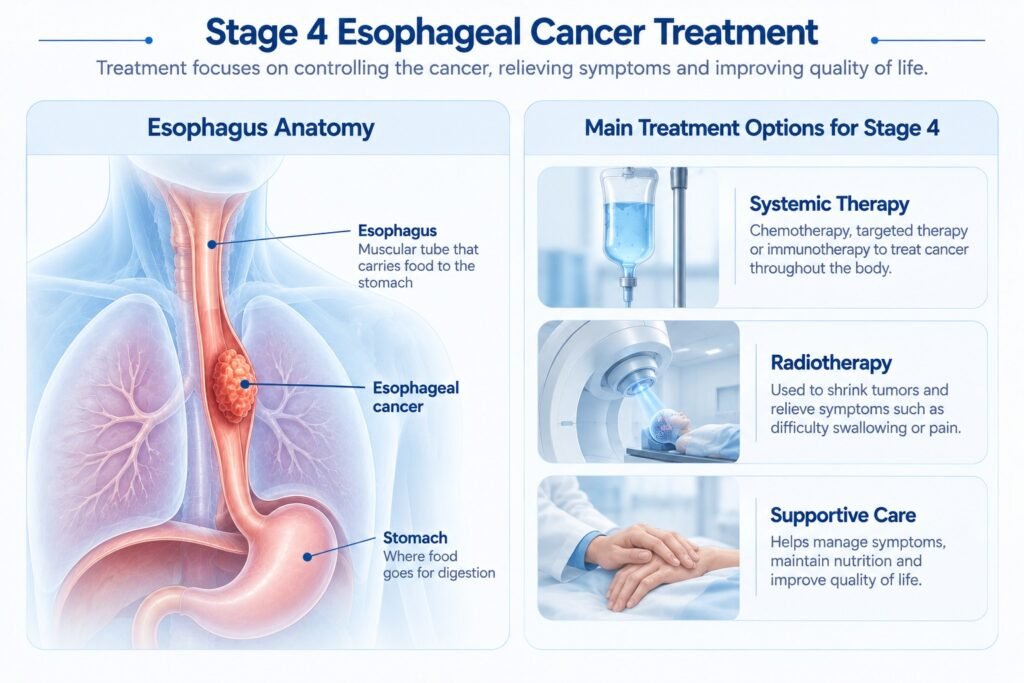
Stage 4 esophageal cancer treatment in Germany focuses on extending life and easing symptoms like difficulty swallowing. The plan typically combines systemic chemotherapy with the FLOT regimen (for adenocarcinoma) or ECF/DCF (for squamous cell cancer), checkpoint immunotherapy with nivolumab or pembrolizumab, HER2-targeted trastuzumab where applicable, and TACE for liver metastases.
Reply in 4 hours · Plan and quote in 2 days · 100% confidential
Stage 4 esophageal cancer – also referred to as stage 4 esophagus cancer or metastatic esophageal carcinoma – is not just a diagnosis; it’s a reality that often comes with difficult symptoms, limited time, and an overwhelming number of decisions. By the time the disease reaches this stage, it has usually spread beyond the esophagus to distant organs, making treatment more complex and focused on extending survival, controlling symptoms, and preserving quality of life. For many patients and their families, this is the moment when local options begin to feel limited, and the search for more advanced, coordinated care becomes urgent.
That search increasingly leads to Germany. Patients from India, the USA, the UK, Russia, Indonesia, Nigeria, the UAE, and more travel there each year, with many arriving at leading centres such as University Hospital Frankfurt, Charité Berlin, or Heidelberg. The upper GI oncology teams at these hospitals are experienced in managing complex, late-stage esophageal cancer cases, including those requiring multidisciplinary decision-making and access to newer systemic therapies. There are clear reasons why these centres attract such a high volume of international patients. If you’re looking for stage 4 esophageal cancer treatment in Germany , Consult with CancerRounds as your coordination partner for end-to-end support.
Stage 4 esophageal cancer – clinically described as metastatic esophageal carcinoma or esophagus cancer at its most advanced stage – is diagnosed when the disease has spread beyond the esophagus to other organs. The liver is the most common metastatic site, followed by the lungs, bones, and distant lymph nodes. At this point, the clinical goal shifts from removing the tumour to controlling its spread, relieving dysphagia (difficulty swallowing), and extending the patient’s functional life.
German centres treat metastatic esophageal cancer along two distinct pathways, depending on subtype. Adenocarcinoma (AC), which arises in the lower esophagus and gastroesophageal junction, is more common in Western patients and responds to HER2-targeted therapy and PD-L1-based immunotherapy. Squamous cell carcinoma (SCC) accounts for 80–90% of esophageal cancers globally and has seen the most significant survival improvements from checkpoint inhibitors. Getting the subtype right matters: it determines the treatment plan from day one.
The practical difference at major German centres is structural. Every patient is reviewed by a formal multidisciplinary tumour board comprising oncologists, surgeons, gastroenterologists, radiation specialists, and palliative care specialists before any treatment decision is made. In many countries, treatment begins with whichever specialist you see first. That is not how it works here.
The other difference is upfront molecular profiling. German centres perform next-generation sequencing (NGS) before treatment begins to map HER2 status, PD-L1 expression, MSI status, and NTRK fusions. In many healthcare systems, this testing is reserved for patients who have already failed first-line therapy. The logic of doing it first is straightforward: the initial treatment gets matched to the tumour’s actual biology, not a default protocol.
Treatment initiation typically runs two to three weeks from the first consultation. Most major centres accept self-paying international patients directly.
Stage 4 esophageal cancer treatment in Germany is personalised for each patient. German healthcare centres combine therapies that target the cancer locally and strengthen the immune system systemically. Every case is reviewed by a multidisciplinary team comprising oncologists, radiologists, and immunotherapy experts who collaborate to select the most effective therapies for each individual. These are some of the procedures used by the top doctors in Germany.
The centres listed below are selected based on DKG/DGAV certification, case volume, named specialist credentials, and treatment range and are considered as Best hospitals in Germany for Stage 4 Esophageal cancer Treatment. All accept international self-paying patients.
The Charité Comprehensive Cancer Centre holds DKG certification and treats over 14,000 cancer patients annually, making it one of Europe’s largest oncology centres by volume. For esophageal cancer, the centre runs immunotherapy, proton therapy, targeted therapy, and active clinical trials. Prof. Dr. Ulrich Keilholz leads the medical oncology program.
Heidelberg’s National Centre for Tumour Diseases (NCT) runs more than 15 active clinical trials in esophageal cancer across phases I to III. The surgical department holds DGAV Centre of Excellence certification for gastroesophageal surgery and performs minimally invasive esophageal resection in a significant proportion of cases.
One of Germany’s original four Cancer Aid-designated oncology centres of excellence. For esophageal cancer, Freiburg offers IMRT, IGRT, intraoperative radiotherapy (IORT), brachytherapy, and stereotactic radiotherapy under the direction of Prof. Dr. Anca-Ligia Grosu. Active clinical trials combine high-precision radiotherapy with immunotherapy for upper GI cancers.
LMU’s oncology team delivers chemotherapy, immunotherapy, targeted therapy, and antibody therapy for esophageal cancer. One of Germany’s largest brachytherapy programs (approximately 300 patients per year). One of only three German facilities operating the MR-Linac system for real-time imaging-guided radiation delivery. Dedicated psycho-oncology and palliative care are built into the esophageal cancer pathway.
Holds DGAV Centre of Excellence certification for esophageal and gastric disease surgery. Led by Prof. Dr. Helmut Friess, the surgical team coordinates closely with Prof. Florian Bassermann’s 30-specialist oncology unit. Part of the Munich Comprehensive Cancer Centre, one of Germany’s 13 DKG-designated excellence centres, with 35 integrated clinics.
DGAV-certified Centre of Competence in Gastric and Esophageal Surgery. Robotic esophagectomy via da Vinci X is the standard approach here, not an add-on option. Led by Prof. Dr Karl Jürgen Oldhafer. For stage 4 patients with liver metastases, the interventional radiology department coordinates TACE, radiofrequency ablation, and chemosaturation.
Treatment costs at German centres are approximately 40–70% lower than equivalent care in other countries. The total estimated cost for a complete Stage 4 esophageal cancer treatment protocol is approximately €205,000–€272,000 (~$266,000–$353,000 USD).All costs listed below are approximate.
| Treatment | Approx. Cost (EUR) | Approx. Cost (USD) |
| FLOT chemotherapy (per cycle) | €3,500–€5,000 | $4,550–$6,500 |
| Immunotherapy (nivolumab/pembrolizumab, per cycle) | €4,000–€6,500 | $5,200–$8,450 |
| Trastuzumab (per cycle) | €3,000–€5,000 | $3,900–$6,500 |
| TACE (per session) | €8,000–€12,000 | $10,400–$15,600 |
| Proton therapy (full course) | ~€85,830 | ~$111,580 |
| Dendritic cell (DC) immunotherapy (full course) | €24,000 | $31,200 |
| Minimally invasive esophagectomy | €25,000–€40,000 | $32,500–$52,000 |
| Palliative SEMS stenting | ~€10,570 | ~$13,750 |
| Endoscopic bougienage | €1,500–€3,000 | $1,950–$3,900 |
| Chemoradiotherapy (full course) | €18,000–€28,000 | $23,400–$36,400 |
Note: The above-mentioned costs are approximated costs. Additional costs for consultation, imaging, hospital stay, and accommodation vary by centre and case complexity.
Behind every statistic are patients and families holding on to hope, and the numbers below give real reason to do so.
Baseline shift: Survival data for stage 4 esophageal cancer have meaningfully shifted since immunotherapy entered routine practice.
CheckMate 648 – Nivolumab + Chemo (Metastatic SCC)
HER2-Positive Adenocarcinoma
For patients travelling from outside Germany – whether from Russia, UK , USA, Romania, France, Bulgaria, the UAE, or Saudi Arabia. Or elsewhere – access to these treatment options follows a straightforward process. CancerRounds coordinates the full pathway, from initial remote evaluation to treatment start, so international patients with stage 4 esophageal cancer or metastatic esophageal carcinoma do not need to navigate German healthcare systems alone.
Travelling abroad for cancer treatment feels overwhelming. CancerRounds exists to make sure you never have to navigate it alone.
You do not need to travel to get started:
What CancerRounds manages for you:
Why international patients choose CancerRounds:
How to take the next step: Visit CancerRounds.com to submit your case or request a free evaluation. The process takes minutes, and the clarity it brings is immediate.
Most people who reach CancerRounds for Stage 4 esophageal cancer have already been through a lot – a late diagnosis, a treatment that stopped working, or a second opinion they did not know how to get.
The first thing most notice is how fast things move. Within the first week, molecular profiling is complete, a tumour board has reviewed the case, and a treatment plan is ready. For someone who spent months waiting on referrals at home, that pace alone feels different.
Swallowing is usually the most urgent problem. Patients who arrive unable to eat are often assessed for palliative stenting within the first few days. Families mention this more than almost anything else – the moment a patient could finish a proper meal again after weeks on liquids.
Being far from home is hard. CancerRounds handles the logistics, but the distance is real. What most patients say afterwards is simple: they did not expect to feel like their case had already been carefully thought through before they walked into the room.
Yes, though not with curative intent in most cases. Treatment at this stage focuses on controlling disease progression, managing symptoms, and extending functional life. Immunotherapy has changed what it means to be “treatable”. A proportion of patients with high PD-L1 expression achieve durable responses that were not possible five years ago.
Yes, as first-line standard-of-care. Nivolumab and pembrolizumab are both approved and used routinely across all major German centres. Eligibility is determined by PD-L1 expression (CPS/TPS scoring), MSI status, and tumour subtype all tested before treatment begins, not after failure.
Medical records, imaging, and biopsy reports are reviewed, and the case is presented to a multidisciplinary tumour board before any treatment decision is made. Next-generation sequencing (NGS) for molecular profiling covering HER2 status, PD-L1 expression, and MSI status – is initiated at this stage. A personalised stage 4 esophageal cancer treatment plan is typically ready within the first week.
Molecular profiling analyses the tumour’s biology, including HER2 status, PD-L1 expression, and MSI status using next-generation sequencing. German cancer centres perform this before treatment begins, so the first regimen, whether FLOT chemotherapy, targeted therapy, or immunotherapy, is matched to the tumour’s actual characteristics rather than a default protocol.
Yes. TACE treatment for esophageal cancer liver metastases is the standard interventional approach at German centres, delivering chemotherapy directly to the tumour at concentrations far higher than systemic delivery. Centres such as Asklepios Hospital Barmbek coordinate TACE alongside radiofrequency ablation for stage 4 esophageal cancer patients with hepatic spread
Life expectancy of stage 4 esophageal cancer varies depending on treatment response, overall health, and cancer spread. With treatments like chemotherapy, immunotherapy, and targeted therapy, some patients may live longer and experience improved quality of life.
Survival rate for stage 4 esophageal cancer is generally low compared to early stages, but outcomes can improve with advanced treatments and personalized care plans.
Immunotherapy for stage 4 esophageal cancer can help the immune system target cancer cells and has shown promising results in improving survival in selected patients.
Stage 4 esophageal cancer without treatment may progress rapidly, leading to worsening symptoms such as difficulty swallowing, weight loss, and fatigue, while reducing overall survival time.
Sources:
Published By
.webp)
Global Patient Care, Redefined
The CancerRounds Medical Content Team specialises in creating accurate, clear and patient-focused healthcare content. Our content is written by medically trained writers, medically reviewed, and based on reputable medical sources to support informed healthcare decisions.



Get expert guidance instantly
Share a few details and our medical team gets back to you within 4 hours with the next steps.
Tell us what you are facing and our medical team will guide you to the right doctors, hospitals and treatment.
Free Review, No Commitment
Free assessment with no pressure to proceed.
Trusted by 100,000+ Patients
Across 125+ countries worldwide
500+ Top Partner Hospitals
Globally accredited medical facilities
5000+ Expert Specialists
Senior doctors across major specialties.
Making quality healthcare accessible to patients worldwide
Everything you need to know about choosing the right hospital, doctor and treatment plan.