
Germany is a leading destination for autologous hematopoietic stem cell transplantation (HSCT) for carefully selected patients with highly active MS. Learn about eligibility, treatment steps, benefits, risks, recovery, costs (€70,000–€130,000 / USD $82,000–$153,000), leading transplant centers, and what international patients can expect before, during, and after treatment.
Reply in 4 hours · Plan and quote in 2 days · 100% confidential
Hematopoietic stem cell transplantation (HSCT) is a specialized medical procedure that uses hematopoietic stem cells (HSCs), blood-forming stem cells found primarily in the bone marrow and, in smaller numbers, in the bloodstream. These cells have the unique ability to develop into all types of blood cells, including red blood cells, white blood cells, and platelets, helping to maintain a healthy blood and immune system.
HSCT has been used for several decades to treat blood cancers, blood disorders, immune deficiencies, and, more recently, selected autoimmune diseases such as multiple sclerosis (MS). In MS, the goal of HSCT is not to replace damaged nerve cells but to reset the immune system.
The procedure involves:
Collecting healthy hematopoietic stem cells → Administering high-dose chemotherapy to suppress the abnormal immune system → then reinfusing the stored stem cells → These cells gradually rebuild the immune system → Helping reduce the inflammatory attacks on the protective covering of nerves (myelin).
Important Note: HSCT is not considered a cure for multiple sclerosis. Instead, it is an evidence-based therapy option for carefully selected patients with highly active disease who continue to experience disease activity despite high-efficacy disease-modifying therapies.
Stem Cell Source: The patient’s own stem cells are collected, stored, and reinfused after high-dose chemotherapy.
Role in Multiple Sclerosis: For people with multiple sclerosis, autologous HSCT (aHSCT) is the established transplant approach and the type offered at specialized centers for eligible patients.
Stem Cell Source: Stem cells are donated by a matched family member or unrelated donor.
Role in Multiple Sclerosis: Not routinely used for MS due to the higher risk of complications, including graft-versus-host disease. It is primarily used to treat blood cancers and certain blood disorders.
Stem Cell Source: Stem cells are obtained from an identical twin.
Role in Multiple Sclerosis: Rarely performed because very few patients have an identical twin donor.
Multiple sclerosis (MS) is an autoimmune disease in which the immune system mistakenly attacks myelin, the protective covering around nerve fibers in the brain and spinal cord. This ongoing inflammation can disrupt nerve signals and, over time, lead to permanent nerve damage and disability.
Hematopoietic stem cell transplantation (HSCT) aims to interrupt this abnormal immune response by rebuilding the immune system. Rather than repairing damaged nerves, the procedure works by resetting the immune system so that it is less likely to continue attacking myelin.
The treatment is performed in several carefully monitored stages:
For carefully selected patients with highly active relapsing multiple sclerosis, HSCT may reduce relapses, decrease new MRI lesions, slow disability progression, and improve long-term disease control.
Note: However, it does not reverse permanent nerve damage or cure multiple sclerosis, which is why careful patient selection and long-term neurological check-in remain essential.
Not everyone with multiple sclerosis is a candidate for HSCT. It is generally considered for carefully selected patients with highly active inflammatory MS who continue to experience disease activity despite treatment with high-efficacy disease-modifying therapies (DMTs). Before recommending HSCT, specialists evaluate the patient’s disease course, MRI findings, disability level, previous treatments, and overall health.
You may be considered for HSCT if you:
Note: Many German university transplant centers contribute data to national and international HSCT registries and participate in clinical research aimed at improving transplant safety, refining patient selection, and evaluating long-term outcomes for people with multiple sclerosis.
HSCT may be considered for selected patients with progressive multiple sclerosis only when there is ongoing inflammatory disease activity, such as clinical relapses or new and active lesions seen on MRI. In these patients, the procedure may help slow further inflammatory damage.
However, HSCT is generally not recommended for progressive MS without active inflammation, particularly when disability is advanced and progression is driven primarily by neurodegeneration rather than immune-mediated inflammation. Current evidence suggests that these patients are much less likely to benefit from immune system “resetting.”
Age is only one part of the evaluation. Younger adults generally experience better outcomes, largely because they are more likely to have inflammatory disease and less irreversible neurological damage. However, there is no single age cutoff, and eligibility is determined by a comprehensive assessment of disease activity, disability, previous treatment response, and overall fitness rather than age alone.
Key Point: The ideal candidate for HSCT is typically a person with highly active inflammatory relapsing MS, evidence of ongoing MRI activity, inadequate response to high-efficacy disease-modifying therapies, relatively low disability, and sufficient physical fitness to tolerate the transplant procedure.
This reflects current recommendations from the MS Society, EBMT guidance, and recent evidence reviews, while avoiding overly restrictive criteria that can vary between transplant centers.
For HSCT treatment in Germany, which is one of the preferred destinations for treating MS using HSCT therapy, patients are treated by a team of professionals including neurologists, hematologists, transplantation experts, physiotherapists, and infectious diseases experts as part of the multidisciplinary approach used in Germany in selecting candidates and treating them.
German transplant centers follow internationally recognized recommendations, including those developed by the European Society for Blood and Marrow Transplantation (EBMT), to determine whether HSCT is appropriate.
Instead of transplanting all patients who suffer from MS, clinicians assess the disease course, MRI scan results, prior response to high-efficiency disease-modifying drugs, disability status, age, and general health state of the patient. This systematic procedure makes it possible to distinguish patients who will benefit the most and avoid unnecessary risks.
The HSCT procedure is conducted at special university hospitals that have special units for stem cell transplantation as well as advanced laboratories.
There are numerous facilities that work in accordance with the JACIE criteria, which indicates their conformity to international standards of stem cell mobilization, processing, transplantation, and quality assurance. The recent developments include more effective methods for stem cell mobilization, less toxic conditioning, and follow-up procedures.
Treatment extends beyond the transplant itself. Patients undergo detailed neurological assessments, advanced MRI monitoring, infection surveillance, rehabilitation, and long-term follow-up to evaluate immune recovery and disease control. This integrated model is particularly valuable for patients with multiple sclerosis, where ongoing neurological care remains essential after HSCT.
While HSCT is available in Germany, the United Kingdom, and the United States, access pathways differ considerably.
In the United Kingdom, HSCT is mainly provided through the NHS under strict eligibility criteria based on national guidance. Patients usually need to demonstrate highly active disease despite treatment with specific high-efficacy disease-modifying therapies, and access may depend on referral pathways and treatment capacity.
In the United States, HSCT is available at major transplant centers and through clinical trials. However, access often depends on private insurance approval, institutional policies, or the patient’s ability to cover substantial treatment costs if insurance coverage is limited.
In Germany, treatment decisions are made within specialized university transplant centers using multidisciplinary evaluation and internationally recognized clinical criteria. For German residents, medically approved procedures are generally covered by statutory or private health insurance. International patients can also undergo evaluation and treatment on a self-pay basis, provided they meet the center’s eligibility requirements.
The blend of specialized transplant knowledge, certified facilities, extensive rehabilitation programs, and evidence-based clinical procedures in Germany makes it an ideal destination for international patients requiring HSCT for multiple sclerosis.
Nonetheless, similar to other sophisticated medical treatments, whether a person qualifies for the procedure is decided via a customized medical evaluation process and not personal choice.
HSCT is a complex therapy that involves several weeks of treatment and several months of recovery period with continuous monitoring. In advance of the procedure, all patients pass through a careful pre-treatment evaluation process to ensure HSCT is the most appropriate therapy for their condition and that they are in good enough condition to undergo the treatment.
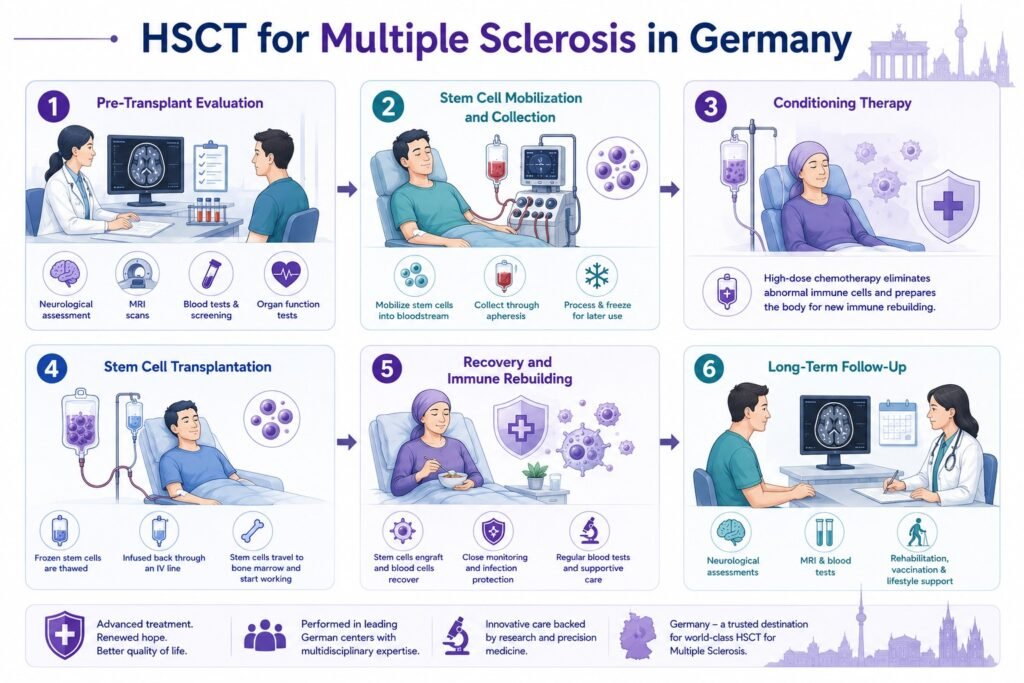
The procedure can be conducted in the following stages:
Before HSCT therapy, specialists conduct a thorough medical examination to identify suitability for the treatment.
These include:
Only those patients who qualify for HSCT proceed to the transplantation stage.
The patient’s own hematopoietic stem cells are encouraged to move from the bone marrow into the bloodstream using specialized medications. Once enough stem cells are circulating, they are collected through a procedure called apheresis, which separates stem cells from the blood while returning the remaining blood components to the body.
The collected stem cells are carefully tested, processed, and frozen until they are needed later in the treatment.
Patients undergo high-dose chemotherapy for several days to suppress or eliminate the abnormal immune cells that attack the protective covering of nerves in multiple sclerosis.
This stage is crucial as it sets the stage for the immune system to rebuild using the patient’s previously collected stem cells. Many German centers use reduced-toxicity (non-myeloablative or intermediate-intensity) conditioning regimens for appropriately selected patients with MS, aiming to balance treatment effectiveness with patient safety.
After chemotherapy is completed, the frozen stem cells are thawed and infused back into the bloodstream through an intravenous (IV) line.
The stem cells naturally travel to the bone marrow, where they begin producing new blood and immune cells.
Over the next few weeks, the transplanted stem cells begin to engraft, meaning they start producing healthy blood cells and rebuilding the immune system.
During this period, patients remain under close medical supervision because the immune system is temporarily weakened, increasing the risk of infections. Supportive treatments, protective isolation when required, and regular blood tests help ensure a safe recovery.
Even after leaving the hospital, regular follow-up is essential. Patients undergo neurological assessments, MRI scans, and blood tests to monitor immune recovery and evaluate disease activity. Rehabilitation, physiotherapy, vaccinations, and lifestyle guidance may also be recommended to support long-term recovery.
Randomized trials and long-term observational studies have shown that autologous HSCT is more effective than many high-efficacy disease-modifying therapies (DMTs) at controlling inflammatory disease activity in appropriately selected patients with relapsing-remitting MS, although continued long-term monitoring remains essential.
Like any intensive medical treatment, hematopoietic stem cell transplantation (HSCT) carries potential risks and side effects. The likelihood of complications depends on factors such as the patient’s overall health, disease severity, conditioning regimen, and the experience of the transplant center. Modern autologous HSCT protocols, combined with careful patient selection and supportive care, have significantly improved the safety of the procedure.
Common Short-Term Early Complications
Most patients experience temporary side effects related to chemotherapy and immune system suppression, including:
The risk of complications may be higher in patients who have:
Advanced age or frailty, Significant heart, lung, liver, or kidney disease, Active infections, Higher levels of disability, etc.
Potential Long-Term Risks
Although less common, some patients may experience long-term complications, such as:
Serious but Uncommon Complications
Particularly during the period of profound immune suppression. These include:
Recovery after hematopoietic stem cell transplantation (HSCT) is gradual and varies from person to person. While the stem cell infusion itself is completed in a single day, rebuilding the immune system and regaining strength can take several months. Close follow-up with neurologists and transplant specialists is essential throughout the recovery period.
The cost of HSCT for Multiple Sclerosis in Germany varies depending on the transplant center or hospital tier, conditioning regimen, duration of hospitalization, rehabilitation needs, and individual medical requirements. For international self-paying patients, the total cost generally ranges from €70,000 to €130,000 (approximately USD $82,000–$153,000).
The cost will generally include the transplant procedure itself, hospital stay, chemotherapy, stem cell harvesting and transplantation, diagnostic tests, and follow-up care during the initial phase of recovery. Other costs may include additional stays, accommodation charges, air fare, etc.
| Treatment Component | Estimated Cost (€) | Approx. Cost (USD) |
| Initial consultation and eligibility assessment | €500–€1,500 | $590–$1,770 |
| MRI, laboratory tests, and pre-transplant investigations | €2,000–€5,000 | $2,360–$5,900 |
| Stem cell mobilization and collection | €8,000–€15,000 | $9,400–$17,700 |
| Conditioning chemotherapy | €10,000–€20,000 | $11,800–$23,600 |
| Stem cell transplantation and hospitalization | €40,000–€75,000 | $47,200–$88,500 |
| Follow-up and rehabilitation | €5,000–€15,000 | $5,900–$17,700 |
The overall cost of HSCT differs significantly between countries because of variations in healthcare systems, insurance coverage, hospital charges, and supportive care.
| Country | Estimated Self-Pay Cost |
| Germany | €70,000–€130,000 (USD $82,000–$153,000) |
| United Kingdom | NHS-funded for eligible residents; private treatment generally £70,000–£120,000 (approximately USD $95,000–$162,000) |
| United States | USD $150,000–$300,000+ depending on hospital, insurance coverage, and treatment complexity |
Most of the time, the majority of the international patients opting for HSCT in Germany pay out of their own pockets because foreign insurance policies do not necessarily cover any treatment that will be undertaken outside the country. If you have any international health insurance, then you should contact your insurance provider prior to traveling to Germany to confirm whether the procedure is covered or not.
Hospitals Offering HSCT for Multiple Sclerosis in Germany
HSCT for multiple sclerosis is performed only in centers with expertise in autologous hematopoietic stem cell transplantation (aHSCT) and autoimmune neurological conditions. Popular cities in Germany providing HSCT for MS with specialized care and evaluation include Berlin, Frankfurt, and Munich.
| City | Hospital / Center | HSCT for Multiple Sclerosis |
| Freiburg | University Hospital Freiburg – Institute for Transplantation and Cellular Therapy (ITG) | Provides hematopoietic cell therapy expertise, including stem cell collection, processing, and transplantation. Patients with autoimmune diseases such as MS may be evaluated for autologous HSCT based on clinical suitability. |
| Berlin | Charité – Universitätsmedizin Berlin | Offers advanced hematology and stem cell transplantation services. Patients with highly active MS may be assessed through specialist neurology and transplant teams for suitability for HSCT. |
| Hamburg | University Medical Center Hamburg-Eppendorf (UKE) | Provides autologous and allogeneic hematopoietic stem cell transplantation services. HSCT evaluation for MS is performed based on individual medical criteria and specialist assessment. |
| Heidelberg | University Hospital Heidelberg | One of Germany’s experienced stem cell transplantation centers. Patients with MS may be assessed for autologous HSCT depending on disease characteristics and eligibility criteria. |
| Cologne (Köln) | University Hospital Cologne (Uniklinik Köln) | Provides specialized hematopoietic stem cell transplantation services. HSCT for MS may be considered for carefully selected patients following multidisciplinary evaluation. |
Considering traveling to Germany for HSCT for multiple sclerosis? this may seem daunting, but experienced transplant centers guide you through every stage of treatment.
Remember: Every patient’s journey is unique. The timeline of the course and recovery period depends on your health, disease activity, and response to HSCT.
At CancerRounds, we make the search for advanced cancer care easier and more transparent. Our team supports patients in exploring treatment options in Germany with trusted medical guidance, hospital coordination, and personalized assistance.
No. HSCT is not a cure for multiple sclerosis. It aims to reset the immune system, helping reduce relapses, MRI disease activity, and disability progression in carefully selected patients. However, it cannot reverse permanent nerve damage.
HSCT is generally recommended for patients with highly active relapsing-remitting MS (RRMS) who continue to have disease activity despite high-efficacy disease-modifying therapies. Eligibility is determined after a comprehensive medical evaluation.
The transplant process usually takes 3–5 weeks, including stem cell collection, conditioning chemotherapy, transplantation, and initial recovery. Long-term immune recovery may take several months.
For international self-paying patients, the estimated cost of HSCT in Germany typically ranges from €70,000 to €130,000 (approximately USD $82,000–$153,000), depending on the hospital, treatment plan, and duration of hospitalization.
Clinical studies show that HSCT can provide long-term disease control for many carefully selected patients with highly active inflammatory MS. Outcomes are generally best when treatment is performed early in the disease course before significant irreversible nerve damage develops.
Yes. Many German university hospitals evaluate international patients for HSCT. Treatment is offered only after a specialist review confirms that the patient meets the established eligibility criteria.
Most patients remain in the hospital for 2–4 weeks. Depending on recovery and follow-up requirements, international patients may need to stay in Germany for 4–8 weeks before returning home, as advised by their transplant team.
Many patients are able to remain free from disease-modifying therapies (DMTs) for years after successful autologous HSCT. However, ongoing neurological follow-up is essential, and treatment decisions are individualized based on disease activity.
Sources:
Published By
.webp)
Global Patient Care, Redefined
The CancerRounds Medical Content Team specialises in creating accurate, clear and patient-focused healthcare content. Our content is written by medically trained writers, medically reviewed, and based on reputable medical sources to support informed healthcare decisions.
Get expert guidance instantly
Share a few details and our medical team gets back to you within 4 hours with the next steps.

Tell us what you are facing and our medical team will guide you to the right doctors, hospitals and treatment.
Free Review, No Commitment
Free assessment with no pressure to proceed.
Trusted by 100,000+ Patients
Across 125+ countries worldwide
500+ Top Partner Hospitals
Globally accredited medical facilities
5000+ Expert Specialists
Senior doctors across major specialties.
Making quality healthcare accessible to patients worldwide
Everything you need to know about choosing the right hospital, doctor and treatment plan.