
Hyperthermia treatment in Germany uses controlled heat to support cancer treatment for different types of cancers such as cervical cancer, recurrent breast cancer, head and neck cancers, etc., often alongside radiotherapy or selected chemotherapy. Germany offers specialized oncology centres and hospitals with local, regional/deep, interstitial, and other thermal therapy approaches.
Reply in 4 hours · Plan and quote in 2 days · 100% confidential
Hyperthermia (HT), also called thermotherapy, thermal therapy, and oncothermia, is a cancer treatment method that uses controlled heat, usually raising the temperature of tumor tissue to about 40–45°C (104–113°F) in a specific area of the body. The goal is to damage cancer cells directly or make them more sensitive to other treatments, particularly external beam radiation therapy (EBRT), brachytherapy, and chemotherapy.
Cancer cells can respond in different ways to heat compared with normal cells. Controlled heating may interfere with cancer-cell proteins and cellular structures, alter blood flow and oxygenation within a tumour, and affect the ability of cancer cells to repair damage. These effects may increase the sensitivity of some types of tumours to radiation therapy or to certain chemotherapy drugs.
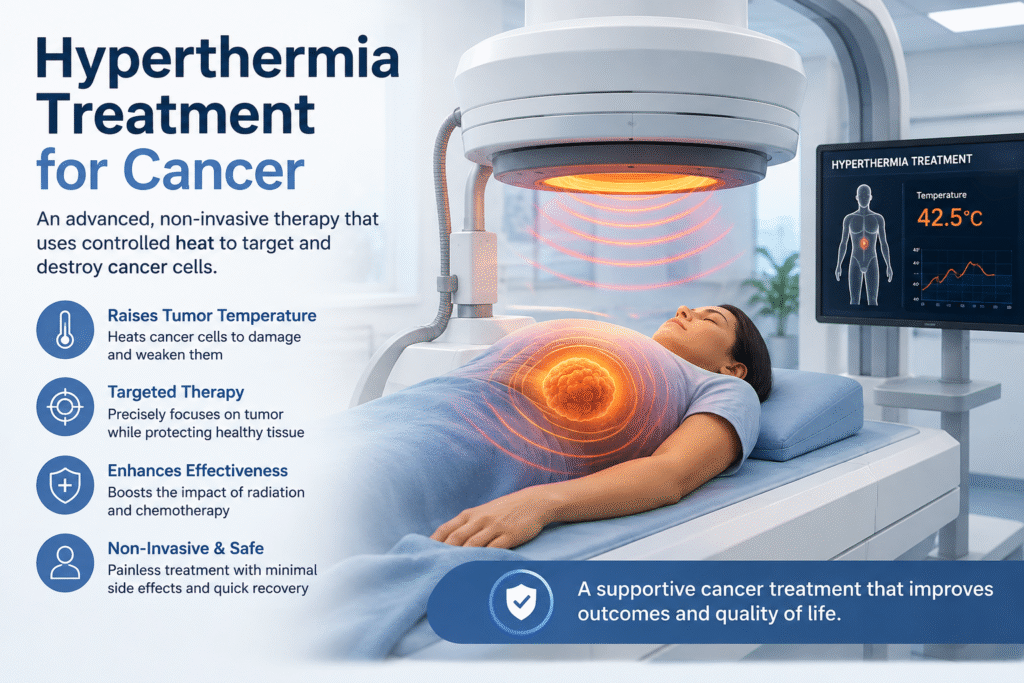
This is how controlled heat is applied to the tumour tissue; the intensity can place these cancerous cells under stress, damage proteins and cellular structures, and disrupt normal cell function, making it harder for the cells to survive and grow. It also affect has an effect on the tumour’s blood flow and oxygen levels, which can influence how well treatments like radiation and chemotherapy work.
In some cases, hyperthermia can make cancer cells more sensitive to radiation by interfering with their ability to repair DNA damage, and it can increase the effectiveness of certain chemotherapy drugs by increasing blood flow and cell membrane permeability. This is why Hyperthermia is often used alongside other cancer treatments (immunotherapy-immune checkpoint inhibitors (ICIs) rather than on its own.
Uses external energy sources, like radiofrequency, microwaves or ultrasound, to apply heat to a small, targeted tumor. It is done on accessible tumors and tries to preserve healthy tissue around the tumor.
Applies heat to a larger/deeper region, including pelvic or abdominal tumors, with the use of special applicators and temperature control. It is often accompanied by chemotherapy or radiation treatment.
Involves applying heat to/around the tumor through the use of needles or catheters. This method is applied in special cases when other types of heat application cannot be effective.
Increases the body temperature as a whole. It is mostly done for research purposes or in some cases of cancer development and requires special medical control.
Is a separate treatment that involves the administration of heated chemotherapy drugs inside the abdominal cavity following tumor removal. It is used in some cancers and is different from the previous procedures.
Cancer types in which hyperthermia may be considered include cervical cancer, soft-tissue sarcoma, recurrent breast cancer, bladder cancer, prostate and rectal cancer, as well as other selected pelvic or locally advanced tumours. It is important to know that hyperthermia is not a standard cancer treatment in Germany. It is not a standard treatment method like surgery. Thermal therapy may be complementary to other medical procedures (chemotherapy, radiotherapy, and others) in onco-related treatments.
Used in cervical cancer and other gynecologic cancers like uterine cancer, mainly in locally advanced stages, including selected FIGO stage IIB–IVA cases and some recurrent disease, and is typically combined with radiotherapy and/or brachytherapy to enhance tumour sensitivity and improve local control.
In soft-tissue sarcoma, it may be applied in selected locally advanced or high-risk cases, including unresectable or difficult-to-resect tumours and some recurrent disease, where it is used along with chemotherapy to improve tumour response.
For recurrent breast cancer (particularly locally recurrent or superficial disease), thermal therapy is often used in combination with radiation therapy to improve the effectiveness and results of the treatment in previously treated areas.
In bladder cancer, selected non-muscle-invasive or recurrent cases may be treated with hyperthermia in combination with intravesical chemotherapy, where heat can enhance drug efficacy.
In prostate and rectal cancers, its use is mainly investigational in locally advanced or recurrent disease and may be used in combination with concurrent chemoradiotherapy (such as external beam radiotherapy with fluoropyrimidine-based chemotherapy)
Finally, in other pelvic or locally advanced cancers, thermotherapy may be considered when regional heating is technically feasible, intending to enhance the effects of radiation or systemic therapies, although the strength of evidence varies across tumour types.
It is important to note that hyperthermia is not appropriate for every cancer patient. It is generally considered for selected cancers and clinical situations, most often as an addition to treatments such as radiotherapy or chemotherapy.
Note: Doctors consider multiple factors such as the type, size, location, and extent of the tumour, previous treatments done (if any), other underlying conditions, along with overall health and the feasibility of safely delivering heat to the target area.
When Hyperthermia May Be Considered
Unlike chemotherapy, which uses anticancer drugs such as cisplatin, doxorubicin, or paclitaxel, or radiotherapy, which uses ionizing radiation to damage cancer cells, hyperthermia uses controlled heat as a treatment modality.
Hyperthermia generally fits into a multimodal treatment strategy. It may be considered for selected locally advanced or recurrent cancers, particularly where evidence supports combining it with radiotherapy or chemotherapy. The exact role depends on the tumour type, location, stage, previous treatment, and the hyperthermia technique available.
It therefore differs from standard cancer treatments mainly in how it works and how it is used: rather than functioning primarily as a drug, radiotherapy, or surgical procedure, hyperthermia can act as a thermal therapy that complements established therapies. It should not be presented as a universally effective or stand-alone cancer treatment, as evidence and accepted indications vary between cancer types and techniques.
Germany offers patients coming from other countries for treatment of cancer a well-established location, with several university hospitals and specialized cancer centers having facilities for advanced diagnosis and surgeries along with radiotherapy, systemic treatment, and newer research-driven treatment methodologies. Treatment for cancer cases could be discussed in multidisciplinary tumour board meetings with oncologists, radiation oncologists, surgeons, radiologists, pathologists, and others. It is important in cases that are complicated or recurrent, where different forms of available methods are required to be used together.
Patients have the opportunity in Germany to receive state-of-the-art thermal therapy equipment and technology. The hyperthermia procedure is not applicable for all types of cancer; therefore, a particular evaluation of patients should be performed in terms of their tumours and other aspects.
For self-paying patients, the overall cost of cancer treatment in Germany can be competitive with private treatment in countries such as the United States, United Kingdom, and Australia. Hyperthermia costs also vary according to the technique and whether it is combined with radiotherapy, chemotherapy, or another treatment.
Rather than comparing the price of hyperthermia alone, international patients should consider the complete treatment pathway, including diagnostics, treatment sessions, hospital care, medications, and follow-up.
Hyperthermia is generally selected on a patient-specific basis rather than offered as a standard treatment for every cancer. Cancer centers in Germany assess the tumour’s characteristics, previous treatments, the health of the patient in a holistic manner, and the feasibility of safely delivering hyperthermia before incorporating it into the treatment plan.
Possible effects (may vary from case to case) include:
The use of appropriate methods for monitoring the temperature can significantly minimize the chances of overheating. Individual assessment of risks is necessary, taking into account the health status of the patient, localization of the tumor, and type of hyperthermia used.
For international patients who are paying out of pocket, the price of hyperthermia in Germany varies based on the type of heating method, the number of sessions, the location of the tumor, the treatment plan, the medical facility, and whether hyperthermia is used in conjunction with chemotherapy or radiotherapy.
Note: Costs are not uniform throughout Germany, and a quoted “hyperthermia cost” may pertain only to the heating procedure, rather than the entire cancer treatment process.
When evaluating different hospitals, it’s essential for patients to consider more than just the price; they should verify if the facility provides the specific hyperthermia type suitable for their cancer, has a track record with the relevant tumor type, employs suitable temperature monitoring and treatment planning, and can integrate hyperthermia with chemotherapy or radiotherapy if necessary.
Additionally, it’s crucial to inquire whether the estimate includes consultation, treatment planning, temperature monitoring, imaging, hospital or day clinic fees, and follow-up. International patients should request a detailed, written estimate before traveling.
| Type of hyperthermia | Indicative self-pay cost* | Approx. USD* |
| Local hyperthermia | €500–€1,500 per session | $575–$1,725 |
| Regional / deep regional hyperthermia | €1,000–€2,000 per session | $1,150–$2,300 |
| Regional / deep regional hyperthermia – full course | €8,000–€15,000+ | $9,200–$17,250+ |
| Interstitial hyperthermia | €1,500–€3,000+ per treatment session | $1,725–$3,450+ |
| Whole-body hyperthermia | €2,000–€5,000+ per session/course, depending on protocol | $2,300–$5,750+ |
| Hyperthermia combined with chemotherapy | €15,000–€30,000+ | $17,250–$34,500+ |
*These are indicative planning ranges, not fixed German hospital tariffs. USD figures are approximate. Actual quotations can vary substantially according to the choice of hospital, indication, number of sessions, and accompanying cancer treatment.
What can increase the overall cost? The final bill may be higher when treatment also requires specialist consultation, pathology review, CT/MRI/PET-CT, treatment planning, chemotherapy, radiotherapy, medication, inpatient care or repeated treatment cycles.
For foreign patients, the most useful comparison is therefore the total treatment package, rather than the price of one hyperthermia session alone. Before travelling, you must ask the hospital to specify exactly which services are included, how many sessions are planned, and whether additional treatment or monitoring may be charged separately.
Those visiting Germany for cancer treatment typically need to arrange for the payment of their planned medical procedures in advance. This requirement applies unless their health insurance provider has pre-approved coverage for the treatment. In many cases, hospitals in Germany may ask for a deposit or full advance payment prior to the commencement of any treatment, as this practice helps ensure that the financial aspects are settled before services are rendered.
To facilitate this process, it is crucial to directly communicate with the international-patient department of the hospital you are considering. The department dedicated to international patients can assist in providing a detailed treatment estimate that takes into account your medical history and the specific treatment options recommended by your healthcare team. By reviewing your medical records and the proposed treatment plan, they can offer a more accurate assessment of the associated costs, allowing you to plan accordingly for your journey to receive care.
Germany has specialized oncology facilities that may offer hyperthermia as part of a comprehensive cancer treatment strategy. Major urban areas like Düsseldorf, Heidelberg, Berlin, Munich, and Frankfurt have developed robust oncology and research capabilities. Cancer centers accredited by the German Cancer Society (DKG) offer integrated cancer treatment, while institutions like university hospitals and Comprehensive Cancer Centers may engage in clinical research and trials assessing the use of hyperthermia alongside radiotherapy or chemotherapy.
Note: The availability of hyperthermia depends on the specific technique, type of cancer, and the individual treatment plan, so international patients should verify the specific services and their eligibility with the treating center prior to traveling.
University Hospital Düsseldorf (UKD) has a dedicated regional hyperthermia programme and provides thermotherapy within a multidisciplinary oncology setting. particularly recognized for pioneering thermal therapy combined with chemotherapy or radiation to treat complex, recurrent, or therapy-resistant solid tumors in both adult and pediatric oncology.
Heidelberg University Hospital is a major German center for all kinds of cancer treatment and research, including hyperthermia. Heidelberg offers wIRA surface hyperthermia using water-filtered infrared A, combined with radiotherapy for superficial tumors, with real-time thermal monitoring.
Charité – Universitätsmedizin Berlin is one of Germany’s major university medical centres, providing comprehensive oncology and radiation-oncology services. Its strong research focus and end-to-end services and infrastructure for cancer care make Berlin an important location for patients. Specialized hyperthermia treatments are administered as a complementary therapy for cancer, mainly through its Department of Radiation Oncology and cancer clinics. The hospital employs regional and whole-body hyperthermia methods in conjunction with conventional radiotherapy and chemotherapy to enhance tumor response.
-Charité’s research focuses on hyperthermia-assisted re-irradiation, radio- and chemotherapy sensitization, and biomarker studies to identify patients most likely to benefit from thermal therapy.
University Hospital Frankfurt, Germany, provides multidisciplinary cancer care through specialized oncology and radiation-oncology services. International patients can have their diagnosis, previous treatment, and imaging reviewed to determine whether a hyperthermia-based approach is appropriate. The clinic utilizes regional and deep-tissue hyperthermia as a complementary, minimally invasive locoregional therapy for complex oncological cases.
– Coordinates clinical research on hyperthermia combined with radiotherapy and chemotherapy, including early-phase trials investigating thermal sensitization in difficult-to-treat cancers
LMU Klinikum in Munich, Germany, is a globally recognized pioneer in utilizing regional deep hyperthermia to treat complex cancers. The university hospital is globally acknowledged for having administered more than 15,000 hyperthermia treatments, reinforcing its status as a top institution in the field of advanced clinical thermal oncology.
– LMU led a Phase III clinical study demonstrating that adding regional hyperthermia to neoadjuvant chemotherapy improves long-term, disease-free survival for high-risk soft tissue sarcomas.
– LMU is involved in the Hyperthermia European Adjuvant Trial (HEAT), a randomized trial assessing the effects of combining standard chemotherapy with regional hyperthermia in pancreatic cancer patients.
Patients should check whether the centre:
International patients should confirm the current service and eligibility directly with the centre before making travel arrangements.
The recovery process following hyperthermia is influenced by the treatment method, the specific area that was heated, the frequency of sessions, and whether hyperthermia is used in conjunction with chemotherapy or radiotherapy. For international patients, organizing recovery is especially crucial since traveling shortly after treatment may not always be advisable.
Foreign patients should avoid planning a flight immediately after a treatment session without clearance from the centre/hospital where they are getting thermal therapy, especially in cases when hyperthermia is combined with chemotherapy, radiotherapy or an invasive procedure.
After a local or regional hyperthermia session, most patients can be monitored for a short period before returning to their accommodation if no other session is required or the number of sessions is complete. Patients may also experience some temporary side effects.
Patients are advised to remain adequately hydrated and allow time to rest after the session. Significant pain, blistering, persistent dizziness, weakness, breathing difficulties, or other unusual symptoms or side effects should be reported to the medical team promptly.
With repeated hyperthermia, mild local effects may continue between sessions. Chemotherapy and radiotherapy may cause fatigue, skin reactions, nausea or other effects that last longer than the temporary effects of hyperthermia itself.
Patients travelling from abroad should therefore plan with sufficient time in Germany for the course of their treatment, medical observation and any planned follow-up, rather than arranging their return flight solely around the final hyperthermia session.
Hyperthermia itself does not usually require a prolonged recovery period when it is delivered as controlled local or regional treatment. Long-term recovery is more closely related to the cancer being treated and the other therapies received.
Follow-up may include:
German cancer center you choose or the hospital you get your thermal therapy from should provide a discharge summary, treatment details, imaging reports and follow-up recommendations that can be shared with the patient’s oncology team at home.
Before travelling home, international patients should confirm:
For patients receiving hyperthermia as part of a longer course of cancer treatment, returning home does not necessarily mean treatment has finished. Follow-up and continuation of the overall cancer treatment plan remain important after returning to the home country.
Considering Hyperthermia Treatment in Germany?
Get an informed view of your treatment options, understand whether hyperthermia may be appropriate for your cancer, and explore care options in Germany with CancerRounds.
No. Hyperthermia is generally used as an adjunct to treatments such as radiotherapy or selected chemotherapy regimens. Its role depends on the cancer type, tumor location, and available clinical evidence.
No. Suitability depends on factors such as the type and stage of cancer, tumour size and location, previous treatments, overall health, and whether the tumour can be safely heated.
Yes, in selected cases. Local or regional hyperthermia may be considered for some locally recurrent or superficial tumours, particularly when combined with radiation or other treatments. It is not appropriate for every recurrence.
Yes. Hyperthermia can be used alongside external-beam radiation therapy or brachytherapy in selected cancers. The timing of the two treatments is determined by the specific clinical protocol.
Usually, it is tolerated without severe pain, although patients may experience warmth, pressure, tingling, or local discomfort. Excessive pain or burning should be reported immediately to the treatment team.
No. Regional hyperthermia targets a specific body region or tumour, while whole-body hyperthermia raises the temperature of most or all of the body. Their indications, techniques and evidence are different.
Yes. International patients can seek treatment at German centres offering the appropriate hyperthermia technique. Medical records, pathology, imaging and previous treatment details are usually reviewed before treatment is planned.
Not necessarily. The required stay depends on the number of hyperthermia sessions, whether chemotherapy or radiotherapy is being given at the same time, and the need for follow-up. Patients should plan travel around the complete treatment schedule provided by the center.
Sometimes. This depends on the treatment protocol and whether the required technology is available locally. Before leaving Germany, patients should obtain a treatment summary and follow-up plan, so their home-country oncology team can continue or coordinate care.
The cost is estimated based on the type of hyperthermia, number of sessions, cancer type and location, treatment center, and whether it is combined with chemotherapy or radiotherapy. Patients may receive either a per-session estimate or a quote for the complete treatment course. International patients should talk to the hospital and also check whether consultations, treatment planning, monitoring, imaging and hospital/day-clinic charges are included.
Sources:
Published By
.webp)
Global Patient Care, Redefined
The CancerRounds Medical Content Team specialises in creating accurate, clear and patient-focused healthcare content. Our content is written by medically trained writers, medically reviewed, and based on reputable medical sources to support informed healthcare decisions.

Get expert guidance instantly
Share a few details and our medical team gets back to you within 4 hours with the next steps.

Tell us what you are facing and our medical team will guide you to the right doctors, hospitals and treatment.
Free Review, No Commitment
Free assessment with no pressure to proceed.
Trusted by 100,000+ Patients
Across 125+ countries worldwide
500+ Top Partner Hospitals
Globally accredited medical facilities
5000+ Expert Specialists
Senior doctors across major specialties.
Making quality healthcare accessible to patients worldwide
Everything you need to know about choosing the right hospital, doctor and treatment plan.