
Regenerative orthopedic treatment in Germany includes PRP/ACP, SVF, ChondroFiller, and ACT for selected cartilage, joint, tendon, and ligament conditions. Germany combines orthopedic care with regenerative medicine research and clinical trials. Costs start at around €300 for PRP/ACP, while advanced cell-based and cartilage-repair treatments can cost several thousand euros. International patients should confirm suitability, evidence, regulatory status, and total costs before travelling.
Reply in 4 hours · Plan and quote in 2 days · 100% confidential
Regenerative orthopedic treatment comprises therapies designed to enhance the body’s natural healing processes for damaged or degenerated muscles, tendons, ligaments, cartilage, and other musculoskeletal structures. These therapies may utilize substances or cells derived from the patient’s own blood, fat tissue, or cartilage.
Unlike conventional treatments that rely on masking pain with drugs, reducing inflammation with steroids, or performing invasive mechanical fixes like joint replacement surgery or spine surgery. Regenerative methods aim to promote healing and repair. Their effectiveness varies based on the type of treatment, orthopedic condition, severity of damage, and individual patient factors.
A common question asked, Can anyone get regenerative medicine for orthopedic-related issues? Not everyone is eligible for regenerative medicine. Your eligibility is determined by your specific medical condition, overall health status, and the availability of a safe, approved, and clinically appropriate therapy for your diagnosis. Many experimental or specialized treatments often exclude patients with active cancers, severe infections, or unstable vital signs.
In Germany, regenerative orthopedic medicine includes established procedures and newer approaches under investigation, such as PRP/ACP therapy, stromal vascular fraction (SVF), ChondroFiller, and autologous cartilage transplantation (ACT), each with different applications and levels of clinical evidence.
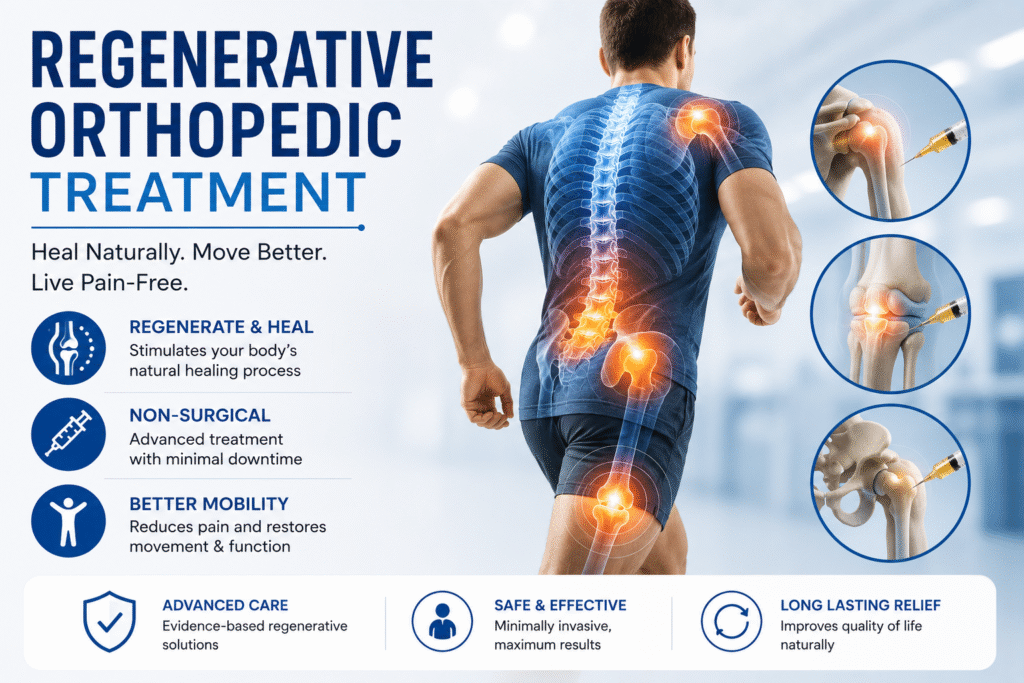
Treatments such as PRP/ACP may be used for certain tendon, ligament, and joint conditions, while ChondroFiller and ACT are primarily used for localized cartilage defects. Cell-based approaches such as SVF are being studied for cartilage and degenerative joint conditions.
Why even consider Germany in the first place for regenerative medicine? Germany is not only amongst the leading countries in this field, having been involved in stem cell and regenerative medicine research for decades, with research institutions and university hospitals investigating cell-based therapies, tissue engineering, cartilage repair, and other regenerative approaches. Germany’s well-established biomedical research system and regulated healthcare environment have facilitated the advancement and clinical exploration of tissue engineering, gene therapy, and cell therapy.
It is crucial to consider that regenerative therapy in itself is not widely accessible. For international patients, when compared with other countries, Germany can also be a cost-effective alternative to the United States and Japan for selected regenerative treatments, although the actual cost depends on the therapy, facility, and treatment plan.
Hospitals in Germany offers access to blood-derived therapies such as PRP and ACP, adipose-derived cell therapies such as SVF, cartilage-repair techniques including ChondroFiller and ACT, and emerging cell-based treatments under investigation in clinical research. These options are provided within Germany’s regulated healthcare and research framework, although availability and approval vary by treatment.
Regenerative treatments in orthopedics work by activating biological repair pathways within musculoskeletal tissues such as cartilage, tendons, ligaments, and joint structures.
Conventional surgery, on the other hand, addresses structural problems directly through mechanical intervention. This may include removing damaged tissue, repairing torn structures, stabilizing joints, or replacing joints entirely.
Regenerative treatments aim to support the body’s natural healing processes using approaches such as PRP/ACP, SVF, ChondroFiller, or ACT, while conventional surgery focuses on repairing, removing, stabilizing, or replacing damaged structures.
| Factor | Regenerative Treatment | Conventional Orthopedic Surgery |
| Main goal | Support tissue healing, repair, or preservation | Repair, reconstruct, remove, or replace damaged structures |
| Approach | Often minimally invasive, such as injections or small procedures | May involve arthroscopy or open surgery, depending on the condition |
| Common applications | Selected cartilage, tendon, ligament, and degenerative joint problems | Severe cartilage damage, fractures, joint instability, major ligament injuries, and advanced joint degeneration |
| Recovery | Generally involves less procedural downtime, although recovery varies by treatment | Usually requires a longer recovery and rehabilitation period |
| Tissue replacement | Primarily aims to support the body’s own repair mechanisms | May involve implants, grafts, artificial joints, or reconstruction |
| Evidence | Varies considerably between different regenerative therapies and conditions | Many orthopedic surgical procedures have established indications and clinical evidence |
| When considered | Often explored when tissue damage is suitable for biological treatment and surgery is not immediately necessary | Considered when structural damage requires mechanical correction or when conservative options have failed |
Regenerative treatment is not necessarily an alternative to surgery. For some patients, it may be considered before surgery or alongside conventional orthopedic care, while extensive tissue damage, severe joint degeneration, fractures, or instability may require surgery. An orthopedic specialist should assess imaging, symptoms, and the underlying structural problem before recommending either approach.
The cost of regenerative orthopedic treatment in Germany varies based on several factors, including the type of therapy, the severity of the orthopedic condition, and the complexity of the procedure.
As a general guide, PRP/ACP treatments may cost around €300–€1,500 per session, while more complex cell-based or cartilage-repair procedures such as SVF, ChondroFiller, or ACT may range from approximately €3,000 to €15,000 or more.
Additional factors influencing the total cost include the number of treatment sessions required, fees for specialists and hospitals, diagnostic imaging, laboratory tests, rehabilitation, and necessary follow-up care. For international patients, additional expenses related to medical coordination, translation services, and other treatment-related needs may also contribute to the overall cost.
| Treatment | Approximate cost in Germany (Self-pay) |
| PRP / ACP | €300–€1,500 ($350–$1,750) per session |
| Stem Cell Therapy (e.g., BMAC / MSC) | €8,000–€20,000+ ($9,300–$23,300+) |
| Autologous Fat Stem Cells (SVF) | €5,000–€15,000+ ($5,800–$17,500+) |
| ChondroFiller | €3,000–€8,000+ ($3,500–$9,300+) |
| Autologous Cartilage Transplantation (ACT) | €8,000–€15,000+ ($9,300–$17,500+) |
International patients commonly Self-pay for regenerative orthopedic procedures themselves, particularly for elective or investigational treatments. This would mean the following things:
For an international patient, Berlin, Heidelberg, Munich, Hamburg, and Frankfurt are particularly practical starting points because they combine specialized medical infrastructure with international accessibility. Availability of a specific regenerative orthopedic procedure should always be confirmed with the hospital you’re selecting.
List of popular hospitals for Regenerative medicine in orthopedics:
As a travelling patient, you should be well-informed about how to select the right hospital for your orthopedic concern. From knowing if the center performs the right therapy for your condition to seeing how check-ups work remotely.
Note: Clinical Trials Information System (CTIS) is the single online platform for submitting, evaluating, and monitoring clinical trials in the European Union (EU) and European Economic Area (EEA).
Is Regenerative Orthopedic Treatment Safe? Regenerative orthopedic therapy can be safe when they are appropriately indicated, performed by qualified specialists, and prepared and administered under proper medical standards. However, safety varies by treatment. PRP/ACP, SVF, ChondroFiller, and ACT involve different procedures and therefore carry different risks.
Before treatment, you should discuss the expected benefits and outcomes, possible complications, available alternatives, supporting evidence, and regulatory status with a qualified orthopedic specialist. This is particularly important when considering newer or cell-based regenerative therapies, such as bone marrow aspirate concentrate (BMAC), adipose-derived stromal vascular fraction (SVF), platelet-rich plasma (PRP) enhancements, and emerging biologic or exosome-based approaches.
Let’s discuss:
The end outcome varies from case to case. But generally, the following points can be considered:
If you’re planning regenerative orthopedic treatment in Germany from abroad, it’s essential to take structured steps to ensure a smooth process. Start by sharing your diagnosis, MRI or other imaging, previous treatment records, medications, and relevant medical history with the German orthopedic specialist for an initial assessment. Here’s a guideline to help you through the process:
If you’re navigating the process of planning regenerative orthopedic treatment in Germany, CancerRounds can assist international patients without any bias in understanding available treatment options, comparing estimated costs, and organizing medical records for assessment by suitable orthopedic centers.
Q.1 Is regenerative orthopedic treatment available in Germany?
Yes. Germany offers several regenerative orthopedic approaches, including PRP/ACP, SVF, ChondroFiller, and autologous cartilage transplantation (ACT). Availability depends on the treatment, orthopedic condition, and individual center.
Q.2 Is regenerative orthopedic treatment safe?
Yes, when an appropriate treatment is performed by a qualified specialist under proper medical and regulatory standards. However, every procedure has potential risks, and safety and evidence vary between treatments.
Q.3 Can regenerative treatment repair damaged cartilage?
It can support cartilage repair in selected conditions, but it does not guarantee complete restoration of severely damaged cartilage. Treatments such as ChondroFiller and ACT are primarily intended for specific, localized cartilage defects.
Q.4 Can regenerative treatment help osteoarthritis?
It may help selected patients with osteoarthritis, particularly in earlier stages. The expected benefit depends on the severity of joint degeneration and the specific treatment used.
Q.5 Is PRP or ACP better than surgery?
Not necessarily. PRP/ACP and surgery have different purposes and indications. Regenerative treatment may be considered when surgery is not yet necessary, while significant structural damage may require conventional orthopedic surgery.
Q.6 How much does regenerative orthopedic treatment cost in Germany?
Costs vary by treatment and complexity. PRP/ACP may cost around €300–€1,500 per session, while SVF, ChondroFiller, and ACT can cost several thousand euros. Additional diagnostics, processing, hospital fees, and rehabilitation may increase the final cost.
Q.7 Does health insurance cover regenerative orthopedic treatment in Germany?
Coverage depends on the treatment, indication, insurance policy, and whether the procedure is established clinical care. International self-paying patients should not assume that regenerative treatment will be reimbursed and should confirm coverage before travelling.
Q.8 Are regenerative treatments in Germany approved or experimental?
Some procedures are used in clinical practice, while certain cell-based approaches remain under investigation. Patients should ask whether their proposed treatment is established care or being provided through a registered clinical trial.
Q.9 Can international patients receive regenerative orthopedic treatment in Germany?
Yes. International patients can seek assessment and treatment in Germany, subject to the requirements of the treating center and applicable medical and travel regulations.
Q.10 What medical records should international patients send before travelling?
Usually, patients should provide their diagnosis, MRI or X-rays, previous treatment records, medication list, relevant medical history, and recent laboratory results when applicable. The treating center can then determine whether further tests are required.
Q.11 Can I return home immediately after treatment?
Not always. Your specialist should confirm when you are medically fit to travel. Patients undergoing procedures involving surgery or restricted weight-bearing may need to remain in Germany for an initial follow-up.
Sources:
Published By
.webp)
Global Patient Care, Redefined
The CancerRounds Medical Content Team specialises in creating accurate, clear and patient-focused healthcare content. Our content is written by medically trained writers, medically reviewed, and based on reputable medical sources to support informed healthcare decisions.
Get expert guidance instantly
Share a few details and our medical team gets back to you within 4 hours with the next steps.

Tell us what you are facing and our medical team will guide you to the right doctors, hospitals and treatment.
Free Review, No Commitment
Free assessment with no pressure to proceed.
Trusted by 100,000+ Patients
Across 125+ countries worldwide
500+ Top Partner Hospitals
Globally accredited medical facilities
5000+ Expert Specialists
Senior doctors across major specialties.
Making quality healthcare accessible to patients worldwide
Everything you need to know about choosing the right hospital, doctor and treatment plan.