
“Why am I so itchy?” It starts with a small itch. Maybe there’s no visible rash. Maybe it keeps coming back at night, or you’ve been scratching for days without figuring out what’s causing it.
Most of the time, itchy skin has a simple explanation. Dry skin, allergies, eczema, medications, and other common conditions are far more likely causes than cancer. But when itching is persistent, unexplained, or accompanied by other unusual symptoms, it’s natural to wonder: Could an unexplained itch be more than a skin problem? The answer is sometimes yes, but not in the way you might expect.
In a study of 16,925 patients with pruritus, those experiencing itching had a 5.76-fold higher odds of having a concurrent malignancy, with particularly strong associations involving liver and biliary cancers, hematologic cancers, and skin cancers.
So, what cancer can cause itchy skin, why does it happen, and what does cancer-related itching actually look like? More importantly, when is an itch simply an itch, and when should you have it checked?
Let’s take a closer look.
Confused about treatment options?
Get a free second opinion from our oncologists
Not all cancers cause itchy skin, but certain cancers can trigger persistent pruritus through immune-system changes, problems with bile flow, or direct involvement of the skin. The cancers below are among those associated with itching.
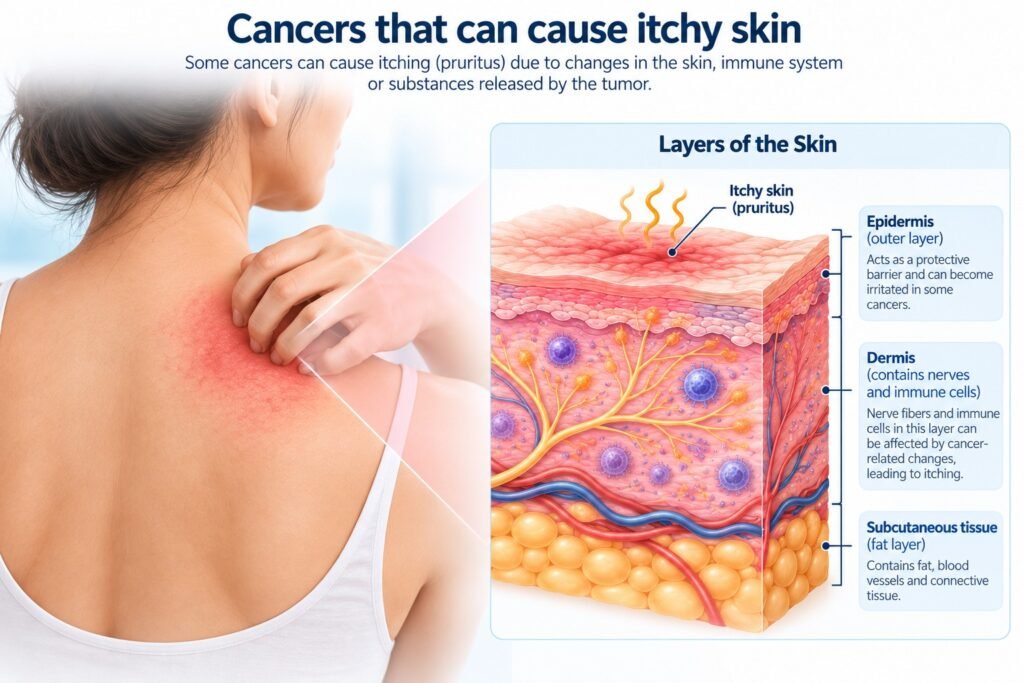
Cancer-related itching, or pruritus, can happen for several reasons. From a biological perspective, itching begins when chemical signals activate itch-sensitive nerve endings (pruriceptors) in or near the skin. Cancer can trigger these signals directly or indirectly.
Some cancers, particularly lymphomas, can alter the body’s immune response. Cancer cells and immune cells may release signaling proteins called cytokines, which promote inflammation and can activate itch-sensitive nerve endings. This may result in persistent itching even when there is no visible rash.
Certain cancers can affect the release of histamine and other chemical mediators involved in the itch response. These substances can stimulate nerve fibers in the skin, producing the familiar urge to scratch.
Cancers affecting the liver, bile ducts, or pancreas can sometimes obstruct the normal flow of bile. This condition, known as cholestasis, can cause bile-related substances to accumulate in the bloodstream and is often associated with generalized itching. Jaundice may occur at the same time.
Some cancers can directly involve the skin or nearby tissues. Abnormal cancer cells may infiltrate the skin or cause local inflammation, resulting in irritation, itching, swelling, or changes in the affected area.
When a tumor affects nearby tissues or nerves, it can alter the way sensory signals are transmitted. Irritation or damage to these nerve pathways can sometimes be perceived by the brain as itching, burning, or tingling.
Itching does not always come from the cancer itself. Chemotherapy, radiation therapy, immunotherapy, and targeted therapies can cause dry skin, inflammation, rashes, or allergic reactions that trigger pruritus. This is why new itching during cancer treatment should be discussed with the treating team.
Cancer-related itching, or pruritus, does not have one distinct appearance. However, certain patterns may help distinguish it from a typical skin irritation:
Consider speaking with a doctor if the itching is persistent, severe, getting worse, or has no obvious cause, especially if it is affecting your sleep or daily life.
Pay closer attention if itching occurs alongside unexplained weight loss, persistent fatigue, fever or night sweats, swollen lymph nodes, or yellowing of the skin or eyes (jaundice). A new or changing mole, growing skin lesion, bleeding, crusting, or a sore that does not heal also deserves medical attention.
Common question: Does persistent itching mean I have cancer?
Not necessarily. Most itching is caused by non-cancerous conditions. However, when the cause isn’t clear or other unusual symptoms appear, getting it checked can help identify the right cause early.
The first clue is often the pattern of the itch. When did it start? Is it constant, widespread, or linked to something specific? Your doctor uses these details, along with a physical examination and targeted tests, to narrow down the cause.
Your doctor may ask when the itching started, how severe it is, where it occurs, and whether anything triggers it, such as heat or a hot shower. They will also examine your skin for dryness, rashes, scratch marks, changing moles, or other visible changes, while checking for symptoms such as swollen lymph nodes, fatigue, or unexplained weight loss.
If the cause isn’t clear, blood tests may help identify an underlying condition. Depending on your symptoms, these may include a complete blood count (CBC), liver and kidney function tests, thyroid tests, and other investigations.
If your symptoms or test results point to a possible underlying problem, your doctor may recommend imaging such as an ultrasound or CT scan. A skin or lymph node biopsy may be needed if there is a suspicious lesion or enlarged lymph node.
The tests aren’t automatically looking for cancer. They are selected based on your symptoms to help identify what is actually causing the itch.
Treating the underlying cancer may help reduce the itching, while additional treatments can provide relief from the symptom itself.
Depending on the cause and severity, doctors may recommend:
Because not all cancer-related itching is caused by the same mechanism, a treatment that works for one person may not work for another. Your healthcare team can identify the likely cause and choose the most appropriate approach.
Itching alone does not mean you have cancer. Persistent, unexplained itching, particularly when accompanied by symptoms such as unexplained weight loss, night sweats, swollen lymph nodes, fatigue, or jaundice, should be evaluated by a doctor.
Nighttime itching can occur with some cancers, particularly Hodgkin lymphoma and non-Hodgkin lymphoma. However, itching that becomes worse at night is not specific to cancer and can have many other causes.
Squamous cell carcinoma (SCC) and cutaneous T-cell lymphoma can cause itchy skin lesions. Basal cell carcinoma and melanoma may also itch, particularly when a lesion is changing or irritated.
Yes. Lymphoma-related pruritus can occur without an obvious rash and may affect large areas of the body. Scratching over time can cause redness, marks, or skin thickening.
Yes. These cancers can sometimes obstruct the normal flow of bile, causing cholestasis and generalized itching. Itching may occur alongside jaundice, dark urine, or pale stools.
Pancreatic cancer may cause itching when a tumor blocks the bile duct. This can lead to jaundice and generalized pruritus, often accompanied by dark urine and pale stools.
Yes. Chemotherapy, immunotherapy, radiation therapy, and targeted therapies can cause dry skin, rashes, inflammation, or other reactions that lead to itching. Tell your cancer care team about new or worsening itching during treatment.
Get expert guidance instantly
Tell us about your condition and we will help you find the right care.
Get expert guidance instantly
Share a few details and our medical team gets back to you within 4 hours with the next steps.

Tell us what you are facing and our medical team will guide you to the right doctors, hospitals and treatment.
Free Review, No Commitment
Free assessment with no pressure to proceed.
Trusted by 100,000+ Patients
Across 125+ countries worldwide
500+ Top Partner Hospitals
Globally accredited medical facilities
5000+ Expert Specialists
Senior doctors across major specialties.
Making quality healthcare accessible to patients worldwide
Everything you need to know about choosing the right hospital, doctor and treatment plan.
.webp)