
Melanoma treatment in Germany costs approximately €15,660–€60,900, with an average cost of around €30,450, depending on the cancer stage and treatment approach. This includes surgery, lymph node removal, and medication for advanced disease. Immunotherapy costs approximately €2,175–€19,140 per cycle, depending on the drug used and the number of cycles required.
Reply in 4 hours · Plan and quote in 2 days · 100% confidential
Your biopsy says melanoma. Your mind jumps to the worst place, and every hour of waiting feels long. We get it. The good news is that melanoma treatment in Germany is built around speed, precision, and clear plans, whatever your stage.
Germany has specialist skin tumour centres, tumour boards where several doctors agree on your plan together, and quick access to newer drugs. For many patients from abroad, that means a second look at their diagnosis and sometimes a better option than the one they were offered at home.
In this guide, we’ll walk you through how melanoma is staged, which treatments exist, what survival numbers really mean, and what it costs. We’ll also show you how Cancer Rounds supports you, from your first message to your safe return home.
Germany offers melanoma care through certified skin tumour centres, where dermatologists, oncologists, surgeons and pathologists plan treatment together. Care follows a national guideline, and about 94 to 95 in 100 patients are alive five years after diagnosis, largely because most cases are caught early.
The country’s public screening programme has offered skin checks every two years from age 35 since 2008. As a result, around two in three melanomas are found at an early stage, when surgery alone can often cure them.
Certified centres also have to prove every year that they meet strict standards for diagnosis, treatment and follow-up. Only about 35 skin tumour centres hold this status, and many sit inside university hospitals. That matters for you because these hospitals also run clinical trials, so you may get access to newer treatments.
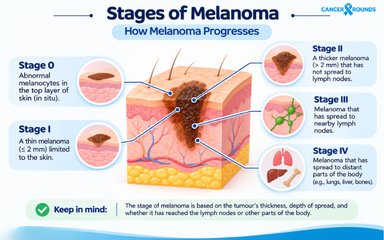
Doctors start with a skin exam using dermoscopy, a lighted magnifier, then remove the suspicious spot for a biopsy. Pathologists measure its thickness. Depending on the result, you may have a sentinel lymph node biopsy, scans and gene testing to confirm the stage and guide treatment.
Thickness is the most important number in your pathology report. It tells doctors how deep the melanoma has grown and helps predict how likely it is to spread. They also check whether the surface is broken, which is called ulceration.
A sentinel lymph node biopsy checks the first lymph node the cancer would reach. It’s usually offered when the melanoma is thicker. If the cancer may have spread further, you’ll have a CT, MRI or PET scan.
Gene testing comes next. Close to half of melanomas carry a BRAF mutation, and testing for it is standard once the cancer is stage 3 or 4. If surgery isn’t an option, doctors can use next-generation sequencing, which reads many genes at once, to look for more treatment targets.
Before you travel, your German team will usually ask for your original pathology report, the biopsy slides and any scans. Pathologists at the centre may re-read your slides, since a small change in thickness can move you to a different stage. That’s why we collect your records early and send them for review before anything else happens.
Treatment depends on stage, and in Germany a tumour board usually agrees the plan before you start. Here’s the general picture.
| Stage | Main treatment | What may follow |
| 0 to I | Surgery to remove the melanoma with a margin of healthy skin | Regular skin checks |
| II | Surgery | Immunotherapy for about a year if the risk of return is high |
| III | Surgery, increasingly with immunotherapy before it | Immunotherapy or targeted drugs for about a year, based on response |
| IV | Immunotherapy or targeted drugs | Radiotherapy, surgery or trials for selected cases |
Surgery is the backbone of treatment for melanoma that hasn’t spread. For stage III, giving immunotherapy before surgery (called neoadjuvant treatment) is now standard in many centres. It also lets doctors see how well the tumour responds.
If the melanoma has spread, you can read more about stage 4 cancer treatment in Germany. Drugs usually come first. Radiation therapy in Germany can target a spot in the brain or bone that’s causing problems. Surgery can remove single tumours in selected cases, and a direct injection into skin tumours (called T-VEC) is an option when they can’t be cut out. Chemotherapy works less well than the newer drugs, so doctors keep it for when nothing else fits.
What happens after surgery depends on what the lab finds. If the tumour responded well to treatment before surgery, many patients need no further drugs and move to regular check-ups. If it responded only partly, your team may add a year of immunotherapy or targeted pills to lower the risk of the cancer coming back. This response-based approach means you get the treatment you need and no more.
Yes, for most people with advanced melanoma, immunotherapy is the first choice. Drugs called checkpoint inhibitors, such as pembrolizumab and nivolumab, help your immune system find and attack cancer cells. If your tumour has a BRAF mutation, targeted drugs are another strong option.
Checkpoint inhibitors are given by drip every few weeks. Doctors sometimes combine two of them, such as ipilimumab with nivolumab, because the pair works harder. The trade-off is more side effects. In a large 2024 trial in stage III melanoma, two doses before surgery left 77 in 100 patients free of relapse or progression at two years. For those who had surgery first, it was 56 in 100. Serious side effects were more common too, at about 31 in 100 versus 16 in 100.
Targeted drugs come as daily pills that block the BRAF signal telling melanoma cells to grow. They often work fast, which helps when the cancer is spreading quickly, though resistance can develop over time. You can learn more about immunotherapy in Germany, including how your team watches for side effects such as rashes, bowel problems and thyroid changes.
So who gets which drug? Doctors look at your stage, your BRAF result, how fast the cancer is growing and your general health. Someone with a heart, liver or autoimmune condition may need a different plan from someone who’s otherwise healthy. Your tumour board weighs all of this, then explains the options in plain language so you can decide together.
Survival depends mostly on stage. In large US data, more than 99 in 100 people with localised melanoma are alive five years after diagnosis. That drops to about 76 in 100 once it has reached nearby lymph nodes, and about 36 in 100 when it has spread to distant organs.
These figures describe groups of people diagnosed between 2015 and 2021. They can’t predict what will happen to you. Your tumour thickness, genes, age and general health all change the picture.
Treatment keeps improving. Immunotherapy and targeted drugs now help more people with advanced disease, and treatment before surgery is changing the outlook for stage III. Germany’s high overall survival comes mainly from early detection, which is why a quick, accurate diagnosis matters so much. A second opinion on your stage and plan is often the fastest way to check you’re on the right path.
Not every hospital treats melanoma the same way. Start by looking for a certified skin tumour centre, then ask a few direct questions:
Germany has several specialised centres for skin cancer treatment, particularly in cities such as Heidelberg, Berlin, and Munich. Leading institutions, including Heidelberg University Hospital, Charité – Universitätsmedizin Berlin, and LMU University Hospital Munich, provide multidisciplinary care for melanoma, non-melanoma skin cancers, and rare skin tumours. These centres combine specialised dermatology departments, surgical oncology, advanced diagnostics, and personalised treatment planning for both domestic and international patients.
| Hospital | City | Specialised Centre | Key Details |
| Heidelberg University Hospital (UKHD) | Heidelberg | Skin Tumor Center | DKG-certified since 2009. Treats over 2,000 patients annually, including those with melanoma, non-melanoma skin cancer, mucosal tumours, and skin lymphomas. Works in collaboration with NCT Heidelberg and DKFZ. |
| Charité – Universitätsmedizin Berlin | Berlin | Skin Tumor Center Charité (HTCC) | Established in 2004. Provides interdisciplinary diagnosis, personalised treatment, follow-up care, and access to clinical trials through its Department of Dermatology and Charité Comprehensive Cancer Center. |
| LMU University Hospital Munich (LMU Klinikum) | Munich | Certified Skin Cancer Center | Provides specialised skin cancer care through its Department of Dermatology and Allergology, in collaboration with Comprehensive Cancer Center Munich (CCC Munich LMU). Offers diagnostic, surgical, and multidisciplinary treatment services. |
You can compare them on our page for the top skin cancer hospitals in Germany, or meet the specialists on our list of skin cancer doctors in Germany.
Ask how the centre handles side effects, too. Immunotherapy can cause rashes, diarrhoea or thyroid problems, and quick treatment keeps them manageable. A good centre gives you a clear plan for what to do if something feels wrong, including who to call and when.
You don’t have to make this choice alone. Your Cancer Rounds case manager will match your reports to the centre with the right experience for your stage, then handle the introductions.
Cost depends on your stage and treatment. Melanoma care costs approximately €15,660–€60,900, with an average cost of around €30,450. These are estimates, and you’ll get a personalised quote once our team reviews your reports.
Here are some typical price points:
| Item | Estimate |
| Initial workup (biopsy review, imaging, gene tests) | €2,000 to €5,000 |
| Overall melanoma treatment (surgery, lymph node surgery, drugs if the cancer has spread) | €15,660–€60,900 (average: approximately €30,450) |
| Immunotherapy, headline range (priced per cycle) | €2,175–€19,140 (a full course can cost more) |
| Pembrolizumab, one dose (given every 3 weeks) | about €4,080 |
| Pembrolizumab, one year (drug only) | about €69,300 |
| Conventional radiation therapy, full course | €24,000 to €31,000 |
Timelines vary: Surgery alone needs a shorter stay, while plans with drugs, radiotherapy or repeated scans can take two to four weeks in Germany. Many patients then continue drugs at home with a local oncologist, guided by their German team.
A typical start looks like this. Your German team reviews your slides and scans, repeats any tests they need and presents your case to the tumour board. Once the board agrees a plan, treatment can begin soon after. We’ll share the schedule before you fly, so you know what to expect each week.
We take care of the logistics: medical visa documents, translation, airport pickup, hotel booking and a dedicated case manager, with support in 11+ languages. You can also get an online second opinion before you book anything.
Three things to take with you. Your stage decides your plan, so get your pathology report and scans together first. Germany pairs early detection with tumour boards, gene testing and immunotherapy, including treatment before surgery for stage III. And a second opinion can confirm your plan or change your options.
If you’re ready, book a consultation or ask for a personalised treatment plan. If you’re not sure yet, request a callback, ask about costs or start a chat with us on WhatsApp. You don’t have to face this alone. Send us your reports today, and our team will come back with a clear plan and a cost estimate within 4 hours.
Yes, melanoma is often curable, especially when it’s found early. In large US data, more than 99 in 100 people with localised melanoma are alive five years after diagnosis. Germany’s overall five-year survival is around 94 to 95 in 100, helped by national skin checks from age 35. Cure becomes harder once the cancer reaches lymph nodes or other organs, but newer immunotherapy and targeted drugs have improved outcomes for many people. No doctor can promise a cure, and your stage, tumour thickness and genes all matter. Share your reports with us, and a specialist will tell you where you stand and what your realistic options are.
Stage 3 melanoma, where cancer has reached nearby lymph nodes, is usually treated with surgery plus immunotherapy or targeted drugs. For melanoma that can be seen in the nodes, German centres increasingly give two doses of ipilimumab and nivolumab before surgery. In a large 2024 trial, 77 in 100 patients on this approach had no relapse or progression after two years, compared with 56 in 100 who had surgery first. After surgery, your team decides whether you need more treatment based on how well the tumour responded. Side effects can be serious, so close monitoring matters. Your tumour board will choose the plan that fits your stage, genes and health.
Melanoma treatment in Germany typically costs between €15,000 and €50,000 as a package, depending on your stage and therapy. A diagnostic workup with biopsy review and imaging often runs €2,000 to €5,000. Radiation therapy may cost €15,000 to €30,000. Yearly immunotherapy can range from €40,000 to €80,000, and targeted therapy from €50,000 to €70,000. These are estimates, not quotes. The final price depends on the hospital, how long you need drugs and whether you need surgery. Send us your reports for a personalised estimate at no charge, and see our cost guide for more detail.
Your stay depends on your treatment. Surgery for early melanoma may need only a shorter visit, while plans that include drugs before or after surgery, radiotherapy or repeated scans can take two to four weeks in Germany. Many patients then continue maintenance drugs at home with a local oncologist, guided by the German team. Your Cancer Rounds case manager will map out dates, accommodation and follow-up before you travel, so you’re not guessing. Because immunotherapy side effects can appear after you leave, we also plan how you’ll stay in touch with your German doctors.
Yes, and we’d encourage it. Share your pathology report, scans and medical history, and our team will have them reviewed by a German skin cancer specialist. You’ll get a personalised plan and cost estimate within 4 hours. A second opinion can confirm your current plan, correct the stage or point to options such as treatment before surgery or targeted drugs. It also helps you decide whether travelling is worth it for your case. The review is free and carries no obligation, so you can compare it with what your home doctors have told you.
Yes. German centres test melanoma tissue for BRAF mutations, which are found in close to half of melanomas. European guidelines treat this test as essential for stage 3 and stage 4 disease, because it decides whether targeted drugs can be used. These are daily pills, usually a BRAF inhibitor plus a MEK inhibitor, such as dabrafenib with trametinib. If surgery isn’t possible, doctors may also run next-generation sequencing to look at more genes. Even if you have the mutation, immunotherapy is often still the first choice, and your team will weigh speed, side effects and your health.
Melanoma needs regular follow-up for years, even after successful treatment. Your German team will give you a written summary, scan results and a schedule, so your home doctors know what to check. This usually includes skin exams, lymph node checks and sometimes imaging, depending on your stage. If you’re on immunotherapy, see a doctor quickly for a new rash, diarrhoea, breathlessness, unusual tiredness or yellow skin, because immune side effects can appear months later. Cancer Rounds stays in touch after you go home and can help you reach your German specialists when questions come up.
Published By
.webp)
Global Patient Care, Redefined
The CancerRounds Medical Content Team specialises in creating accurate, clear and patient-focused healthcare content. Our content is written by medically trained writers, medically reviewed, and based on reputable medical sources to support informed healthcare decisions.
Get expert guidance instantly
Share a few details and our medical team gets back to you within 4 hours with the next steps.
Tell us what you are facing and our medical team will guide you to the right doctors, hospitals and treatment.
Free Review, No Commitment
Free assessment with no pressure to proceed.
Trusted by 100,000+ Patients
Across 125+ countries worldwide
500+ Top Partner Hospitals
Globally accredited medical facilities
5000+ Expert Specialists
Senior doctors across major specialties.
Making quality healthcare accessible to patients worldwide
Everything you need to know about choosing the right hospital, doctor and treatment plan.