
Quick Answer: A new lump under your skin is usually harmless, but a lump that keeps growing, feels deep or firm, or returns after removal needs a doctor’s check. Early-stage cancer lumps under the skin can come from soft tissue sarcoma, lymphoma, breast cancer, or skin cancer. Pain isn’t a reliable guide. Book an exam and imaging first, then a biopsy if advised. Cancer Rounds can help you get a specialist opinion.
Confused about treatment options?
Get a free second opinion from our oncologists
Early-stage cancer lumps under the skin often feel firm, deep or fixed in place, and many don’t hurt. But some feel soft, and harmless lumps can feel the same way. Touch can raise a flag, yet it can’t confirm or rule out cancer, so any new or growing lump needs checking.
Why so little pain? A growing tumour often doesn’t press on nerves at first. That’s why the most common sign of soft tissue sarcoma is a painless lump that slowly gets bigger. Pain usually appears later, when the lump presses on nerves or muscle.
Doctors look at a few features together:
| Feature | What may raise concern |
| Texture | Firm or hard |
| Growth | Getting bigger over weeks or months |
| Pain | Often absent, especially early on |
| Movement | Feels stuck in place |
| Depth | Sits below the surface, in or under muscle |
Treat these as clues, not a test. A shallow lump usually moves when you press it, while a deep one feels fixed and can be hard to find when you tense the muscle. Some harmless lumps share these traits.
Once you know what a lump can feel like, the obvious question is what could cause it. A few cancers can show up this way, and they don’t behave alike.
Soft tissue sarcoma: These cancers start in muscle, fat, nerves, blood vessels, and other supporting tissue. They’re rare, making up only about 1% of all cancers. A lump or swelling is the main sign.
Lymphoma: The most common sign is a painless swollen lymph node in the neck, armpit or groin. Some people also have fevers, night sweats or weight loss. Most swollen nodes come from infections, though, and settle on their own.
Breast cancer: A breast lump is the most common sign, and a lump in the armpit needs checking too. More than 80% of breast lumps turn out to be benign, but you shouldn’t assume. A lump usually needs to reach about 1 cm before you can feel it. Our guides to breast cancer symptoms and breast cancer go deeper.
Skin cancer: Some skin cancers appear as small, pearly bumps. Early signs are often painless, and doctors suggest a check if a patch or lump hasn’t improved after about four weeks.
None of this tells you whether a lump is early-stage. Staging is the process doctors use to find out whether cancer has spread, and it needs tests.
You can’t tell reliably by touch. Lipomas, cysts and swollen glands are far more common, and a doctor needs an exam, imaging and sometimes a biopsy to be sure. Features like growth, depth and size help decide how urgently a lump needs testing.
The usual harmless suspects are easy to describe. A lipoma is a soft, movable lump of fat. An epidermoid cyst is smooth, firm and painless. A lymph node that’s swollen from a cold or infection is often tender.
| More often benign | Needs closer attention |
| Stays the same size | Keeps growing |
| Soft and easy to move | Firm, deep or stuck in place |
| Small and smooth | Large or irregular |
| Tender, with a cold or infection | Painless and lasting for weeks |
Size matters, but it isn’t a safe line. One UK specialist-centre study found sarcomas averaged 8.6 cm when examined, against 5.4 cm for benign lumps. Yet a Dutch study found that sarcomas removed without warning were often small and shallow.
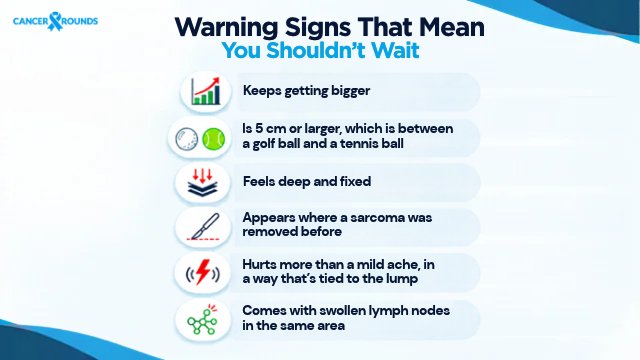
Because touch can’t settle the question, doctors lean on a short list of warning signs. See a doctor soon if your lump:
Don’t ignore swollen nodes that last more than 3 to 4 weeks, especially with fevers, night sweats or weight loss. A skin sore that won’t heal needs a look too.
Notice what’s missing? Pain isn’t a requirement. NHS referral guidance treats significant pain as the least sensitive sign of a sarcoma. In England, national guidance backs an ultrasound within two weeks for an unexplained lump that’s growing.
Your doctor will start with questions and a physical exam, then usually order an ultrasound or MRI. If imaging looks concerning, a planned biopsy takes a small tissue sample to confirm the diagnosis. For a lump that might be a sarcoma, imaging should come before any surgery.
Ultrasound is often the first scan for a shallow lump. MRI shows the lump’s size, depth and nearby structures, which is why it’s preferred for lumps on the limbs and trunk. A biopsy is the only way to confirm sarcoma, and a pathologist with sarcoma experience should read the sample.
One mistake is worth knowing about. A surgeon removes a lump thinking it’s harmless, and the lab then finds cancer. Studies report that 37% to 71% of soft tissue sarcomas had surgery like this before reaching a specialist centre. It can leave cancer cells behind and mean more surgery later.
So if a doctor suggests simply cutting out a large or deep lump, it’s fair to ask whether you can have a scan first.
Often, yes, especially when the cancer is found before it spreads. The plan depends on the cancer type, grade, and stage. Surgery is the main treatment for most soft tissue sarcomas, sometimes with radiation or drug therapy, while lymphoma and breast cancer follow their own paths.
For soft tissue sarcoma, stage 1 is often treated with surgery, and radiation is sometimes added. Stages 2 and 3 often get both, with chemotherapy in some cases. Surgery removes the cancer and a margin of healthy tissue around it.
Because sarcomas are rare, it helps to have your case planned by a specialist sarcoma team. Not every country or hospital has one close by. That’s where Cancer Rounds can help, with a dedicated case manager who arranges second opinions and travel. You can see what specialist care looks like on our page about sarcoma treatment in Germany, or learn how each approach works in our guide to cancer treatment modalities.
Knowing the options is reassuring, but none of it helps until the lump is checked.
Book a routine visit if a new lump hasn’t gone in 3 to 4 weeks. Don’t wait that long if it’s growing, 5 cm or larger, deep, or paired with fevers, night sweats or weight loss. And don’t wait for pain.
Bring a few notes to make the visit count:
Start with your family doctor, who can arrange scans and refer you on if needed.
Most lumps aren’t cancer. Still, a lump that grows, feels deep or firm, or doesn’t go away deserves a proper look, even when it doesn’t hurt. Only an exam, imaging and sometimes a biopsy can tell you what it is.
If you’ve found one, don’t wait and wonder. Cancer Rounds is backed by the Vaidam Health group, which has supported patients from more than 125 countries. Talk to a cancer specialist or get a personalised treatment plan from a case manager who speaks your language (we support 11+ languages). Not ready yet? Request a callback, ask about costs, or start a WhatsApp chat. A short call can settle weeks of worry.
Q.1 What does an early-stage cancer lump under the skin feel like?
It often feels firm, deep or stuck in place, but some cancerous lumps feel soft. Many are painless, especially at first. Feel alone can’t confirm cancer, so have any new or growing lump examined.
Q.2 Can a cancerous lump under the skin be painless?
Yes. A painless, growing lump is the most common sign of soft tissue sarcoma, and swollen lymph nodes from lymphoma are usually painless too. Pain is the least sensitive warning sign, so a painless lump isn’t a reason to wait.
Q.3 How big is a cancerous lump usually?
There’s no set size. Referral guidance flags lumps of 5 cm or more, and sarcomas averaged 8.6 cm in one specialist study. But small, shallow lumps can also be cancer, so size alone shouldn’t decide whether you get checked.
Q.4 How can you tell if a lump is a lipoma or cancer?
A lipoma is typically soft, painless and easy to move under the skin. A lump that’s firm, deep, growing or larger than 5 cm raises more concern. An ultrasound or MRI, and sometimes a biopsy, is needed to know for sure.
Q.5 Can cancerous lumps under the skin grow quickly?
Some grow over weeks, while others enlarge slowly over many months. Growth speed alone can’t confirm or rule out cancer. A lump that keeps getting bigger should be checked either way, and in England an ultrasound within two weeks is advised for an unexplained growing lump.
Q.6 Which doctor should I see for a suspicious lump?
Start with your family doctor or a general surgeon, who can examine you and arrange scans. Depending on the findings, you may be referred to a sarcoma specialist, breast specialist, dermatologist or blood cancer doctor. Ask for imaging before any removal.
Q.7 Can international patients get a second opinion for a lump abroad?
Yes. Cancer Rounds helps patients from many countries get specialist opinions and plan treatment abroad, with a dedicated case manager and support in 11+ languages. Reach out with your reports, and a case manager will explain your next steps.
.webp)
Get expert guidance instantly
Tell us about your condition and we will help you find the right care.
Get expert guidance instantly
Share a few details and our medical team gets back to you within 4 hours with the next steps.

Tell us what you are facing and our medical team will guide you to the right doctors, hospitals and treatment.
Free Review, No Commitment
Free assessment with no pressure to proceed.
Trusted by 100,000+ Patients
Across 125+ countries worldwide
500+ Top Partner Hospitals
Globally accredited medical facilities
5000+ Expert Specialists
Senior doctors across major specialties.
Making quality healthcare accessible to patients worldwide
Everything you need to know about choosing the right hospital, doctor and treatment plan.