
Quick Answer: What is the first sign of throat cancer? There’s no single first sign of throat cancer. Lasting hoarseness, a sore throat that won’t clear, painful swallowing, one-sided ear pain or a painless neck lump can each show up first, depending on where the tumour starts. Most of these have harmless causes. Still, if one lasts three weeks, see an ENT doctor. If you’re diagnosed, Cancer Rounds can arrange a free second opinion.
Confused about treatment options?
Get a free second opinion from our oncologists
There isn’t one first sign that fits everyone. The earliest symptom depends on where the tumour starts: lasting hoarseness for vocal cord cancer, a neck lump, sore throat or ear pain for cancer at the back of the throat, and painful swallowing for cancer above the vocal cords. Some people notice nothing at first.
“Throat cancer” is an umbrella term. It covers the pharynx (the tube that runs from behind your nose to your windpipe) and the larynx (your voice box). Doctors group these tumours with other types of head and neck cancer.
Each area does a different job, so each reacts differently. A growth on a vocal cord changes your voice early. A growth low in the throat has more room to grow, so it may cause no symptoms at first.
These symptoms aren’t a fixed sequence. You might notice one, a few, or none. What matters is whether they last or get worse.
Most sore throats fade within a week. One that drags on for weeks, even with the usual treatment, needs a look. Specialists advise seeing an ENT doctor if a symptom lasts more than two weeks or doesn’t respond to treatment.
A rough, weak or breathy voice that doesn’t improve is a classic early sign of tumours on the vocal cords. For these cancers, hoarseness is almost always the first symptom.
Food may feel stuck, or each swallow may hurt. Doctors call this dysphagia. For cancer above the vocal cords, painful swallowing is usually the first warning sign, and voice changes come later.
A firm, painless lump is often a swollen lymph node (a small gland that helps filter fluid). It can be the only symptom you have, and it’s the most common one for cancer at the back of the throat. A lump that doesn’t shrink within a few weeks needs checking.
The pain often starts in the throat, but you feel it in the ear. That’s called referred pain. Ear pain is one of the early signs of cancer at the back of the throat, so one-sided ear pain with no infection should be checked.
A cough with no cold behind it that lasts for weeks is worth mentioning to a doctor. Coughing up blood needs prompt attention, even once.
Losing weight without trying, or having noisy or short breathing, tends to appear as a tumour grows. If breathing feels hard, or you can’t swallow your own saliva, go to an emergency department straight away.
Yes. Cancer on the vocal cords usually shows up first as hoarseness. Cancer at the back of the throat (the oropharynx) often starts with a neck lump, sore throat or ear pain. Cancer in the lower throat (the hypopharynx) may stay quiet until it’s larger.
| Where it starts | Common first sign |
| Vocal cords (glottis) | Hoarseness that doesn’t clear |
| Upper voice box (supraglottis) | Pain when swallowing; voice changes come later |
| Back of the throat (oropharynx) | Painless neck lump, sore throat or ear pain |
| Lower throat (hypopharynx) | Often nothing early; swallowing trouble later |
HPV changes the picture too. Human papillomavirus is a common virus, and some strains cause oropharyngeal cancer. It belongs to the same virus family linked to cervical cancer.
In one study, HPV-positive patients more often noticed a neck lump first, while HPV-negative patients more often had throat pain. So a painless lump with a normal-feeling throat still matters.
A regular sore throat improves within days. A possible warning sign lasts three weeks or more, keeps getting worse, or comes with a voice change, neck lump or swallowing trouble. If that sounds like you, book an ENT check. It doesn’t mean you have cancer; it means you need answers.
Doctors lean on time because infections fade and cancers don’t.
| Likely an infection or irritation | Worth getting checked |
| Improves within days | Lasts three weeks or more |
| Comes with a cold, fever or runny nose | Often has no cold or fever |
| Eases with the usual treatment | Doesn’t respond to treatment |
| Affects the throat in general | Comes with a lump, a voice change or one-sided ear pain |
Myth Buster: A sore throat that lasts a few weeks doesn’t mean cancer. Allergies, bronchitis, laryngitis and strep throat can cause almost every symptom on this list too. The three-week rule is there to prompt a check, not a panic.
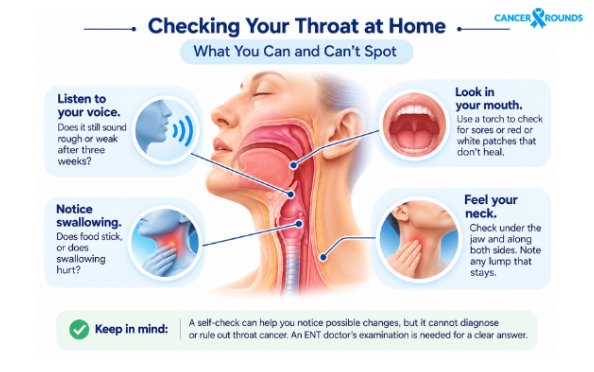
You can’t diagnose throat cancer at home, but you can catch changes early. Once a month, try this:
A mirror only shows the front of your mouth. Your deep throat and voice box are out of sight, so doctors use a thin camera called an endoscope to see them. A clear home check never rules cancer out.
Often, early throat cancer looks like nothing at all. The visible signs are a firm lump on one side of the neck, or in the mouth, a sore or a red or white patch that won’t heal.
Mouth ulcers and patches have many harmless causes, so a photo online can’t tell you much. A doctor has to see it in person.
No. The first signs depend on where the tumour starts, as the table above shows, not on gender. Please don’t dismiss a lasting hoarse voice or neck lump because you think throat cancer is a man’s disease. A symptom that stays deserves a check at any age.
Symptoms raise a question. Tests answer it. Here’s what usually happens:
Blood tests can’t diagnose throat cancer. They’re used to check your general health before treatment.
Many early-stage throat cancers can be treated successfully. Outcomes depend on where the cancer starts, how far it has spread, HPV status and your general health. Treatment usually involves surgery, radiation, chemotherapy, or a mix, with immunotherapy for some advanced cases.
Survival numbers. Survival figures are averages, not predictions. For laryngeal cancer diagnosed between 2015 and 2021, US registry data show a 5-year relative survival of 80% when the cancer is localised, 50% when it has reached nearby tissue or nodes, and 36% when it has spread. For hypopharyngeal cancer, the overall figure is 35% across all stages.
Those numbers cover the larynx and hypopharynx only. Oropharyngeal cancers are staged differently depending on HPV status, so their outlook differs.
Treatment options. Surgery removes the tumour and sometimes nearby lymph nodes. Radiation therapy aims high-energy beams at the tumour. Image-guided methods help protect healthy tissue, which matters for speech and swallowing.
Chemotherapy is often given alongside radiation. Two immunotherapy drugs are approved for recurrent or metastatic head and neck cancer. You can read how immunotherapy is changing cancer treatment on our blog.
Three things to take with you. There’s no single first sign, because it depends on where the tumour starts. Most throat symptoms aren’t cancer, but anything lasting three weeks needs an ENT check. And only a biopsy can confirm a diagnosis, not a photo, a self-check or a search result.
If you’re worried, don’t wait and watch. If a doctor has found something suspicious, or you want a second opinion, book a consultation with Cancer Rounds. Share your reports and our team will reply within 4 hours, with a free expert review and a personalised treatment plan.
Not ready yet? Ask about costs, request a callback or start a WhatsApp chat. You can also talk to a head and neck specialist directly. Acting on a small symptom is never an overreaction, and early answers give you more choices.
There’s no single first sign for everyone. It depends on where the tumour starts: hoarseness is common with vocal cord cancer, while a neck lump, ear pain or painful swallowing are common with cancer at the back of the throat. Any symptom that lasts three weeks should be checked.
It can, but a sore throat alone rarely means cancer. Most sore throats come from infections or irritation. A sore throat that lasts more than two to three weeks, gets worse, or comes with a voice change or neck lump should be seen by an ENT doctor.
They’re the same as in men. The first signs depend on where the tumour starts, such as hoarseness for the vocal cords or a neck lump for the back of the throat. Any lasting symptom deserves a check, whatever your gender.
Many early-stage throat cancers can be treated successfully. For laryngeal cancer, 5-year relative survival is 80% when the cancer is localised (2015 to 2021 data). Outcomes still vary by site, stage, HPV status and general health.
There’s no single figure, because each site differs. For people diagnosed with laryngeal cancer between 2015 and 2021, 5-year relative survival was 57% across all stages and 35% for hypopharyngeal cancer. Ask your doctor how these averages apply to you.
Doctors examine your mouth, throat and neck, look inside with an endoscope, and take a tissue sample. A biopsy is the only way to confirm cancer. Scans show how far it has spread, and a blood test alone can’t diagnose it.
Yes. Many patients travel for a second opinion or treatment, and it helps to plan funding and follow-up care before you go. Cancer Rounds connects you with accredited partner hospitals and a case manager, and helps with visas, travel and interpreters. Costs depend on the cancer site, stage and treatment type; see our cost guide for details.
.webp)
Get expert guidance instantly
Tell us about your condition and we will help you find the right care.

January 28, 2022
Get expert guidance instantly
Share a few details and our medical team gets back to you within 4 hours with the next steps.

Tell us what you are facing and our medical team will guide you to the right doctors, hospitals and treatment.
Free Review, No Commitment
Free assessment with no pressure to proceed.
Trusted by 100,000+ Patients
Across 125+ countries worldwide
500+ Top Partner Hospitals
Globally accredited medical facilities
5000+ Expert Specialists
Senior doctors across major specialties.
Making quality healthcare accessible to patients worldwide
Everything you need to know about choosing the right hospital, doctor and treatment plan.