
Confused about treatment options?
Get a free second opinion from our oncologists
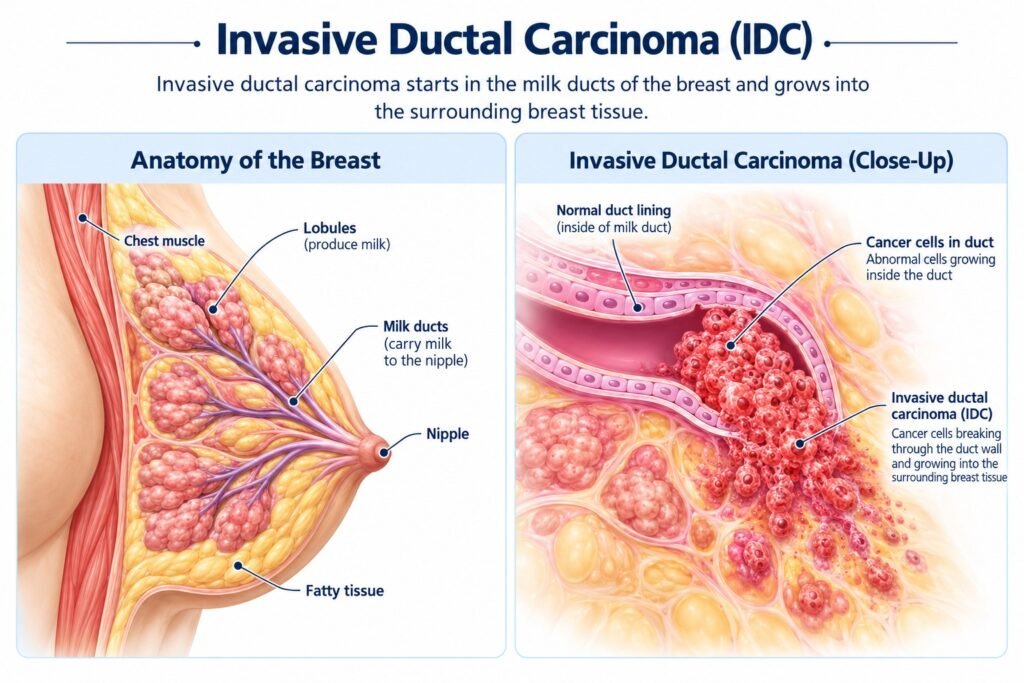
Invasive ductal carcinoma (IDC) is a type of breast cancer that begins in the cells lining a milk duct and grows beyond the duct into the surrounding breast tissue.
IDC is the most common type of invasive breast cancer, accounting for about 70% to 80% of invasive breast cancer diagnoses.
The word “invasive” can sound alarming, but it does not automatically mean that the cancer has spread to distant organs or that it is stage 4. In this context, invasive means that cancer cells have moved beyond the milk duct where they began and entered nearby breast tissue.
From there, the cancer may remain localized, spread to nearby lymph nodes, or, in some cases, travel to distant parts of the body.
The breast contains a network of milk ducts and lobules. The ducts carry milk toward the nipple, while the lobules are the glands that produce milk.
IDC starts in the cells lining a milk duct. As abnormal cells multiply, they can break through the duct wall and invade nearby breast tissue. This distinguishes invasive ductal carcinoma from ductal carcinoma in situ (DCIS), in which abnormal cells remain confined within the duct.
Once cancer becomes invasive, doctors need to determine how large the tumor is, whether nearby lymph nodes are involved, and whether there is evidence of spread elsewhere. These findings help establish the cancer’s stage and guide treatment planning.
Both conditions begin in the milk ducts, but there is an important difference:
| Condition | What it means |
| Ductal carcinoma in situ (DCIS) | Abnormal cancer cells remain inside the milk duct and have not invaded surrounding breast tissue. |
| IDC / carcinoma NST | Cancer cells have broken through the duct and invaded the surrounding breast tissue. |
Importantly, invasive does not mean metastatic. Metastatic breast cancer refers to disease that has spread to distant organs or tissues and is classified as stage 4.
An IDC pathology report may also include information about tumor grade, estrogen receptor (ER), progesterone receptor (PR), and HER2 status. These characteristics provide information that staging alone cannot.
Knowing that a breast tumor is invasive is only the beginning. Doctors need to determine whether the cancer is limited to the breast, has reached nearby lymph nodes, or has spread to another part of the body.
This process is called staging. For someone diagnosed with IDC, the stage is based on several findings rather than one test. The results help the care team understand the cancer and choose an appropriate treatment approach.
The tests needed can differ from one person to another. Your doctor may use a combination of:
Staging tests do not all answer the same question. Some assess the size and location of the primary tumor, while others look for cancer beyond the breast and nearby lymph nodes.
Doctors also consider information from the pathology report, including tumor grade and hormone receptor and HER2 status. These characteristics are different from stage but can significantly influence treatment decisions.
A major part of breast cancer staging is the TNM system, which considers three features:
These findings are combined to determine an overall stage, generally ranging from stage 0 to stage 4.
For invasive breast cancer, stages 1 through 3 describe different degrees of disease within the breast and nearby tissues or lymph nodes. Stage 4 indicates distant metastatic disease.
However, TNM is not the only information doctors consider. Breast cancer staging and treatment decisions can also take tumor grade and biological characteristics such as ER, PR, and HER2 status into account.
This is why two people with a similar tumor size or even the same broad stage may receive different treatments.
For invasive ductal carcinoma, stages generally range from 1 to 4. Stage 0 usually refers to ductal carcinoma in situ (DCIS), where abnormal cells remain within the milk ducts and have not invaded surrounding tissue.
For invasive disease, staging considers factors such as tumor size, lymph-node involvement, and whether the cancer has spread to distant parts of the body.
Stage 1 is generally considered early-stage breast cancer.
Stage 2 includes a broader range of tumor sizes and lymph-node involvement.
Stage 3 is considered locally advanced breast cancer.
Stage 4 means the cancer has spread to distant parts of the body and is also called metastatic breast cancer.
Common sites can include:
Treatment focuses on controlling the cancer, slowing its progression, managing symptoms, and maintaining quality of life. Depending on the tumor’s biology and previous treatments, options may include hormone therapy, targeted therapy, chemotherapy, immunotherapy, and radiation.
Important: Stage tells doctors how far the cancer has spread, but it does not tell the entire story. Tumor grade, ER/PR status, HER2 status, and other biological features can significantly influence treatment and outlook.
Two people can both be diagnosed with stage 2 disease but receive different treatment plans.
For example, one tumor may be hormone receptor-positive and HER2-negative, while another may be HER2-positive or have a different biological profile. Age, overall health, menopausal status, tumor grade, lymph-node findings, and additional testing can also affect treatment decisions.
In simple terms, stage provides a map of where the cancer is, while tumor biology helps explain what the cancer is like.
Treatment for invasive ductal carcinoma depends on more than the cancer’s stage. Doctors consider the tumor’s size, lymph-node involvement, grade, ER/PR and HER2 status, overall health, and whether the cancer has spread.
Depending on these factors, treatment may involve surgery, radiation, chemotherapy, hormone therapy, targeted treatment, immunotherapy, or a combination of approaches.
Surgery is often part of treatment for early-stage disease. The main options include:
The choice of surgery depends on factors such as tumor size and location, the number of affected areas, genetic factors, and patient preference.
Radiation uses high-energy beams to destroy cancer cells that may remain after surgery.
It is commonly recommended after breast-conserving surgery and may also be advised after mastectomy for some patients, particularly when certain high-risk features are present.
Modern radiation techniques can help deliver treatment accurately while limiting exposure to nearby healthy tissue.
Chemotherapy uses medicines that travel throughout the body to destroy or control cancer cells. It may be given:
Not everyone with IDC needs chemotherapy. Decisions depend on factors such as stage, tumor biology, grade, lymph-node involvement, and sometimes genomic test results.
If a tumor has estrogen or progesterone receptors, hormone therapy may be used to reduce the cancer’s ability to grow in response to these hormones.
Depending on the patient’s situation, treatment may include:
Treatment decisions can depend on menopausal status, cancer characteristics, and previous treatment.
Some breast cancers have high levels of the HER2 protein, which can promote cancer growth. These are known as HER2-positive breast cancers.
HER2-targeted medicines may include:
The specific treatment depends on the stage, whether treatment is being given before or after surgery, and whether the cancer has responded to previous therapy.
For selected patients, newer systemic treatments may also be considered, including:
These treatments are not appropriate for every person with IDC. Eligibility depends on the cancer subtype, biomarkers, stage, and previous treatments.
For some patients, particularly those with certain hormone receptor-positive, HER2-negative cancers, genomic tests can provide additional information about recurrence risk and the potential benefit of chemotherapy.
These tests:
Ultimately, an IDC treatment plan brings all of these factors together. The same stage does not necessarily mean the same treatment, because the biology of each tumor can differ.
Finishing treatment can bring relief, but it can also raise new questions: Could the cancer come back? How often are check-ups needed? What symptoms should you watch for?
Follow-up care is an important part of recovery. It helps the care team monitor for recurrence, manage treatment effects, and support long-term health.
Yes, breast cancer can recur after treatment, but recurrence does not happen to everyone.
It can occur in different ways:
The risk varies from person to person and depends on factors such as the original stage, tumor size, lymph-node involvement, grade, hormone receptor and HER2 status, and response to treatment.
After completing treatment, follow-up care may include:
Routine follow-up does not usually mean having every possible scan or blood test. The type and frequency of monitoring are tailored to the individual.
Prognosis refers to the expected course of the disease. It is influenced by several factors rather than the cancer’s name alone.
Important factors include:
The American Cancer Society reports 5-year relative survival rates using SEER data for women diagnosed with breast cancer in the United States from 2015–2021:
| SEER stage at diagnosis | 5-year relative survival |
| Localized — cancer has not spread outside the breast | >99% |
| Regional — cancer has spread to nearby structures or lymph nodes | 87% |
| Distant — cancer has spread to distant parts of the body | 33% |
| All SEER stages combined | 91% |
Source: American Cancer Society, Breast Cancer Survival Rates, based on data from the National Cancer Institute’s SEER Program.
These figures describe outcomes across groups of patients and cannot predict an individual person’s prognosis.
An invasive ductal carcinoma diagnosis can leave you with many questions, especially when a pathology report contains unfamiliar terms. Here are some common questions about IDC stages, treatment, prognosis, and biomarkers.
Many early-stage cases of invasive ductal carcinoma can be treated with curative intent. Treatment may involve surgery, radiation therapy, chemotherapy, hormone therapy, targeted therapy, or a combination, depending on the cancer’s characteristics.
For stage 4 IDC, treatment generally focuses on controlling the cancer, slowing its progression, managing symptoms, and maintaining quality of life. Individual outcomes vary considerably.
Not necessarily. IDC describes the type of breast cancer, not how aggressive it is.
Its behavior can depend on:
This is why two people diagnosed with invasive ductal carcinoma may have very different treatment plans and outlooks.
There is no single survival rate that applies to every person with IDC. Survival can vary according to:
Population-level statistics, such as those reported by the American Cancer Society using SEER data, can help explain general outcomes. However, they cannot predict what will happen to an individual patient.
No. Chemotherapy is not automatically required for everyone with invasive ductal carcinoma.
Doctors consider factors such as:
For some patients, the expected benefit from chemotherapy may be relatively small, while others may benefit significantly from it.
Yes. IDC can spread from the breast to nearby regional lymph nodes, particularly those in the armpit, known as axillary lymph nodes.
Doctors may evaluate lymph nodes through imaging, needle biopsy, or a sentinel lymph node biopsy. Finding cancer in nearby nodes does not automatically mean the cancer is stage 4; distant spread is what defines metastatic or stage 4 breast cancer.
These terms describe biological characteristics of the tumor and can help guide treatment.
Get expert guidance instantly
Tell us about your condition and we will help you find the right care.
Get expert guidance instantly
Share a few details and our medical team gets back to you within 4 hours with the next steps.

Tell us what you are facing and our medical team will guide you to the right doctors, hospitals and treatment.
Free Review, No Commitment
Free assessment with no pressure to proceed.
Trusted by 100,000+ Patients
Across 125+ countries worldwide
500+ Top Partner Hospitals
Globally accredited medical facilities
5000+ Expert Specialists
Senior doctors across major specialties.
Making quality healthcare accessible to patients worldwide
Everything you need to know about choosing the right hospital, doctor and treatment plan.
.webp)