
Bladder cancer stage 4 stands as the most formidable and advanced form of this malignancy, defined by the relentless spread of cancer cells beyond the bladder’s confines into distant lymph nodes, the liver, lungs, and in some cases, the bones. As one of the most prevalent cancers worldwide, bladder cancer accounts for an estimated 573,000 new diagnoses annually and tragically claims over 200,000 lives each year.
At this metastatic stage, treatment becomes a complex battle and the prognosis considerably more guarded. One of the most pressing questions asked by patients and caregivers is, “Is stage 4 bladder cancer curable?” While a definitive cure remains rare, cutting-edge oncology has brought hope—significantly improving the stage 4 bladder cancer survival rate and enhancing quality of life.
According to the American Cancer Society, the 5-year survival rate for stage 4 bladder cancer hovers around 5–10%, influenced heavily by treatment responsiveness and the patient’s overall health. Without intervention, the stage 4 bladder cancer life expectancy without treatment may shrink to just a few months. However, the stage 4 bladder cancer 1 year survival rate varies considerably worldwide—elite cancer centers in regions such as Germany, the USA, and India report survival rates between 25–40%, far surpassing the global average.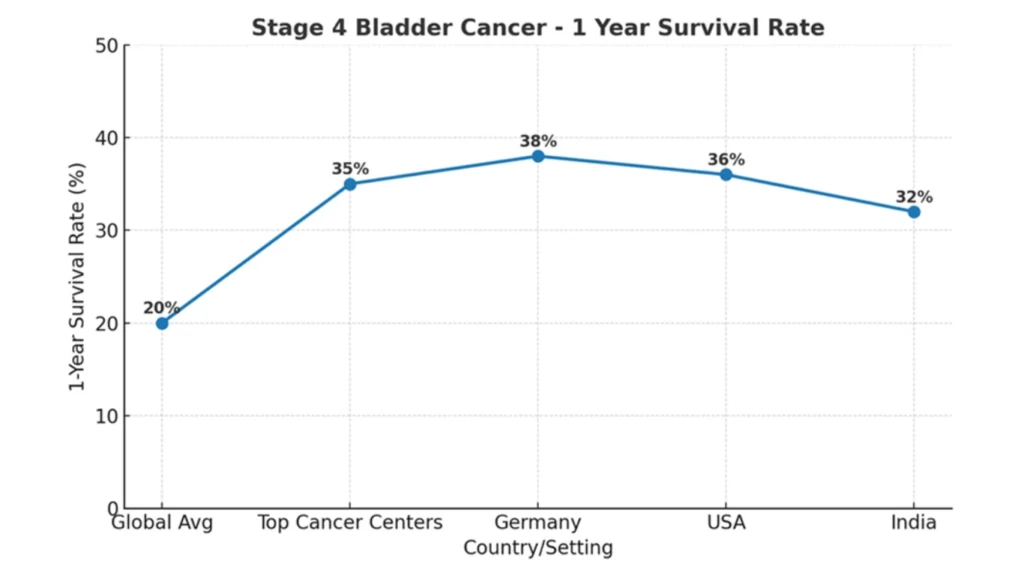
Confused about treatment options?
Get a free second opinion from our oncologists
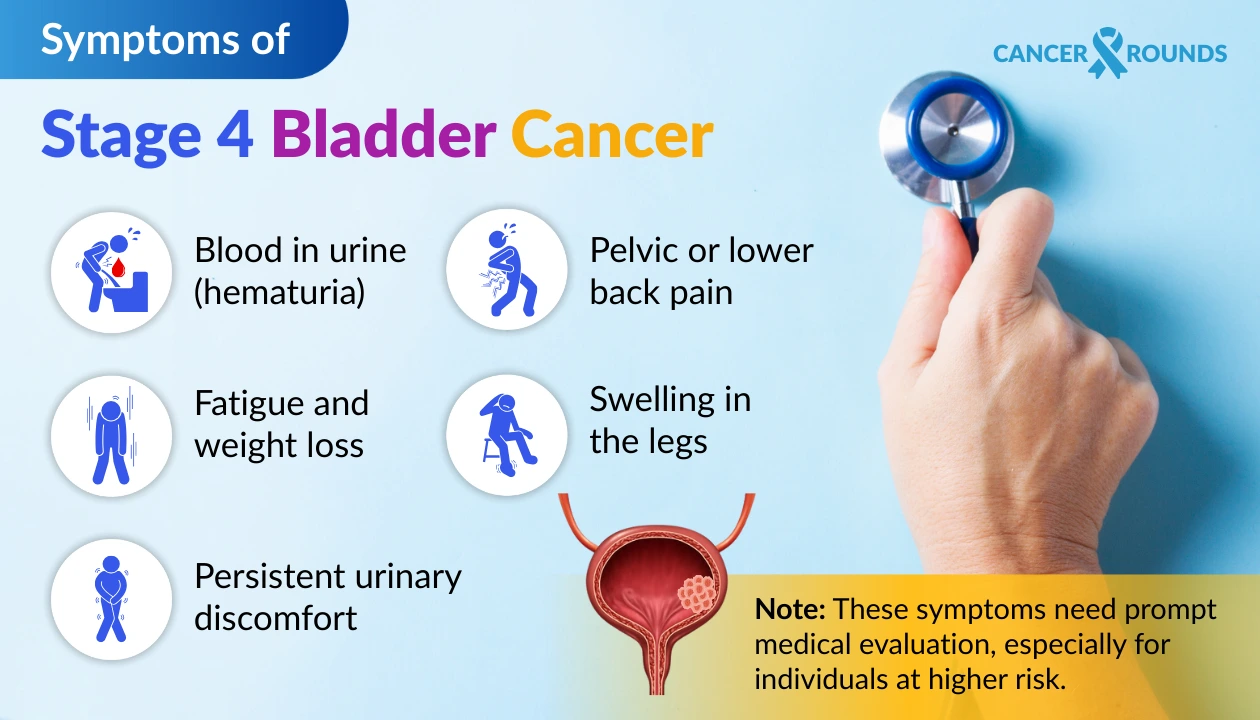
Identifying stage 4 bladder cancer symptoms promptly can be lifesaving, as early intervention in advanced disease helps guide treatment strategies and may improve the stage 4 bladder cancer survival rate. Below are the hallmark signs, their corresponding diagnostic approaches, and initial management considerations.
1. Blood in Urine (Hematuria)
2. Pelvic or Lower Back Pain
3. Fatigue and Unexplained Weight Loss
4. Swelling in the Legs (Edema)
5. Persistent Urinary Discomfort
Each stage 4 bladder cancer symptom is a diagnostic clue pointing toward the extent and severity of disease. Linking symptom evaluation with advanced imaging, lab studies, and pathology not only confirms the diagnosis but also informs a precise treatment plan—whether the goal is tumor control, symptom relief, or both.
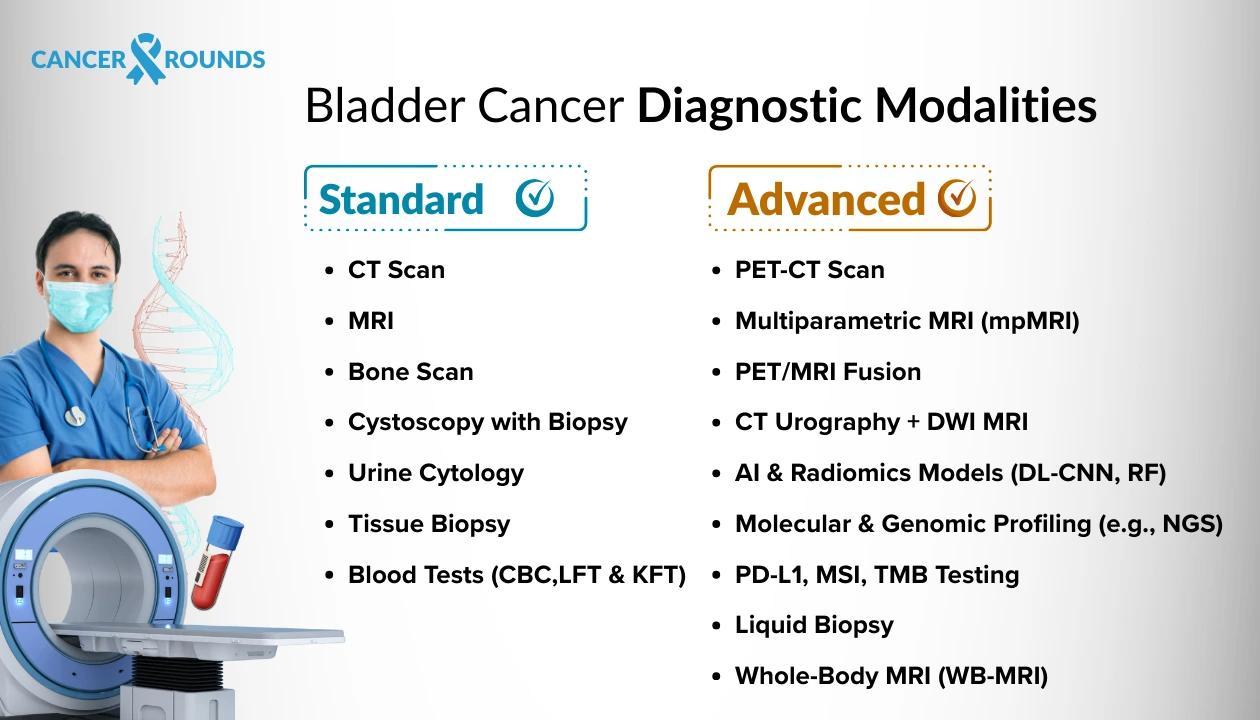
In the rapidly evolving world of oncology, diagnosing stage 4 bladder cancer has become both more exact and more informative. These breakthroughs not only sharpen detection but empower tailored strategies that can significantly improve the stage 4 bladder cancer survival rate and overall patient outcomes.
Cutting-Edge Diagnostic Innovations
These advances redefine what’s possible in diagnosing stage 4 bladder cancer—making staging more precise, prognostic evaluation sharper, and treatment strategies smarter. Together, they pave the way for more personalized, effective care in even the most challenging cases.
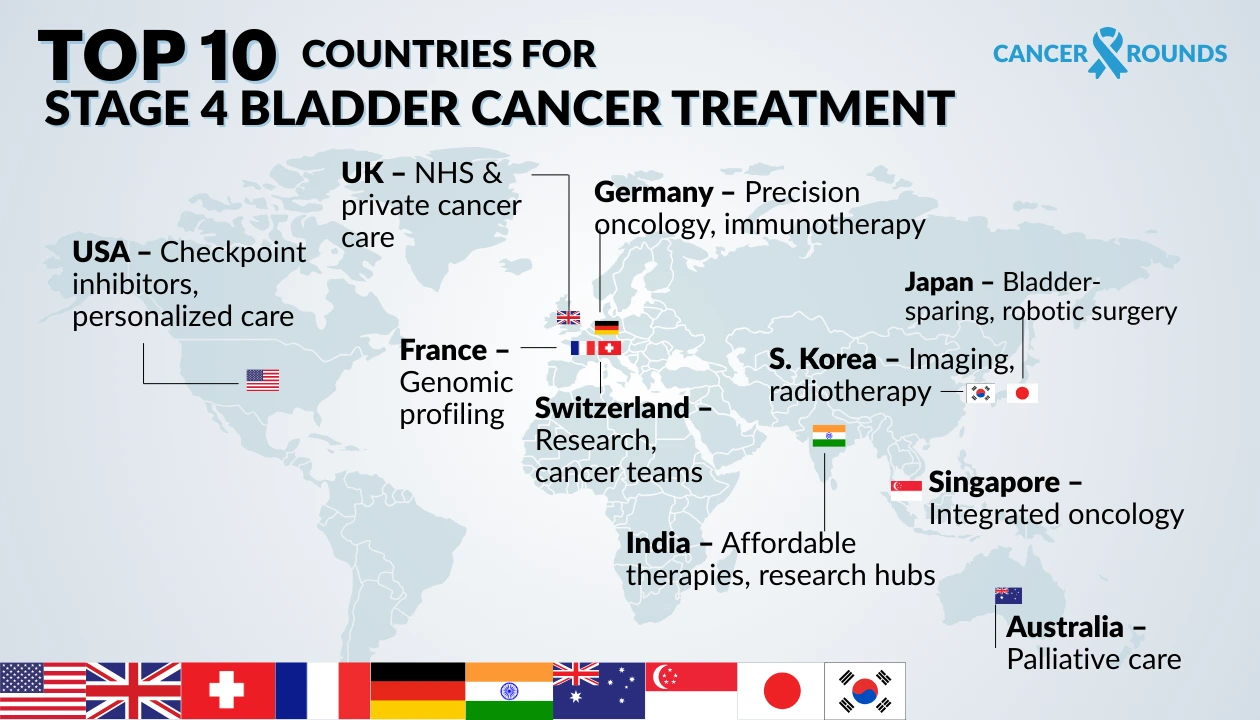
Amid the intricate realm of oncologic care, a select cadre of nations stands at the forefront of stage 4 bladder cancer management, weaving together cutting-edge diagnostics, avant-garde therapeutics, and multidisciplinary expertise. These global leaders, revered for their relentless pursuit of innovation and uncompromising clinical precision, have transformed the prognosis landscape — offering patients not merely extended survival, but the promise of tailored, dignified, and hope-infused treatment journeys
While treatment quality varies worldwide, some countries are recognized as leaders in managing stage 4 bladder cancer.
Top 10 Countries for Advanced Care:
| Country | Famous Hospitals/ Centres | Cost (Advanced Care — Approximate) | 1-Year Survival (Stage 4, Approximate) | Local Tumour-Control (Ablative / ECT / TACE) |
| Germany | Charité – Universitätsmedizin Berlin; University Hospital Heidelberg / NCT Heidelberg | €8,000–€40,000+ (includes diagnostic workup, immunotherapy cycles, interventional procedures; TURBT approx. €8–12k, other therapies variable) | ~30–45% with modern systemic ± local therapy; some series report ~43% | ~70–80% in selected ablation/ECT cases for liver/pelvic metastases |
| India | Tata Memorial Centre (Mumbai), Apollo Hospitals, AIIMS | US$5,000–$25,000 (more affordable; immunotherapy available at reduced cycle costs) | ~25–40%, with outcomes improving due to greater immunotherapy and trial access | ~60–75% in select interventional/ablative cases; expanding rapidly |
| United States | MD Anderson, Memorial Sloan Kettering, Dana-Farber, Mayo Clinic | US$50,000–$250,000+ / year (immunotherapy drug costs often exceed $100k/year; total costs vary widely) | ~35–55% in treated cohorts; improvements seen with chemo/immunotherapy over recent years | ~60–80% for appropriate ablative/local techniques in selected metastases |
| United Kingdom | The Royal Marsden, Christie Hospital, Addenbrooke’s | £15,000–£100,000+ (NHS covers many costs for UK residents; private access varies) | ~30–50%, depending on access to treatments and trials | ~60–75% in multimodal bladder-preservation/local control studies |
| Japan | National Cancer Center Tokyo; major university hospitals with uro-oncology programs | ¥1,000,000–¥5,000,000+ (cost varies with systemic and procedural care) | ~30–50%, dependent on timing of detection and therapy | ~60–80% in selected ablation/CRT approaches |
| South Korea | Asan Medical Center, Samsung Medical Center | USD $15,000–$80,000+ (medical tourism packages for high-tech oncology care) | ~30–50%, outcomes comparable to other high-income countries | ~65–80% for targeted ablations/interventional approaches |
| Switzerland | University Hospital Zurich, Lausanne University Hospital (CHUV) | CHF 20,000–100,000+ (reflects advanced immunotherapy/targeted therapy costs) | ~35–50% in specialised centres | ~70–80% in experienced interventional oncology units |
| Singapore | National Cancer Centre Singapore (NCCS), Singapore General Hospital | US$15,000–$80,000+ (integrated oncology services; cost varies by package) | ~30–50% with multimodal care and trial participation | ~60–80% in selected ablative/interventional protocols |
| Australia | Peter MacCallum Cancer Centre, Royal Melbourne Hospital, Royal Prince Alfred Hospital | AUD $20,000–$120,000+ (cost varies between public and private care) | ~30–50%; strong emphasis on palliative and supportive care | ~60–75% in bladder-preserving radiotherapy/ablative series |
| France | Gustave Roussy, Institut Curie | €15,000–€90,000+ (includes genomic profiling, targeted therapy access) | ~30–50% with access to advanced drugs and trials | ~65–80% in high-expertise centres |
Germany, in particular, offers hope to patients asking, “Is bladder cancer curable at stage 4?” While cure remains rare, German oncology centers such as Charité – Universitätsmedizin Berlin and University Hospital Heidelberg specialize in advanced diagnostic imaging, precision-targeted treatments, and personalized therapy protocols.
For stage 4 bladder cancer, treatment focuses on controlling tumor growth, easing symptoms, and extending life.
While these treatments can improve the stage 4 bladder cancer survival rate, they often come with side effects and limited long-term control.
Advancements in oncology have brought promising alternatives:
Immunotherapy
In the sophisticated arsenal against stage 4 bladder cancer, immunotherapy emerges as a beacon of modern medicine—designed to awaken and fortify the body’s intrinsic defenses. By harnessing checkpoint inhibitors and precision biologics, it empowers immune cells to recognize and attack malignant tissues that once evaded detection. For metastatic cases, immunotherapy has shifted the narrative from purely palliative to potentially life-extending, offering select patients durable responses where conventional chemotherapy falters.
Dendritic Cell Therapy
Dendritic cell therapy represents a frontier in personalized oncology for stage 4 bladder cancer. By cultivating a patient’s own dendritic cells—nature’s master sentinels of the immune system—and priming them with tumor-specific antigens, physicians can orchestrate a bespoke immune response. This “cellular vaccination” educates the immune army to identify and relentlessly pursue bladder cancer cells, even those lurking in distant metastatic strongholds such as the liver or lungs.
Interventional Radiology – Precision Over Invasion
Interventional radiology offers a refined suite of minimally invasive procedures, granting stage 4 bladder cancer patients the benefits of local tumor control without the systemic toll of traditional therapies. Guided by advanced imaging, these procedures can precisely target primary and metastatic sites, preserving organ integrity and enhancing quality of life.
Transarterial Chemoembolization (TACE)
TACE epitomizes targeted oncology in stage 4 bladder cancer care. By threading a catheter directly into the arteries feeding a tumor, clinicians can deliver concentrated chemotherapy while simultaneously obstructing the tumor’s blood supply, starving it of nutrients and oxygen. Clinical reports indicate tumor response rates of up to 60%, with markedly extended survival when paired with immunotherapy or radiation. Its localized delivery minimizes systemic toxicity, making TACE especially suitable for patients unable to withstand high-dose systemic regimens.
At Cancer Rounds, we understand that a diagnosis of Stage 4 bladder cancer is not just a medical challenge, but an emotional and life-changing journey. Our mission is to be your medical facilitation partner in creating a care pathway that blends medical excellence with compassion, ensuring efficient local tumor control and an increased survival window while preserving your quality of life.
We help you make informed, confident decisions at every step by:
For patients facing stage 4 bladder cancer, the journey is undeniably challenging. However, the stage 4 bladder cancer life expectancy is not fixed—advances in Germany and other top countries, including India, are improving both survival and quality of life.
While statistics such as the stage 4 bladder cancer 1 year survival rate and stage 4 bladder cancer life expectancy without treatment can sound discouraging, real-world patient stories show that innovative therapies, multidisciplinary care, and access to global expertise can make a meaningful difference.
.webp)
Get expert guidance instantly
Tell us about your condition and we will help you find the right care.

March 16, 2023
Get expert guidance instantly
Share a few details and our medical team gets back to you within 4 hours with the next steps.

Tell us what you are facing and our medical team will guide you to the right doctors, hospitals and treatment.
Free Review, No Commitment
Free assessment with no pressure to proceed.
Trusted by 100,000+ Patients
Across 125+ countries worldwide
500+ Top Partner Hospitals
Globally accredited medical facilities
5000+ Expert Specialists
Senior doctors across major specialties.
Making quality healthcare accessible to patients worldwide
Everything you need to know about choosing the right hospital, doctor and treatment plan.