
Hearing that your liver tumour can’t be removed with surgery is hard news. The next question is usually, “Is there anything else that can reach the tumour without harming the rest of my liver?”
Y-90 radioembolization is one answer. It places tiny radioactive beads inside the blood vessels that feed a liver tumour, so the radiation works from the inside. Doctors in Germany use it for primary liver cancer and for cancers that have spread to the liver. You can read our wider guide to liver cancer treatment in Germany for the full range of options.
At Cancer Rounds, we hear from patients abroad who want a clear picture before they travel. This guide explains how the treatment works, who it suits, what the evidence says and what recovery looks like. It also covers the practical side of having it in Germany as an international patient.
We’ll be honest about what Y-90 can and can’t do. The right choice depends on your tumour and on how well your liver is working.
Confused about treatment options?
Get a free second opinion from our oncologists
Y-90 radioembolization injects tiny beads filled with radioactive yttrium-90 into the artery that feeds a liver tumour. The beads deliver a high dose of radiation to the cancer cells. Most of the healthy liver relies on a different blood supply, so it takes less of the hit.
Your liver has two blood supplies: the hepatic artery and the portal vein. Liver tumours tend to depend on the hepatic artery. That’s why an interventional radiologist places the beads in the vessels feeding the tumour, which is what makes the treatment “selective”.
Two types of beads are in use, made of glass or resin. Outcomes with the two are comparable, so the choice usually comes down to your tumour, your liver and the dose your team plans.
Y-90 isn’t chemotherapy, and it isn’t external radiotherapy. The radiation comes from inside the tumour’s own blood vessels. European interventional radiologists describe it as mainly a palliative treatment that eases symptoms rather than cures. In some patients, though, it shrinks tumours enough to allow surgery or a liver transplant.
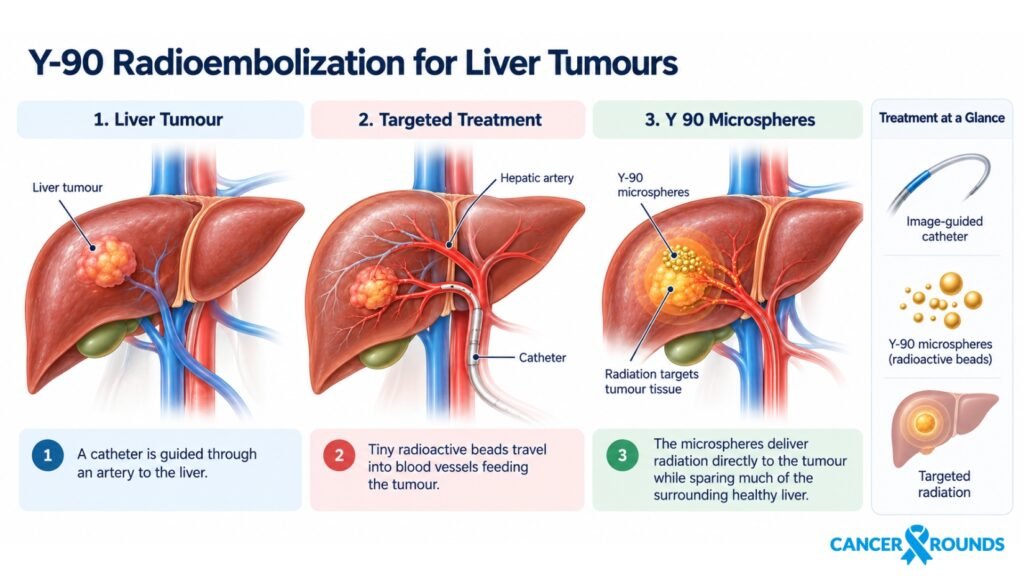
Y-90 radioembolization is usually offered when cancer is mostly in the liver and can’t be treated with surgery or ablation, or when drug treatment has stopped working. You also need liver function that can cope with radiation. A specialist team checks this before booking you in. European registry data describe the treatment the same way.
The treatment is used for several cancer types. A large European registry included people with hepatocellular carcinoma (HCC, the most common liver cancer), bile duct cancer inside the liver, colorectal cancer that had spread to the liver, and spread from other cancers. If you’d like a refresher, our guide to the types of liver cancer explains each one.
Doctors look at tumour size, the number of tumours and how well your liver works. This matters because results differ between groups. The largest European randomised trial, SARAH, found no overall survival benefit compared with a standard drug. A later look at one subgroup, people with a small tumour burden and good liver function, suggested more benefit, with median survival of 21.9 against 17.0 months. The authors said this needs more testing.
Some people can’t have the treatment. A planning scan measures how much of the beads would travel to the lungs. Treatment is generally avoided if that share is above 20%.
Here’s what the process usually looks like at a German hospital. Timing varies by centre, so your case manager will confirm yours.
Two studies give the clearest picture for HCC.
The LEGACY study followed 162 people with a single tumour up to 8 cm that couldn’t be removed. About 72% had a tumour response, and 76% of responders kept that response for at least six months. Liver function held steady in most patients. It had no comparison group, so treat the numbers as encouraging rather than final.
DOSISPHERE-01 asked whether dose planning matters. French researchers randomly assigned 60 people with large tumours to a standard dose or a personalised dose aimed at the tumour. Response was 71% with personalised dosing against 36% with the standard dose. Median survival was 22.9 against 10.8 months. It was a small phase 2 trial, but an international expert group now stresses personalised dosimetry.
Y-90 can also act as a bridge to other treatment. Ask your team whether shrinking the tumour for surgery or transplant is a realistic goal in your case. For most people with advanced disease, the aim is to control the tumour and ease symptoms rather than cure it.
Most people get some tiredness, nausea, low fever or belly discomfort after Y-90 radioembolization. Doctors call this post-radioembolization syndrome, and it’s treated with supportive care. Serious problems, such as liver injury or stomach ulcers, are uncommon.
About half of patients get post-radioembolization syndrome, and a study of 112 patients put the figure at 70%. Symptoms include fatigue, belly pain, nausea, vomiting, poor appetite and fever. They typically appear within 24 to 72 hours.
Serious complications are rare. In the European CIRT registry, grade 3 or higher stomach ulcers affected 0.4% of patients, gastritis 0.3%, gallbladder inflammation 0.2% and radioembolization-induced liver disease 0.5%. In the 112-patient study, late grade 3 or 4 complications reached 8% at 12 months.
That’s why planning scans matter. They show where beads might stray, which protects your lungs, stomach and bowel. Call your care team if you notice yellowing of the skin or eyes, a high fever that won’t settle, or pain that keeps getting worse.
Y-90 radioembolization often keeps tumours from growing for longer than chemoembolization (TACE), but overall survival has been similar in trials. So the choice depends on your tumour size, liver function and goals.
In the PREMIERE trial, time to progression was over 26 months with Y-90 against 6.8 months with TACE. Median survival was similar, at 18.6 against 17.7 months. It was a single-centre study of only 45 people. A pooled analysis of 10 studies and 1,557 patients agreed: similar survival and safety, with progression delayed after Y-90.
Y-90 also tends to be gentler in the short term. A Korean review found fewer post-embolization symptoms and shorter hospital stays than with TACE. If you’d like to compare, read about TACE in Germany.
Drug-based options matter too. Your team may suggest immunotherapy for advanced disease. Trials are now testing immunotherapy given after Y-90, so ask whether a combined plan could suit you.
Cost depends on your case. Our treatment cost pages are a good starting point, and for Germany we currently estimate about $15,000 to $30,000 for interventional procedures such as TACE or SIRT. Treat that as a guide. The final figure depends on the number of sessions, imaging, the hospital stay, and the dose and type of beads.
Insurance is a separate question. One German university hospital notes that statutory insurers cover SIRT only under special contracts. It asks patients without German insurance to get in touch in advance to see whether a foreign insurer might pay.
Germany isn’t new to this treatment. A German health-economics abstract estimated about 500 procedures a year, roughly a quarter of eligible HCC patients.
Cancer Rounds takes care of the practical side. You send your reports, and our medical team replies within 4 hours with a free review. You’ll get a treatment plan and quote within about two days. A dedicated case manager arranges interpreter support, visa and travel help, and a plan for sharing your results with your home doctor. We can match you with partner cancer hospitals in Germany that treat liver cancer and can confirm whether Y-90 is available for you.
Y-90 radioembolization gives people with inoperable liver tumours a targeted option. It works best when the tumour and your liver are well matched to the treatment. Planning and dose choice make a real difference. Side effects are common, but serious ones are uncommon.
If you’re weighing this treatment, you don’t have to work it out alone. Send us your scans and reports, and we’ll arrange a review with a specialist. Talk to a Liver Cancer Specialist or Get a Personalised Treatment Plan today. If you’re not ready yet, start a WhatsApp chat, request a callback or ask about costs. We’ll go at your pace.
Planning and treatment are separate angiograms, so you’ll have at least two procedures. In Germany, one university hospital says a 48-hour stay in a radiation-safe ward is required. Your case manager will give you a schedule for your chosen hospital.
In the LEGACY study, about 72% of people had a tumour response. In DOSISPHERE-01, personalised dosing raised response to 71% from 36%. Remember that Y-90 is generally used to ease symptoms rather than cure, so results depend on your tumour and liver.
Around 70% of patients in one study had post-radioembolization syndrome, which includes fatigue, nausea and fever. Serious problems are uncommon: radioembolization-induced liver disease affected 0.5% of patients in a European registry. Planning scans help lower the risk to the lungs and bowel.
We currently estimate about $15,000 to $30,000 for interventional procedures such as TACE or SIRT in Germany. The final price depends on the number of sessions, imaging, the hospital stay and the beads used. See our cost pages or ask us for a quote based on your reports.
Yes. Germany performs around 500 of these procedures a year. Coverage by German insurers is usually limited to special contracts, so overseas patients should ask about costs early. Cancer Rounds handles records, visas, travel and follow-up.
Sometimes. A small study of 21 patients found repeat treatment had an acceptable toxicity profile. Another retrospective analysis reported two deaths from liver injury after repeat whole-liver treatments. Your team will weigh your liver function carefully before suggesting it.
You’ll have blood tests, imaging, an angiogram and a nuclear scan to check for beads reaching the lungs or other organs. Afterwards, tiredness and nausea are common, and symptoms typically appear within 24 to 72 hours. Rest, fluids and the medicines your team recommends help while you recover.
.webp)
Get expert guidance instantly
Tell us about your condition and we will help you find the right care.
Get expert guidance instantly
Share a few details and our medical team gets back to you within 4 hours with the next steps.
Tell us what you are facing and our medical team will guide you to the right doctors, hospitals and treatment.
Free Review, No Commitment
Free assessment with no pressure to proceed.
Trusted by 100,000+ Patients
Across 125+ countries worldwide
500+ Top Partner Hospitals
Globally accredited medical facilities
5000+ Expert Specialists
Senior doctors across major specialties.
Making quality healthcare accessible to patients worldwide
Everything you need to know about choosing the right hospital, doctor and treatment plan.