
Brain aneurysm treatment in Germany covers clipping, coiling, flow diversion, and active monitoring, chosen by a team of specialists after detailed vascular imaging. The right option depends on the aneurysm's size, location, shape, and whether it has ruptured. Costs vary by procedure and hospital stay. A suspected rupture is an emergency and needs local care right away.
Reply in 4 hours · Plan and quote in 2 days · 100% confidential
Brain aneurysm treatment in Germany is a common search for people who’ve just read the word “aneurysm” on a scan report. Many aneurysms are found by chance, and about 3% of adults have one. Most never rupture. Still, the waiting and the not knowing are hard.
This guide explains your options in plain words: clipping, coiling, flow diversion, and careful monitoring. It also covers cost, how to judge a hospital, and how an international patient gets started.
One rule comes first. A sudden, severe headache or a collapse is an emergency. Get local emergency care right away, and don’t wait to arrange travel.
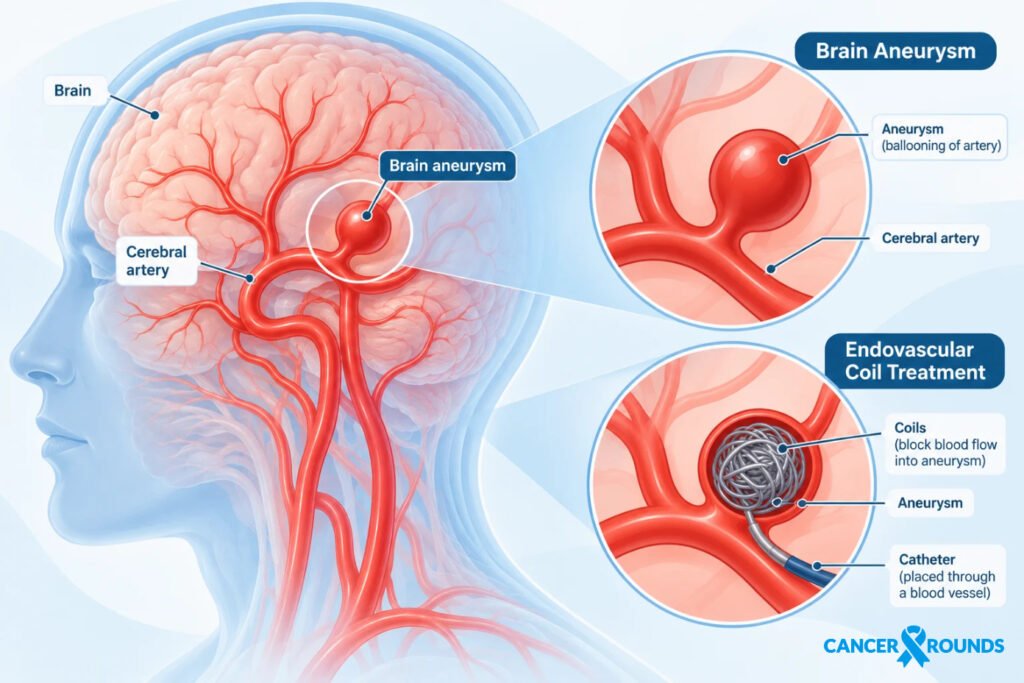
A brain aneurysm is a weak spot in an artery wall that bulges outward. Treatment is considered when the chance of rupture is higher than the risk of the procedure. Size, location, shape, and growth all matter, and so do your age and health.
Aneurysms fall into two groups. An unruptured aneurysm hasn’t bled. A ruptured one has, which causes bleeding around the brain (a subarachnoid haemorrhage). The NHS calls this a life-threatening emergency.
Most unruptured aneurysms stay quiet. Some grow, though, and growth is linked to a higher chance of rupture. The one-year rupture risk ranges from 2% to 10%, depending on size, site, and shape.
Doctors assess the risk of a brain aneurysm rupturing by considering its size, location, shape, growth, and the patient’s medical history, including high blood pressure and previous bleeding.
The main sign of a rupture is a sudden, extremely painful headache that doesn’t go away, often called a thunderclap headache. Neck stiffness, nausea and vomiting, sensitivity to light, seizures, and reduced consciousness.
If you or someone near you has these signs, call local emergency services now. Don’t plan overseas travel. The risk of rebleeding is highest in the first 24 hours.
At selected German university hospitals, neurosurgeons, interventional neuroradiologists, neurologists, and neurocritical care specialists work as one team. These centres can offer both open surgery and catheter-based treatment. Not every hospital offers every technique, so the centre matters more than the country.
Those are fair questions for any hospital, in any country.
What should you look for? European guidelines give a useful yardstick. The ESO suggests that aneurysms be assessed by a multidisciplinary team at centres that see more than 100 patients a year, and repaired only where each operator treats more than 30 aneurysm patients a year.
Complex shapes need extra care. Giant, wide-necked, or previously treated aneurysms are harder to close, and flow-diverting stents were designed for these difficult shapes.
Not every aneurysm needs immediate treatment. Doctors may monitor it with regular imaging, or close it off with a metal clip, platinum coils, or a flow-diverting stent. The choice depends on the aneurysm’s size, shape, and location, your age and health, and whether it has ruptured.
Your team weighs the risk of leaving the aneurysm alone against the risk of treatment. Here’s how the options compare.
| Option | How it works | Main trade-off |
| Clipping | A surgeon seals the aneurysm’s neck with a small clip | Open surgery and a longer recovery |
| Coiling | A catheter places coils inside the aneurysm | A higher chance of retreatment |
| Flow diversion | A mesh stent redirects blood flow away from the aneurysm | Needs antiplatelet medicine; closure is gradual |
| Monitoring | Scans on a set schedule | Needs steady follow-up |
In clipping, the surgeon removes a small piece of skull bone, places a tiny metal clip across the aneurysm, and then replaces the bone. Blood can no longer enter the aneurysm. It’s open surgery, so recovery takes longer than with coiling.
Clipping can suit aneurysms whose shape makes coiling hard. One large analysis found rerupture in 0.5% of clipped patients and 1.5% of coiled patients, and it was rare after the first year in both groups. You’ll still need scans afterwards.
Coiling is less invasive. A doctor guides a thin catheter through the blood vessels and places platinum coils inside the aneurysm, which stops blood from flowing in.
The largest trial to compare the two, ISAT, found that coiling lowered the absolute risk of death or dependency by 7% at one year. It also found that coiled aneurysms needed retreatment more often. By five years, the difference between the two groups was no longer significant once early deaths were excluded.
For ruptured aneurysms that suit both methods, the 2026 European guideline recommends coiling over clipping. Follow-up imaging is part of the plan, since some aneurysms need a second treatment. Our overview of endovascular treatment in Germany covers the procedure in more detail.
A flow diverter is a fine mesh stent placed in the main artery, across the aneurysm’s neck. It reduces blood flow into the aneurysm so it can close over time. In one study of middle cerebral artery aneurysms, closure rates rose from 43.8% at six months to 87.5% at five years.
These devices aren’t for every aneurysm. The ESO suggests flow diverters for unruptured aneurysms only when no other low-risk option exists. For ruptured aneurysms, the guideline makes no evidence-based recommendation for devices other than coils.
Flow diversion also needs antiplatelet medicine (blood thinners that stop clots forming on the stent). In the study above, every patient took dual antiplatelet therapy before the procedure.
Monitoring isn’t “doing nothing.” It’s an active plan. For aneurysms that aren’t treated, the ESO suggests regular imaging to catch growth, plus stopping smoking and treating high blood pressure. Both are standard advice to lower the chance of a bleed. If scans show growth, your team may recommend treatment.
Good treatment starts with good pictures. Specialists usually begin with a CT angiogram, which maps the blood vessels using contrast dye. If that isn’t clear enough, NICE advises a digital subtraction angiogram or an MR angiogram.
Selected centres also use 3D vascular imaging, surgical microscopes, and image-guided catheter systems. These tools help the team measure the aneurysm’s neck and pick the right device. Ask your hospital which one it uses for cases like yours.
Imaging continues after treatment. The ESO suggests follow-up scans once an aneurysm is closed, so any recurrence is caught early.
Cost depends on whether the aneurysm has ruptured, which procedure you need, which devices are used, and how long you spend in intensive care and hospital.
Brain aneurysm treatment in Germany typically costs $25,000-$60,000, with an average estimate of around $40,000. The final cost depends on whether the aneurysm has ruptured, the procedure required, the devices used, and the length of hospital or intensive care.
| Cost estimate | Price (USD) |
| Starting cost | $25,000 |
| Average cost | $40,000 |
| Upper estimate | $60,000 |
| Treatment or care | What influences the cost? |
| Diagnostic imaging and assessment | Type of imaging, specialist consultations, angiography |
| Endovascular coiling | Aneurysm complexity, number of coils, extra devices, procedure time |
| Surgical clipping | Surgical complexity, operating time, inpatient care |
| Flow diversion | Device needs, procedure complexity, follow-up scans |
| Emergency treatment after rupture | ICU care, complications, length of stay, rehabilitation |
Planned treatment for an unruptured aneurysm is usually easier to predict than emergency care after a rupture. A bleed can bring intensive care, complications, and rehabilitation, which push the total up.
A good estimate should state whether it covers imaging, devices, anaesthesia, ICU care, medicines, and follow-up. It should also say what happens if complications add days to your stay.
A specialist review needs your records. Gather your CT or MRI scans, CT or MR angiography, any angiography reports, and notes from earlier treatment. Send scan files from the imaging centre, not photos of printouts.
Once the team has reviewed your case, you’ll get a recommendation and a written cost estimate. If you go ahead, you’ll need a hospital letter for your medical visa (where required), plus travel and accommodation plans. At Cancer Rounds, a dedicated case manager and multilingual support handle these steps. Learn more about our international patient support and our work on treatment in Germany.
Timing depends on your situation. An unruptured, symptom-free aneurysm can usually be planned over days or weeks. A symptomatic aneurysm needs a faster review. A suspected or confirmed rupture is different: it must be treated locally and immediately.
Recovery varies. Clipping involves a longer recovery than coiling, and it depends on whether a rupture occurred. After a bleed, survivors often have lasting effects, so rehabilitation may be part of the plan.
Before you fly home, collect a discharge summary, your imaging files, a medication plan, and a written follow-up schedule. Your local doctors will need them.
Three things to take away: The treatment depends on your aneurysm’s anatomy, whether it has ruptured, and your own risk factors.
A specialist review comes before any decision and emergency symptoms always need local care first.
If you’ve been told you have an unruptured aneurysm, you have time to ask questions and compare options. Send us your scans and we’ll arrange a specialist review, a written estimate, and a plan that fits you.
Ready for the next step? Get a personalised treatment plan today. Not ready yet? Request a callback, ask about costs, or message us on WhatsApp.
It can be, at the right centre. Complex aneurysms do best with a team that offers both surgery and catheter-based options, and guidelines suggest choosing centres with high case volumes. Ask each hospital how many aneurysms it treats and who reviews your case.
Neither is better for everyone. For ruptured aneurysms that suit both, the 2026 European guideline recommends coiling. In the ISAT trial, coiling led to fewer deaths or dependency at one year, but more retreatment. Your team decides based on the aneurysm’s shape and location.
Yes. Many are monitored with scheduled imaging, plus quitting smoking and treating high blood pressure. Others can be closed with coils or a flow-diverting stent, which don’t need open surgery. Your team picks the approach based on your rupture risk.
There’s no fixed price. The total depends on whether the aneurysm has ruptured, the procedure, the devices used, intensive care, length of stay, and any complications. Ask for a written estimate that lists what’s included, and see our brain aneurysm treatment cost page for a breakdown.
It depends on the procedure and your recovery. Coiling usually means a shorter recovery than clipping, and treatment after a rupture takes longer and may include rehabilitation. Your treating team confirms when it’s safe to travel home.
A rupture needs treatment at the nearest capable hospital, right away, because the risk of rebleeding is highest in the first 24 hours. Overseas transfer isn’t a safe first step. Once you’re stable and treated, we can help with records, follow-up, and second opinions.
Published By
.webp)
Global Patient Care, Redefined
The CancerRounds Medical Content Team specialises in creating accurate, clear and patient-focused healthcare content. Our content is written by medically trained writers, medically reviewed, and based on reputable medical sources to support informed healthcare decisions.
Get expert guidance instantly
Share a few details and our medical team gets back to you within 4 hours with the next steps.

Tell us what you are facing and our medical team will guide you to the right doctors, hospitals and treatment.
Free Review, No Commitment
Free assessment with no pressure to proceed.
Trusted by 100,000+ Patients
Across 125+ countries worldwide
500+ Top Partner Hospitals
Globally accredited medical facilities
5000+ Expert Specialists
Senior doctors across major specialties.
Making quality healthcare accessible to patients worldwide
Everything you need to know about choosing the right hospital, doctor and treatment plan.