
Regenerative therapy for back pain in Germany includes PRP, bone marrow concentrate (BMC), and autologous cell-based approaches being used or studied for disc-related pain. Costs for basic platelet-rich plasma treatment start from €500 in Germany for self-paying international patients. Germany offers advanced spine infrastructure, regenerative-medicine research, and regulated clinical-trial opportunities, particularly through university hospitals and research centers.
Reply in 4 hours · Plan and quote in 2 days · 100% confidential
Back pain is a common musculoskeletal problem, and degenerative or herniated discs can become a persistent source of pain and limited mobility. Regenerative medicine is being investigated as a less invasive approach that may help modify inflammation, support tissue repair, and potentially reduce the need for conventional (open) spinal procedures in selected patients.
Orthopedic centers are studying approaches such as platelet-rich plasma (PRP) and cell-based therapies, with major types including mesenchymal stem cell therapy and hematopoietic stem cell transplantation. Their effectiveness varies by condition, and many disc-regeneration treatments remain under investigation.
Back pain is extremely common: around 70–80% of adults experience low back pain at some point in their lives, and it is one of the leading causes of disability worldwide. In a significant proportion of chronic cases, imaging shows age-related disc degeneration, although not all degeneration needs to cause pain.
For disc-related back pain, researchers are investigating therapies such as platelet-rich plasma (PRP), bone marrow-derived cells, mesenchymal stromal cells (MSCs), and other cell-based or biologic treatments. These therapies may release growth factors or other signaling molecules that could influence inflammation and tissue repair. Early clinical studies suggest that a subset of patients (often reported in small trials as roughly 30–60%) may experience meaningful improvements in pain and function, but results vary widely on various factors.
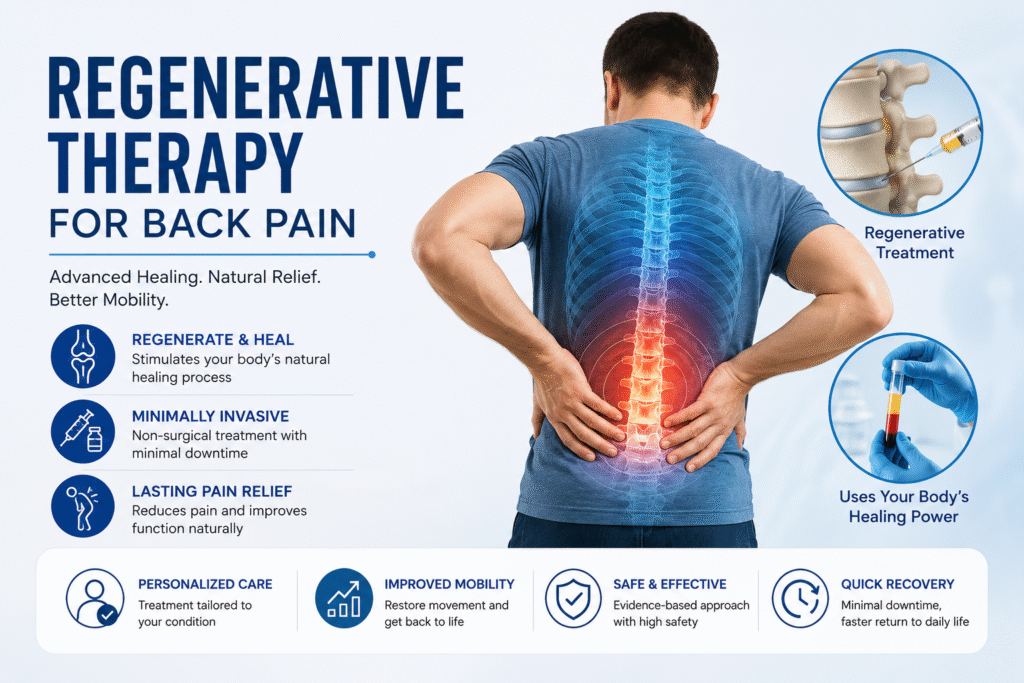
In Germany, regenerative approaches for back and disc pain include orthobiologics such as platelet-rich plasma (PRP), bone marrow concentrate (BMC), and autologous cell-based therapies. PRP uses concentrated platelets from the patient’s blood, while BMC and other autologous cell therapies use bone marrow rich in stem cells obtained from the patient’s body and are being investigated for their potential effects on inflammation, disc-cell activity, and tissue repair.
A particular research interest is mesenchymal stromal cells (MSCs) because of their potential anti-inflammatory and tissue-modulating properties and their possible role in managing chronic low back pain associated with disc degeneration. Other regenerative strategies, including adipose-derived cells, growth factors, and tissue-engineering approaches, remain under investigation.
The availability and evidence for each approach can vary between German centers, so patients should confirm whether a proposed treatment is an established procedure or part of a clinical study. Note that regenerative medicine for back pain is used only in a moderate manner and not as part of standard care. Standard care still relies on conventional approaches.
In Germany, clinical trials involving regenerative or cell-based treatments are subject to German and EU regulatory requirements. Oversight involves authorities such as the Paul-Ehrlich-Institut (PEI) or BfArM, together with ethics committees.
Trials conducted under the EU Clinical Trials Regulation must follow Good Clinical Practice, including informed consent, safety monitoring, reporting of serious adverse events, and regulatory inspections.
Could regenerative treatment be suitable for your disc-related pain? Possibly—but not simply because an MRI shows disc degeneration. A spine specialist typically considers the source and duration of pain, imaging findings, previous treatments, overall health, and whether symptoms have improved with non-surgical care first.
You may be considered when you have:
Candidates include active individuals or athletes with acute soft-tissue strains, chronic pain sufferers, and people who have been treated with conventional methods but the pain persists. The right candidate can also be individuals who are free from any active illnesses, systhemic illness or diseases, maintianing an overall good health this is mainly because of the fact that these therapies rely heavily on your body’s internal biological systems to rebuild tissue.
It may not work for those with end-stage degeneration, meaning a complete tissue collapse, but may work well with easy-to-moderate levels.
Wondering what happens if you choose regenerative treatment for disc pain? The exact process depends on the biological therapy used, and many of these approaches are still considered investigational with evolving clinical evidence, but treatment generally follows these steps:
The important point: regenerative medicine and spine surgery should not be viewed as competing treatments. As discussed earlier, the appropriate choice depends on why the patient has pain. Someone with disc-related pain but no significant neurological compression may be evaluated for non-surgical or regenerative approaches, whereas progressive weakness, severe nerve compression, spinal instability, or other surgical indications may require an operation.
| Regenerative medicine | Spine surgery |
| Uses biological approaches such as PRP, BMC, or cell-based therapies to potentially influence pain, inflammation or tissue repair. | Uses procedures such as discectomy, decompression or spinal fusion to directly address a structural problem. |
| Generally considered for selected patients with persistent symptoms when there is no urgent surgical indication. | Considered when there is significant nerve compression, instability, neurological deficit, or another structural problem requiring correction. |
| Usually involves minimally invasive injection-based procedures. | Involves an operation and therefore generally has a longer recovery period, depending on the procedure. |
| Evidence for disc regeneration and long-term benefit is still developing, particularly for cell-based therapies. | Has established indications and clinical evidence for appropriately selected spinal conditions. |
| May be investigated as a way to delay or potentially avoid surgery in some patients, but this has not been established for all disc conditions. | May be necessary when conservative or less-invasive treatment cannot adequately address the underlying problem. |
Germany is a top destination for many overseas patients, combining specialized spine care, regenerative medicine research, and clinical-trial infrastructure, making it a consideration for patients exploring innovative options like regenerative therapy for disc-related pain.
Is regenerative medicine not accessible to all? Yes, it is largely restricted or not widely accessible as standard, reimbursed care in most countries. High costs, complex manufacturing requirements, a lack of insurance coverage, and strict regulatory approval processes limit these advanced therapies mostly to specialized centers in wealthy nations or to formal clinical trials, such as in Germany and a few other countries such as the US, Japan, India, Mexico, and Thailand.
Within Germany, research and specialist services for regenerative therapies are concentrated in cities including Berlin, Heidelberg, Munich, Frankfurt, Freiburg and Hamburg.
The cost of regenerative treatment in Germany depends largely on the type of orthobiologic used, the number of injections or treatment sessions, and whether the procedure is provided as routine private care or within a clinical research program.
| Regenerative treatment | Estimated cost for international patients (Self-pay) |
| Basic PRP therapy | €500–€1,500 per session |
| Bone marrow concentrate (BMC) | €5,000–€10,000+ |
| Autologous cell-based therapy | €5,000–€15,000+ |
| MSC-based treatment | €10,000–€30,000+* |
*Costs for MSC-based treatment vary considerably because protocols, cell processing, laboratory requirements and clinical-trial arrangements differ between centers.
Therapy-specific exceptions and cost variations
Germany’s university hospitals combine state-of-the-art diagnostic and treatment infrastructure with advanced regenerative-medicine research and access to regulated clinical trials evaluating emerging cell-based and biologic therapies.
| Hospital / Center | City | What to check |
| Charité – Universitätsmedizin Berlin | Berlin | Regenerative medicine research, spine expertise and registered clinical studies |
| University Hospital Heidelberg | Heidelberg | Cell-based medicine, translational research and clinical-trial opportunities |
| LMU University Hospital | Munich | Musculoskeletal/spine research and regenerative medicine programs |
| University Hospital Freiburg | Freiburg | Research in regenerative medicine and specialist spine care |
| University Hospital Frankfurt | Frankfurt | University-based research, spine services and clinical-study infrastructure |
Risks and Limitations of Regenerative Therapy for Back Pain
Getting regenerative therapy for back pain has its own set of benefits and limitations. International patients need to be cautious of claims promising guaranteed disc regeneration or permanent pain relief. Confirm the treatment’s evidence, regulatory status, total cost, and post-therapy arrangements before travelling.
Planning treatment in Germany from abroad? Before travelling, International patients considering regenerative therapy in Germany should share their MRI scans, diagnosis, previous treatment records, and medication history for specialist assessment before travelling. Confirm the exact treatment, such as PRP, BMC, or autologous cell therapy and whether it is established clinical care or part of a registered clinical trial. Patients should also understand the supporting evidence, expected outcomes, risks, number of visits, total treatment cost, and any laboratory or cell-processing requirements. Before returning home, obtain a treatment summary and arrange a follow-up plan with the German center and, where possible, your local specialist.
Begin by consulting your doctor at home to ensure that you are medically fit for travel and to determine if regenerative treatment is suitable for your disc condition. Provide the German specialist with your MRI/CT scans, diagnosis, medical history, details of previous treatments, medications, and any conditions. Before making any arrangements, verify the proposed treatment plan, anticipated outcomes, number of visits needed, estimated costs, and the duration of your stay.
Following your specialist assessment, verify if you’re being evaluated for PRP, bone marrow concentrate (BMC), autologous cell therapy, or another type of orthobiologic treatment. Inquire whether this treatment falls under standard clinical practice or is part of a clinical trial, what evidence backs it, and if any further tests or imaging will be necessary in Germany.
Treatment duration varies by the regenerative approach. PRP is generally performed as an outpatient procedure, while BMC may involve additional preparation and recovery from the bone-marrow harvest. Cell-based treatments can require more appointments when specialized cell processing is involved. Plan your stay to include the procedure, observation, and an initial check-up rather than arranging an immediate return flight.
Recovery varies according to the treatment:
Before leaving Germany, obtain your treatment report, procedure details, imaging results, medication instructions and follow-up plan. Confirm when you can resume normal activities and whether physiotherapy, additional treatment or repeat assessments are required. Arrange check-up with a spine specialist in your home country.
Ask the treating doctor when you are medically fit to fly, particularly if you have ongoing pain or activity restrictions. Discuss prolonged sitting, mobility, medication, and any assistance required at the airport. Arrange suitable transportation and accommodation so that your journey does not interfere with the early recovery period.
Planning regenerative treatment in Germany? CancerRounds can help you understand the available treatment options, compare expected costs, and connect your medical records with suitable specialist centers for an informed treatment plan.
Yes. Germany has specialist centers offering or researching regenerative approaches such as PRP and cell-based therapies. Availability depends on the treatment, diagnosis, and whether it is offered as routine care or within a clinical study.
Not reliably. Some therapies are being studied for their potential to support disc repair, but consistent, long-term disc regeneration has not yet been established.
It depends on the specific cell product and indication. Some cell-based treatments remain investigational and may only be available through appropriately regulated clinical research.
Not always. It may be considered for selected patients without an urgent surgical indication, but significant nerve compression, instability, or progressive neurological problems may require surgery.
Yes, in selected clinical settings. PRP is an autologous orthobiologic that has been investigated for musculoskeletal and disc-related pain, although its effectiveness varies by condition.
It varies by treatment. PRP may cost around €500–€1,500 per session, while BMC and cell-based treatments can cost several thousand euros or more. Cell processing, laboratory requirements, multiple sessions and additional diagnostics can increase the final cost.
Usually not for international self-paying patients. Coverage depends on the treatment, indication and insurance policy, while investigational therapies are generally not routinely reimbursed.
Yes. Patients can seek assessment and treatment in Germany, but they should arrange a specialist review before travelling and confirm the treatment’s availability, evidence, regulatory status and total cost.
It depends on the therapy. PRP and some BMC procedures may be completed during a short visit, while treatments requiring specialized cell processing or multiple sessions may require a longer stay.
It can have risks. Injection-based procedures may cause pain, bleeding, infection or nerve irritation, while cell-based therapies have additional uncertainties related to the specific cell product and preparation method.
Often, yes. Ask the German center for a detailed treatment report, imaging results and follow-up recommendations that can be shared with your local spine specialist.
Published By
.webp)
Global Patient Care, Redefined
The CancerRounds Medical Content Team specialises in creating accurate, clear and patient-focused healthcare content. Our content is written by medically trained writers, medically reviewed, and based on reputable medical sources to support informed healthcare decisions.
Get expert guidance instantly
Share a few details and our medical team gets back to you within 4 hours with the next steps.
Tell us what you are facing and our medical team will guide you to the right doctors, hospitals and treatment.
Free Review, No Commitment
Free assessment with no pressure to proceed.
Trusted by 100,000+ Patients
Across 125+ countries worldwide
500+ Top Partner Hospitals
Globally accredited medical facilities
5000+ Expert Specialists
Senior doctors across major specialties.
Making quality healthcare accessible to patients worldwide
Everything you need to know about choosing the right hospital, doctor and treatment plan.