
Stage 4 pancreatic cancer treatment in Germany focuses on controlling the disease, extending life and protecting quality of life. Most plans combine chemotherapy, such as FOLFIRINOX or NALIRIFOX, with tumour profiling, targeted drugs and supportive care. The first three months usually cost €20,000–€45,000 ($23,400–$52,650).
Reply in 4 hours · Plan and quote in 2 days · 100% confidential
Yes. Stage 4 pancreatic cancer in Germany can be treated, but because the disease has already spread to distant organs, current standard treatment aims to control it rather than cure it. The goals are to slow progression, extend survival, and keep you as comfortable and active as possible.
What Germany adds is depth of expertise: multidisciplinary tumour boards, comprehensive molecular diagnostics and access to clinical trials at university hospitals. These strengths can help match you to the right treatment. They cannot change the underlying biology of the disease.
Stage 4 means the cancer has spread beyond the pancreas to distant parts of the body. The liver is the most common site, followed by the peritoneum (the lining of the abdomen) and the lungs.
Where the cancer has spread, how much of it there is and how well you feel day to day all shape the treatment plan. Your oncologist will also weigh your age, liver function and other health conditions. For a full explanation of diagnosis and staging, see our guide to pancreatic cancer treatment in Germany.
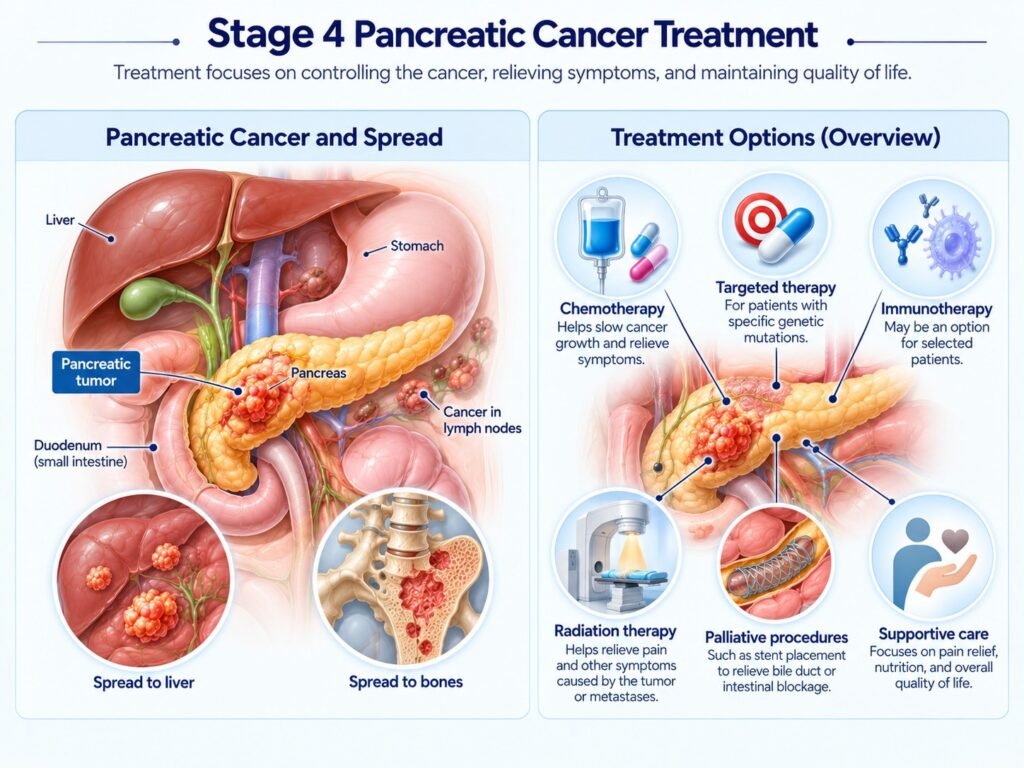
For metastatic disease, systemic treatment (drugs that travel through the bloodstream) is the main cancer-directed approach. Surgery is not routinely recommended once the cancer has reached distant organs, though selected procedures can relieve complications. These are the options your German team may discuss with you.
Chemotherapy forms the backbone of treatment. Two regimens are most common:
German oncologists may also discuss NALIRIFOX, which the EU approved in March 2024 for first-line use. Your age, fitness, bilirubin levels and tolerance for side effects will decide which regimen fits you best.
These options work only for patients whose tumours carry specific biomarkers, covered in the next section. Most pancreatic tumours do not respond to standard immunotherapy, so testing matters before anyone considers it.
Radiotherapy can ease pain or other symptoms in selected patients. It does not replace chemotherapy for controlling the disease overall.
A bile duct stent can clear a blockage that causes jaundice. Bile duct drainage often brings quick relief, and it makes chemotherapy safer to start. Pain management and nutritional support run alongside treatment from the beginning.
Trials can offer access to newer approaches. They are separate from standard care, and joining one depends on eligibility and on the trial’s current status.
Molecular testing looks for genetic changes that drive your cancer. German cancer centres typically run two kinds:
The biomarkers most relevant to stage 4 pancreatic cancer include BRCA1/2 and PALB2 changes, MSI-high or mismatch repair deficiency (dMMR) and NTRK fusions. Your team may check for other actionable alterations too.
One example shows how this works. If you carry a BRCA1/2 mutation and your cancer has not progressed after platinum-based chemotherapy, your doctor may suggest olaparib, a PARP inhibitor, as maintenance treatment. The POLO trial showed it delayed progression, though it did not show a clear gain in overall survival.
Be aware that testing does not guarantee an eligible treatment. Most patients have no targetable change. Options depend on your results, your clinical situation and current drug approvals.
Some centres also offer regional treatments for selected patients, such as chemoembolisation (TACE) for liver metastases or irreversible electroporation (NanoKnife) for local tumour control. These are individual decisions, not standard care, so ask whether the evidence supports them in your case.
University hospitals and comprehensive cancer centres in Germany bring together oncologists, radiologists, pathologists and palliative care specialists in tumour boards. Together they review your scans and test results and agree on a plan. Many of these centres also run precision oncology programmes and clinical trials.
To check whether a trial fits you, search the German Clinical Trials Register, then ask your oncologist about eligibility. International patients can sometimes join trials, but each study sets its own rules.
A word of caution: some clinics promote dendritic cell therapy, proton therapy, or other experimental approaches as treatments for metastatic pancreatic cancer. None of these is established standard care for this disease. Ask whether any therapy you are offered is approved in the EU or part of a registered trial.
The best hospital for you depends on your situation, so look for these markers rather than a ranking:
Deep experience with pancreatic cancer
A multidisciplinary tumour board that reviews every case
In-house medical oncology and molecular diagnostics
Access to clinical trials
An international patient office that can provide written estimates and interpreters
Berlin, Frankfurt and Hamburg also host university cancer centres worth shortlisting. Whichever you consider, confirm its current pancreatic cancer services, certification and trial access directly, because they change over time.
No single price covers treatment for metastatic disease, because stage 4 care is ongoing and changes with how your cancer responds. The cost of stage 4 care depends on which treatments your tumour board recommends and how many cycles you need. Most patients start with chemotherapy and add other treatments as needed.
| Treatment Type | Estimated Cost (USD) |
|---|---|
| Diagnosis, staging and tumour board review | $3,500 – $7,000 |
| Molecular / genetic tumour profiling | $3,500 – $5,850 |
| Chemotherapy – FOLFIRINOX or Gem/nab-P (per cycle) | $1,750 – $3,500 |
| NALIRIFOX chemotherapy (per cycle) | $3,500 – $6,450 |
| Full chemotherapy course (about 3 months) | $9,400 – $17,500 |
| Targeted therapy, e.g. olaparib (per month) | $5,850 – $8,200 |
| Immunotherapy (MSI-high tumours) | $23,400 – $58,500 |
| Palliative radiation therapy / SBRT | $11,700 – $23,400 |
| Proton therapy (selected cases) | $46,800 – $99,500 |
| NanoKnife (irreversible electroporation) | $29,250 – $46,800 |
| Hyperthermia (per session) | $585 – $1,750 |
| Dendritic cell therapy | $17,550 – $35,100 |
| Palliative procedures (stents, nerve block) | $3,500 – $9,350 |
Proton therapy and NanoKnife aren’t standard for most stage 4 patients. Doctors consider them only in selected cases, usually when the main tumour causes symptoms and the spread is limited.
Two cautions apply. A quote for one chemotherapy cycle is not the cost of a full treatment course, and complications can lengthen a stay and raise the total.
For example, lists an indicative diagnostic work-up of about €3,200 and a chemotherapy programme of about €7,400, but it does not spell out what those figures include. Treat them as rough reference points only.
Ask every hospital for a written estimate that states what it covers and what it leaves out. For a deeper breakdown, see our page on pancreatic cancer treatment cost in Germany.
Survival statistics for stage 4 pancreatic cancer measure different outcomes and should be interpreted separately.
Five-year relative survival rate: According to the American Cancer Society, the five-year relative survival rate for pancreatic cancer that has spread to distant organs is approximately 3%, based on US data for people diagnosed between 2015 and 2021.
Median survival with treatment: In landmark clinical trials involving patients with metastatic pancreatic cancer, median overall survival was approximately 8.5 months with gemcitabine plus nab-paclitaxel and 11.1 months with FOLFIRINOX.
Individual prognosis: Survival varies depending on a patient’s overall health, tumour biology, response to treatment and access to supportive care.
These figures come from US population data and clinical trials conducted before many current treatment developments. They are not specific to Germany and cannot predict an individual patient’s outcome. Treatment at a German cancer centre does not guarantee longer survival, but specialist care can help patients access appropriate treatment, molecular testing when indicated, and symptom management.
Patients should discuss their prognosis with their oncologist, who can interpret these statistics in the context of their diagnosis and treatment options.
Most international patients start with a remote review. Gather these before you contact a centre:
Medical records and treatment history, including chemotherapy dates and responses
Recent imaging (CT or MRI) as image files, not only the reports
Pathology report and biopsy material, if requested
Blood test results and any genetic or molecular test results
A cost estimate, visa documents and a hospital invitation letter
Interpreter support, accommodation near the hospital and a companion
Two questions deserve an honest answer before you book a flight. First, are you well enough to travel? Ask your current oncologist, especially if you have jaundice, pain or infection that needs control first. Second, how will treatment continue at home? Many patients return to their home country between visits, so agree on a follow-up plan with both teams in advance.
CancerRounds can help arrange a remote record review as a first step, so you know whether travel makes sense before you commit.
Palliative care focuses on comfort and quality of life, and it can start at diagnosis. It does not mean stopping chemotherapy. Many patients receive both at the same time. A good supportive plan covers:
Pain relief, including nerve blocks when medicines are not enough
Bile duct obstruction, treated with stenting
Pancreatic enzyme replacement, which helps digestion and weight
Nutrition support from a dietitian
Diabetes management, since the cancer can disrupt blood sugar
Blood clot prevention, because clots are more common in pancreatic cancer
Emotional support for you and your family
No standard treatment cures it today. Treatment aims to control the cancer, ease symptoms, and extend life. Research continues, and clinical trials may offer newer approaches for eligible patients.
For fit patients, combination chemotherapy is the usual starting point: FOLFIRINOX or gemcitabine plus nab-paclitaxel. Patients with certain biomarkers may also qualify for targeted therapy. Your oncologist chooses based on your health and test results.
There is no single price. Costs depend on your regimen, treatment length and any complications. Ask for a written estimate that lists exactly what it covers, and remember that one chemotherapy cycle costs far less than a full course.
In landmark trials, median survival for metastatic disease ranged from about 8.5 to 11 months, depending on the regimen. Individual outcomes vary widely, and treatment in Germany does not guarantee a longer survival time.
Surgery is not routinely recommended when distant metastases are present. Systemic therapy is the main approach, though selected procedures, such as bile duct stenting, can relieve complications.
It helps only a small group of patients, mainly those whose tumours are MSI-high or mismatch repair deficient. Most pancreatic cancers do not respond, so molecular testing comes first.
Sometimes. Each trial sets its own eligibility rules, and availability changes. Check DRKS or ClinicalTrials.gov, and ask the centre whether a trial fits your situation.
Chemotherapy for stage 4 disease is ongoing, so there is no fixed end date. An initial assessment visit often takes about a week. Many patients then continue treatment at home under a plan agreed with the German team.
For many patients, chemotherapy can extend life and ease symptoms, but it also causes side effects. The answer depends on your fitness and your goals. Talk it through with your oncologist, and ask for palliative care alongside treatment.
Not yet. Standard treatments still control rather than cure stage 4 disease. Newer targeted drugs and combinations are under study, so ask your oncologist about current trials.
Understanding your options is the first step toward the right care. For stage 4 pancreatic cancer in Germany, the most useful things you can do are get your tumour tested, ask about trials, and choose a specialist team that works with your home oncologist. Germany offers strong expertise, and an honest conversation about goals matters just as much.
If you would like help, CancerRounds can arrange a free review of your medical records and a second-opinion request, so you can decide what comes next with clear information.
Published By
.webp)
Global Patient Care, Redefined
The CancerRounds Medical Content Team specialises in creating accurate, clear and patient-focused healthcare content. Our content is written by medically trained writers, medically reviewed, and based on reputable medical sources to support informed healthcare decisions.
Get expert guidance instantly
Share a few details and our medical team gets back to you within 4 hours with the next steps.

Tell us what you are facing and our medical team will guide you to the right doctors, hospitals and treatment.
Free Review, No Commitment
Free assessment with no pressure to proceed.
Trusted by 100,000+ Patients
Across 125+ countries worldwide
500+ Top Partner Hospitals
Globally accredited medical facilities
5000+ Expert Specialists
Senior doctors across major specialties.
Making quality healthcare accessible to patients worldwide
Everything you need to know about choosing the right hospital, doctor and treatment plan.