
Sarcoma treatment in Germany provides specialized care for soft-tissue and bone sarcomas, including limb-sparing surgery, chemotherapy, radiotherapy (pre- and post operative), targeted and immune-based therapies, and access to selected clinical trials. With Charité – Universitätsmedizin, University Hospital Heidelberg, LMU University Hospital, University Medical Center Hamburg-Eppendorf (UKE)
Reply in 4 hours · Plan and quote in 2 days · 100% confidential
Sarcoma is a rare group of cancers that develops in bone or soft tissue, including muscle, fat, blood vessels, nerves, and connective tissues. Soft-tissue sarcoma (STS) is more common than primary bone sarcoma, and the disease accounts for a small proportion of all cancers. Sarcomas can occur at any age, but their distribution varies by subtype: soft-tissue sarcomas are predominantly diagnosed in adults and older adults, while some bone sarcomas, particularly osteosarcoma and Ewing sarcoma, are more common in children, teenagers, and young adults.
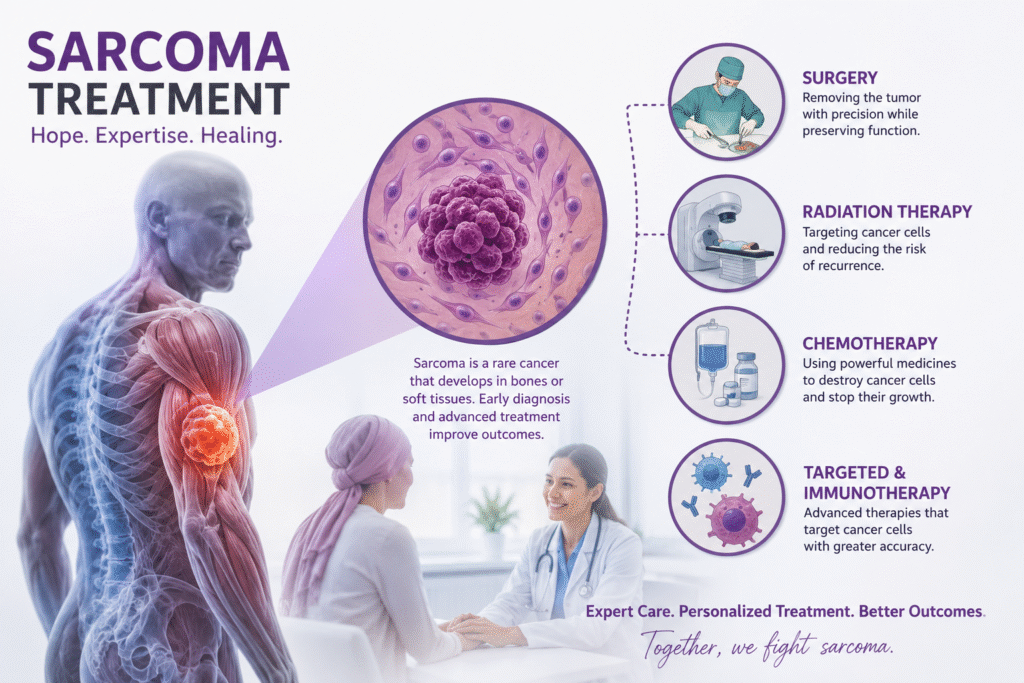
Symptoms depend on where the tumor develops.
At what point is sarcomas often diagnosed? Because early symptoms can resemble more common conditions, sarcoma is sometimes diagnosed only after a growing or persistent tumor mass starts showing up with pressure or persistent pain. Some sarcomas are already locally advanced or have spread when diagnosed, although this varies considerably by subtype.
To elaborate on this, In case of high-grade soft-tissue sarcomas such as undifferentiated pleomorphic sarcoma, synovial sarcoma and angiosarcoma, as well as Ewing sarcoma, are more likely to present with metastatic disease, most commonly to the lungs or other bones, whereas low-grade tumors such as well-differentiated liposarcoma or many chondrosarcomas are more often localized at diagnosis.
This biological and clinical diversity is a major reason why sarcoma treatment is not approached as a single standardized cancer pathway. Sarcomas include numerous bone and soft-tissue malignancies with distinct histological subtypes, ranging from tumors of muscle, fat, bone, cartilage, and connective tissues; genetic and molecular alterations, including characteristic gene fusions and mutations; anatomical locations, from the limbs and trunk to the retroperitoneum and visceral sites; patterns of local invasion; and metastatic behavior, particularly their tendency to spread to the lungs or other distant sites.
These variations and differences can further influence tumor classification, prognosis, and sensitivity to particular treatments.
Because treatment decisions depend on the exact histological and molecular diagnosis, tumor location, size, grade, resectability, and presence of metastases, accurate pathology and imaging are particularly important. Surgery remains central for many localized sarcomas, while radiotherapy and systemic therapies such as chemotherapy, targeted therapy, or other approaches may be incorporated according to the subtype and clinical setting.
This complexity is why patients with suspected or confirmed sarcoma may be evaluated at specialist sarcoma centers. In Germany, patients may be referred to specialist sarcoma centers when complex pathology review, tumor surgery, radiotherapy, or coordinated multidisciplinary treatment is required.
For an international patient, treatment planning in Germany often begins before travelling. Hospitals may review the patient’s pathology reports, biopsy material, MRI/CT or PET-CT scans and previous treatment records to determine whether the diagnosis and treatment plan can be confirmed or needs reassessment.
This review can be particularly important when:
Patients should ask whether their pathology will be reviewed by a sarcoma specialist, whether their case will be discussed by a multidisciplinary tumour board, which treatment is considered standard versus investigational, and whether the proposed treatment can realistically be completed during their stay in Germany.
The treatment pathway usually begins with imaging and a biopsy of the suspected tumour. For many soft-tissue sarcomas, MRI can help define the local extent of the tumour, while CT and other imaging may be used to assess the chest or look for disease elsewhere.
A core-needle biopsy is commonly used to obtain tissue for examination. Pathologists determine the tumour type and grade using microscopic examination, immunohistochemistry and, when appropriate, molecular or genetic tests.
An additional pathology review at a specialist sarcoma centre may be considered for those coming from abroad to Germany. When the diagnosis is uncertain or when complex treatment decisions depend on accurately identifying the subtype.
Grade and stage describe different aspects of sarcoma:
Doctors consider both when estimating prognosis and selecting treatment.
The TNM system is used for staging many sarcomas, although the exact criteria differ according to the sarcoma type and anatomical site.
For soft-tissue sarcoma, TNM is interpreted together with histological grade. Bone sarcomas have their own staging considerations, including the primary tumour, grade and presence or absence of metastases.
Staging does not tell doctors everything they need to know about surgery. They also assess whether the tumour can be removed completely while preserving as much normal function as possible.
This may depend on the tumour’s:
For some patients, treatment is planned before surgery to reduce the tumour or improve local control. In others, immediate surgery may be the preferred approach.
Sarcoma care is often discussed by a multidisciplinary team (MDT) because diagnosis and treatment can involve several specialties. Depending on the tumour, this may include a sarcoma surgeon or orthopaedic oncologist, medical oncologist, radiation oncologist, radiologist, pathologist and rehabilitation specialists.
The team considers the sarcoma subtype, grade, stage, resectability, tumour location and the patient’s overall health and treatment goals before recommending a treatment strategy. This is particularly relevant for rare or anatomically complex sarcomas, where treatment decisions may require specialist expertise.
Bone sarcomas require a different treatment strategy, with tumour grade, local extent, anatomical site, and metastatic status playing important roles. Osteosarcoma and Ewing sarcoma, for example, are generally treated differently from low-grade bone sarcomas.
Sarcomas are a rare but malignant group of cancers, and that is why the treatment strategy is carefully individualized based on the sarcoma subtype, grade, stage, tumour location, resectability, and also considering the patient’s medical history. In Germany, management also reflects a balance between conventional, well-established approaches such as surgery, chemotherapy, and radiotherapy, and increasingly modern, biology-driven strategies like targeted and immune-based therapies. Because treatment differs significantly between soft-tissue and bone sarcomas, and many options apply only to specific subtypes, a more detailed breakdown of these evolving approaches is provided in the sections below.
Surgery is the main curative treatment for many localized soft-tissue and bone sarcomas when complete removal is possible.
Radiotherapy is used mainly for soft-tissue sarcoma, while its role in bone sarcoma depends on the subtype and clinical situation. It may be given before surgery (neoadjuvant/preoperative) or after surgery (adjuvant/postoperative).
Preoperative radiotherapy
Postoperative radiotherapy
Radiotherapy is generally not routinely required for most resected osteosarcomas, which are relatively resistant to conventional radiation. It has a more established role in Ewing sarcoma, where it may be used for local control when surgery is not possible or when specific pathological or clinical circumstances warrant it.
Depending on the tumour and treatment plan, patients may be considered for:
The availability of a particular technique does not mean it is appropriate for every sarcoma.
Chemotherapy is used more extensively for certain bone sarcomas than for most adult soft-tissue sarcomas.
For soft-tissue sarcoma, chemotherapy is more selective. It may be considered for advanced disease, high-risk disease or particular subtypes that are more chemotherapy-sensitive. Commonly used agents include doxorubicin and ifosfamide, with other drugs selected according to the subtype and clinical situation.
Regional hyperthermia is an adjunctive treatment that uses controlled heat to raise the temperature of tumour tissue. In soft-tissue sarcoma, it has been studied particularly in high-risk, locally advanced or recurrent disease, most notably when combined with systemic chemotherapy.
The strongest clinical evidence comes from studies of neoadjuvant chemotherapy combined with regional hyperthermia in high-risk soft-tissue sarcoma. The rationale is that heating the tumour may increase the effectiveness of chemotherapy and improve local tumour response.
Targeted treatment is relevant mainly to selected soft-tissue sarcoma subtypes in which a specific molecular pathway or alteration can be therapeutically targeted.
Examples include targeted drugs used for certain advanced sarcomas, such as tyrosine kinase inhibitors (TKIs) and subtype-specific therapies. The benefit depends on the tumour’s biology; targeted therapy is not a universal treatment for sarcoma.
For bone sarcomas, targeted therapies are generally less established and are more often investigated in recurrent or advanced disease through clinical trials.
Fibroblast activation protein (FAP) is expressed in the tumour microenvironment of several cancers, including some sarcomas. FAPI-based compounds are being investigated primarily for molecular imaging, with researchers also exploring whether FAP can be used as a target for radionuclide-based treatment.
However, FAPI should currently be considered an emerging or investigational approach rather than a standard targeted treatment for all sarcomas. Its potential role in diagnosis, disease mapping and targeted radionuclide therapy continues to be studied.
Immunotherapy has been investigated in both soft-tissue and bone sarcomas, but its effectiveness varies substantially between subtypes.
Immune checkpoint inhibitors targeting pathways such as PD-1/PD-L1 and CTLA-4 have produced responses in some patients, but immunotherapy is not a standard treatment for every sarcoma. It may be considered in selected clinical circumstances or through clinical trials, depending on the subtype, previous treatment and available evidence.
Research is also examining combinations of immunotherapy with chemotherapy, targeted drugs and other treatments.
Dendritic cell therapy is an investigational form of cancer immunotherapy being studied in sarcoma. The approach involves using dendritic cells to stimulate the patient’s immune system to recognize tumour-associated antigens.
Research is also evaluating other cellular and immune-based approaches, including engineered T-cell therapies and adoptive cell therapies.
At present, these approaches should generally be discussed as clinical-trial or investigational options rather than established standard treatment for sarcoma. Availability in Germany depends on the specific trial, sarcoma subtype, and eligibility criteria.
Sarcoma treatment has not shifted from “old” treatments to a completely new set of therapies. Surgery, radiotherapy and systemic treatment remain the foundation of care, but advancements in this sector also help determine which patients are most likely to benefit from additional or newer treatment strategies.
There is a shift toward precision and integration. Standard treatments remain essential, while modern advances add additional options based on tumour biology, immune characteristics and clinical trial availability.
For international patients considering treatment in Germany, this means that the most important factor is not only access to advanced technology, but accurate sarcoma classification, molecular profiling when appropriate, and treatment within experienced specialised sarcoma centres where clinical trials and modern systemic options can be properly evaluated.
Modern sarcoma care increasingly explores therapies based on tumour biology and immune behaviour, especially within clinical trials:
Clinical trials are now a central part of sarcoma management in Germany, especially for:
Complete surgical removal remains central for many localized sarcomas; despite these developments, newer approaches do not replace established sarcoma treatment. While chemotherapy and radiotherapy continue to play essential roles in specific subtypes and clinical situations.
The key evolution is not a replacement of older therapies, but the addition of more precise and biology-driven treatment options.
Because sarcoma is rare and includes many different tumour subtypes, patients may seek treatment outside their home country when they need a specialist second opinion, complex surgery, a multidisciplinary treatment plan or access to a treatment or clinical trial that is not readily available locally. International treatment can also be considered when a patient wants their diagnosis or pathology reviewed by a specialist sarcoma team before starting or changing treatment.
However, travelling abroad does not automatically mean better outcomes. The decision should be based on the specific sarcoma subtype, treatment required, available expertise, expected benefit, cost, travel burden and continuity of care.
Patients may consider an international consultation or treatment when:
For some patients, an international second opinion may be useful even when they ultimately decide to receive treatment in their home country.
On top of having a large network of university hospitals, specialist cancer centers, and multidisciplinary oncology services, the German Cancer Society (DKG) establishes strict certification standards for specialized multidisciplinary Sarcoma Centers across Germany to manage rare bone and soft-tissue sarcomas. For sarcoma patients, the potential value lies less in having a particular machine or drug and more in the coordination of specialized diagnostic and treatment services.
Depending on the individual case, patients may have access to:
Not every hospital provides all of these services, and not every patient will benefit from every technology. Treatment availability also depends on the sarcoma subtype, disease stage, previous treatment and eligibility criteria.
Travelling abroad is a major decision and may not be necessary for every patient. A remote or in-person second opinion can sometimes answer important questions before international treatment is considered.
A specialist review may help clarify:
For a patient with a localized, straightforward sarcoma that can be appropriately treated by an experienced local team, travelling abroad may provide little additional benefit.
Sarcoma survival cannot be represented by a single number. Soft-tissue and bone sarcomas also have distinct treatment patterns, outcomes, and prognoses.
Sarcoma survival varies by subtype and stage, with global 5-year survival for soft-tissue sarcoma generally around 60–70% and substantially higher for localized disease than for metastatic sarcoma. Studies report improved outcomes worldwide. In Germany, the five-year relative survival rate is approximately 65% for soft-tissue sarcomas and ranges between 60% and 79% for bone sarcomas, with outcomes declining as the disease advances. Similarly, better survival for localized sarcoma
The American Cancer Society, using data from the U.S. SEER database for people diagnosed between 2015 and 2021, reports the following 5-year relative survival rates for soft-tissue sarcoma:
| Extent of disease at diagnosis | 5-year relative survival |
| Localized | 83% |
| Regional spread | 60% |
| Distant spread | 17% |
| All stages combined | 65% |
These figures illustrate the importance of disease extent at diagnosis. However, they are population statistics rather than an individual’s predicted outcome. Sarcoma subtype, tumour grade, anatomical site and response to treatment can substantially change the outlook.
Five-year survival is commonly reported because it provides a standardized way to compare outcomes, but sarcoma follow-up often needs to extend much further. Some sarcomas can recur many years after the initial treatment, making long-term surveillance important.
Cancer Research UK and Sarcoma UK publish longer-term survival information for soft-tissue sarcoma, with approximately half to three-fifths of patients surviving 10 years or more, depending on the dataset and population studied.
The exact percentage should therefore be interpreted alongside the source, diagnosis period and sarcoma subtype rather than treated as a universal 10-year survival rate for all sarcomas.
A 10-year survival figure also does not mean that recurrence is impossible after 10 years. The risk of recurrence varies considerably between sarcoma subtypes and according to the original tumour’s grade, size, margins and stage.
For example, the recurrence and metastasis of bone sarcomas (osteosarcoma or Ewing’s sarcoma) usually occur within the first two to three years following the treatment. As many as 80% of the patients who have developed metastatic disease initially will develop recurrent disease, which mostly spreads to the lungs.
Cancer Research UK reports that for bone cancer overall, around 55 out of 100 people (around 55%) survive their cancer for 10 years or more after diagnosis. However, this figure combines different types and stages of bone cancer and should not be interpreted as a 10-year survival rate for osteosarcoma alone.
This is an area where it is important to distinguish research findings from established treatment outcomes.
Dendritic-cell therapy is investigational in sarcoma. Studies have explored whether dendritic cells can stimulate an immune response against tumour-associated antigens, but many have involved relatively small patient groups, early-stage trials or specific sarcoma subtypes.
Other cellular approaches, including adoptive T-cell therapies and engineered T-cell therapies, are also being investigated. Other research has reported tumour responses in selected patients, particularly where the treatment targets a specific tumour antigen. Keeping in mind that response rates should not be presented as equivalent to long-term survival rates.
Choosing a hospital with experience in sarcoma is important; seek sarcoma care in major German university hospitals in Berlin, Heidelberg, Munich, Hamburg and Frankfurt, which provide holistic oncology care with MDT- multidisciplinary tumor boards. German academic centers also conduct clinical trials for advanced sarcomas, including targeted therapies, immunotherapy and other novel approaches supported by advanced imaging and radiotherapy techniques, though availability varies by hospital and case.
| Hospital | City |
| Charité – Universitätsmedizin Berlin | Berlin |
| University Hospital Heidelberg | Heidelberg |
| LMU University Hospital | Munich |
| University Medical Center Hamburg-Eppendorf (UKE) | Hamburg |
| University Hospital Frankfurt | Frankfurt |
Individuals planning to travel to Germany need to provide pathology reports, biopsies, if possible, scans, and records of previous treatments before getting a consultation at their chosen place of receiving treatment for sarcoma. With these, the receiving doctors would be able to evaluate the diagnosis and previous treatments faster.
Patients coming from abroad to Germany also need to inquire if:
Therefore, Germany could be an alternative for those individuals who need a consultation regarding their sarcoma cases, but not necessarily because it is Germany.
The cost of sarcoma treatment in Germany depends on the patient’s sarcoma subtype: soft-tissue or bone sarcoma- osteosarcoma, Ewing Sarcoma, Chondrosarcoma, Chordoma.
For international patients paying privately, the following are indicative self-paying estimates. Actual quotations vary between hospitals and are usually provided after review of the patient’s medical records and treatment plan.
Note: The final cost can be considerably higher when treatment involves complex bone or pelvic surgery, limb reconstruction, prosthetic replacement, multiple chemotherapy cycles, prolonged hospitalization, treatment of metastatic disease, or more than one treatment modality.
| Sarcoma treatment approach | Estimated full-course cost in Germany | Approx. USD* |
| Surgery alone – localized soft-tissue sarcoma | €15,000–€35,000 | $17,000–$40,000 |
| Surgery + radiotherapy – soft-tissue sarcoma | €30,000–€60,000 | $34,500–$69,000 |
| Chemotherapy + surgery – bone sarcoma | €40,000–€80,000 | $46,000–$92,000 |
| Chemotherapy + surgery + radiotherapy, when indicated | €50,000–€100,000+ | $57,500–$115,000+ |
| Complex bone/pelvic sarcoma surgery with reconstruction | €50,000–€100,000+ | $57,500–$115,000+ |
| Advanced/metastatic sarcoma – multimodal treatment | €60,000–€150,000+ | $69,000–$172,500+ |
| Targeted therapy-based treatment | €30,000–€100,000+ | $34,500–$115,000+ |
| Immunotherapy-based treatment | €30,000–€100,000+ | $34,500–$115,000+ |
| Dendritic-cell therapy / cellular immunotherapy programs† | €23,000–€24,000+ | $25,000–$26,000+ |
Patients without applicable insurance coverage generally receive a cost estimate from the German hospital before treatment. An advance payment or deposit may be requested before admission, particularly for planned surgery or prolonged treatment.
In case of costly multimodal treatment, the patient needs to ask for a written cost estimate for all major components of the procedure, such as diagnostics, surgery, hospitalization, drugs, radiotherapy, chemotherapy, and follow-up.
It is also necessary for patients to understand what costs are not covered, such as additional procedures, complications, intensive care, rehabilitation, and treatment of other conditions.
Key note: Insurance coverage is recommended to be secured before travel when possible. Even though reimbursement may be available, this does not guarantee that all treatments offered in Germany will be reimbursable, especially when it comes to novel approaches like dendritic cell therapy and others.
The time needed for soft tissue sarcoma patients to recover from an operation varies from weeks to even months for larger operations. Bone sarcoma surgeries take longer to recuperate from, especially where there is reconstruction of limbs, joints, pelvis, and spine.
Patients who receive chemotherapy, radiotherapy, or additional systemic treatments such as immunotherapy or targeted therapy may require more time to regain strength and normal activity.
There is no single follow-up schedule for every sarcoma. A commonly used approach for patients at higher risk of recurrence is more frequent monitoring during the first 2–3 years, where generally recurrence risk is higher, recurrence to the original site or spreading to the lungs followed by progressively longer intervals.
| Time after treatment | Typical follow-up focus |
| First 2–3 years | Clinical examination and imaging approximately every 3–4 months, depending on subtype and recurrence risk |
| Years 3–5 | Follow-up commonly moves to approximately every 6 months |
| After 5 years | Annual or individualized long-term follow-up may continue, particularly for patients with higher-risk disease or subtypes associated with later recurrence |
For many patients, the difficult part of recovery is not simply leaving the hospital. It may involve learning to walk normally after limb-sparing surgery, adapting to a prosthesis, returning to school or employment, managing fatigue, rebuilding physical strength or adjusting to changes in appearance and body function.
Quality of life is therefore an important part of sarcoma follow-up. Rehabilitation, physiotherapy, pain management, psychological support and functional assessment may be needed alongside cancer surveillance.
For patients with bone sarcoma, preserving mobility and independence can be particularly important.
For soft-tissue sarcoma, recovery may involve restoring movement and function around the treated area.
For those undergoing medical treatment in Germany as an international patient, it would be good to have it planned who will take care of the follow-ups when the person gets back home. A sarcoma center in Germany can offer the medical treatment and follow-up program that one needs, while routine testing and imaging may be managed with one’s oncology team at home.
The goal of long-term sarcoma care is therefore not only to detect recurrence early, but to help patients remain functional, manage late treatment effects and return as fully as possible to everyday life.
How can CancerRounds help you arrange sarcoma treatment in Germany?
CancerRounds can help international patients by offering informing what all is needed to be done without any bias, making them understand their options for treatment of sarcoma, whether Soft-tissue or Bone sarcoma, in Germany, comparing suitable hospitals or specialised centres, organizing medical records for review, and connecting with hospitals. Final diagnosis, treatment decisions, eligibility, and costs are determined by the treating medical team.
Yes. Because sarcomas are rare and include many different subtypes, a specialist pathology review and second opinion can sometimes change the diagnosis, staging or recommended treatment approach.
Yes. Many hospitals can review medical records, pathology reports, biopsy material and imaging before an international patient travels. This can help determine whether an in-person consultation or treatment in Germany is appropriate.
No. Surgery is central to treatment for many localized sarcomas, but the need for surgery depends on the tumour’s subtype, location, stage and resectability. Radiotherapy or systemic treatment may be used before or instead of surgery in selected situations.
It can be. Bone sarcoma surgery may require extensive bone removal, joint reconstruction, endoprosthetic replacement or other complex reconstruction, increasing hospital and surgical costs.
Yes. Complex surgery, reconstruction, multiple chemotherapy cycles, radiotherapy or treatment of metastatic disease can bring total self-paying costs above €50,000. An individualized hospital quotation is needed for an accurate estimate.
No. Dendritic-cell therapy and several other cellular approaches remain investigational for sarcoma and may be available only through specific research programs or clinical trials.
Yes, in some cases. International patients can potentially participate if they meet the trial’s medical and eligibility requirements. Availability depends on the sarcoma subtype, disease stage, previous treatment and current trial recruitment.
Not necessarily. Some treatment plans require a prolonged stay, particularly when major surgery, chemotherapy or radiotherapy is involved. Follow-up imaging and routine monitoring may sometimes be coordinated with an oncology team in the patient’s home country.
Some sarcomas can recur locally or spread to distant sites years after initial treatment. This is why long-term follow-up may continue beyond five years, particularly for patients with higher-risk disease.
Yes. Hospitals can generally prepare an individualized estimate after reviewing the patient’s diagnosis, imaging, pathology and proposed treatment. International self-paying patients should confirm what is included and whether additional costs may arise from complications or changes in treatment.
Published By
.webp)
Global Patient Care, Redefined
The CancerRounds Medical Content Team specialises in creating accurate, clear and patient-focused healthcare content. Our content is written by medically trained writers, medically reviewed, and based on reputable medical sources to support informed healthcare decisions.
Get expert guidance instantly
Share a few details and our medical team gets back to you within 4 hours with the next steps.
Tell us what you are facing and our medical team will guide you to the right doctors, hospitals and treatment.
Free Review, No Commitment
Free assessment with no pressure to proceed.
Trusted by 100,000+ Patients
Across 125+ countries worldwide
500+ Top Partner Hospitals
Globally accredited medical facilities
5000+ Expert Specialists
Senior doctors across major specialties.
Making quality healthcare accessible to patients worldwide
Everything you need to know about choosing the right hospital, doctor and treatment plan.