
QUICK ANSWER: Surgery and chemotherapy still lead treatment for most primary bone cancers, and immunotherapy helps only in selected cases. Germany offers specialist sarcoma teams, EU-approved mifamurtide for some young osteosarcoma patients, and access to research through trial registries. Whether it suits you depends on your tumour type and stage. Send your reports to Cancer Rounds for a specialist review before you plan any travel.
If you or someone you love has bone cancer, you’ve probably heard about immunotherapy. It has worked well in several other cancers. So it’s fair to ask: is there immunotherapy for bone cancer in Germany, and could it help?
The honest answer has two parts. Immunotherapy isn’t yet a standard treatment for most primary bone cancers. But Germany has specialist sarcoma teams, and one immunotherapy drug is authorised in the EU for a small group of osteosarcoma patients.
We wrote this guide so you can see the full picture before you spend money or book flights. You’ll learn what works, what’s still experimental, and what to ask your doctors. At Cancer Rounds, we help international patients get a specialist opinion first. That way, every travel decision rests on facts about your own tumour.
Confused about treatment options?
Get a free second opinion from our oncologists
Immunotherapy has shown only modest results in bone cancer so far. It uses medicines that help your immune system spot and attack cancer cells, but bone tumours tend to hide from it. Surgery and chemotherapy remain the main treatments for most bone cancers, with immunotherapy used in selected cases or trials.
Here’s the basic idea: Cancer cells can press “brake pedals” on your immune cells. Two well-known brakes are called PD-1 and CTLA-4. Checkpoint inhibitors are medicines that release those brakes.
The trouble is that bone tumours, especially osteosarcoma, create an environment that keeps immune cells quiet. In the SARC028 trial, only 2 of 40 bone sarcoma patients responded to pembrolizumab. That’s why researchers are now testing combinations and cell-based treatments.
European guidelines still describe surgery plus multi-drug chemotherapy as the curative treatment for high-grade osteosarcoma. Immunotherapy sits beside that standard care. It doesn’t replace it.
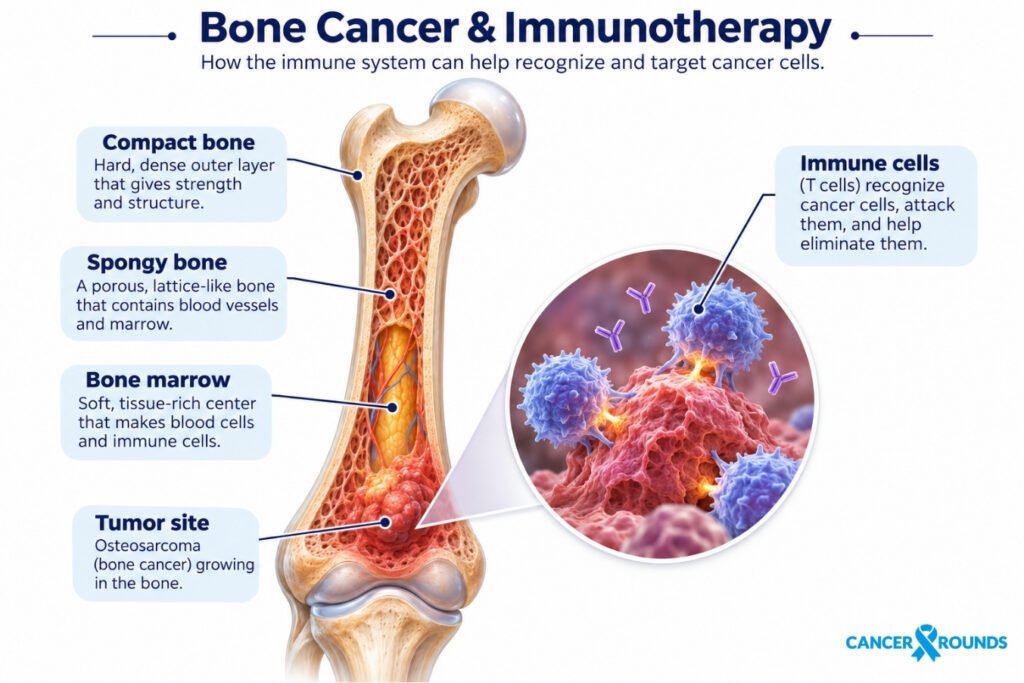
Osteosarcoma, Ewing sarcoma and chondrosarcoma respond differently, and none has a proven immunotherapy cure. Osteosarcoma has the most research behind it. Ewing sarcoma has shown the least response to checkpoint drugs so far.
Chondrosarcoma is harder to sum up. Most trial results come from a rare subtype called dedifferentiated chondrosarcoma, so they don’t apply to every patient with this cancer.
Some trials also mix bone and soft-tissue sarcomas together. Soft-tissue results can’t tell us how bone cancers will react, so ask your doctor which group a study actually covered.
One more point. Cancer that spreads to bone from the breast, lung or prostate is a different situation. Those metastatic bone tumours are more common than primary ones, and your doctors will plan treatment around where the cancer began.
Think of the options in three tiers. Each one carries a different level of evidence, and your team should tell you which tier a suggestion belongs to.
A tumour board of sarcoma surgeons, oncologists, pathologists and radiologists reviews your biopsy, scans and treatment history. They decide whether standard treatment, an immunotherapy drug, or a clinical trial fits best. They choose immunotherapy only when there’s a clear reason, since the evidence in bone cancer is still limited.
The usual path looks like this:
Now, about those tests. They include PD-L1 (a protein that helps tumours hide), TMB (how many gene changes a tumour has) and MSI (a DNA repair flaw). They can offer clues, but they don’t predict response well in sarcoma. A positive result isn’t a promise, and a negative one isn’t a final no.
Bone sarcomas are rare, so many patients want a team that sees these cases often. That’s a big part of why people look abroad for a second opinion.
Trials run in Germany are listed in the German Clinical Trials Register, which is free to search. We can help you look through it and check eligibility. We can’t promise you a trial place, and we’ll say so plainly.
That’s where Cancer Rounds fits in. Your case manager collects your reports and arranges an opinion from a bone cancer doctor in Germany. We also shortlist cancer hospitals in Germany that suit your diagnosis. Our page on sarcoma treatment in Germany covers the wider options. If immunotherapy isn’t right for you, we’ll tell you.
Immunotherapy can cause your immune system to attack healthy organs. Common effects include rash, diarrhoea or colitis, thyroid problems, and inflammation of the liver or lungs. Most are treatable when caught early, which is why regular monitoring and quick reporting matter.
Skin reactions are the most common, followed by bowel inflammation and hormone problems. Lung inflammation is less common but can be serious. These patterns come from checkpoint inhibitors across many cancers, so bone cancer figures may differ.
Combinations raise the risk. Reviews show far more patients stop treatment because of side effects on drug combinations than on a single drug.
Timing matters too. Side effects can start weeks in, or even after treatment ends. Tell your team right away about new diarrhoea, a new cough or severe headaches. Many problems respond to steroids. If you’ve travelled for care, we arrange follow-up video consults with your treating oncologist after you fly home.
No honest article can give you one price for this treatment, because the bill depends on your plan. These are the main factors:
Trial participation, insurance cover and self-funded care are handled differently. Ask about each one before you commit.
We give you a written treatment plan and cost estimate for free, before you decide. Our cancer treatment costs page explains the general picture. If your cancer has spread, read about advanced cancer treatment in Germany too.
Immunotherapy for bone cancer is an area to watch, not a sure fix. Here’s what to remember:
Bone cancer is hard enough without guessing. Send your pathology and scan reports to Cancer Rounds, and we’ll connect you with a specialist for a free, no-obligation opinion. Prefer to talk first? Message us on WhatsApp or ask for a callback. Your questions deserve real answers, and we’d like to help you get them.
.webp)
Get expert guidance instantly
Tell us about your condition and we will help you find the right care.

November 14, 2025

February 21, 2022
Get expert guidance instantly
Share a few details and our medical team gets back to you within 4 hours with the next steps.
Tell us what you are facing and our medical team will guide you to the right doctors, hospitals and treatment.
Free Review, No Commitment
Free assessment with no pressure to proceed.
Trusted by 100,000+ Patients
Across 125+ countries worldwide
500+ Top Partner Hospitals
Globally accredited medical facilities
5000+ Expert Specialists
Senior doctors across major specialties.
Making quality healthcare accessible to patients worldwide
Everything you need to know about choosing the right hospital, doctor and treatment plan.
