
Cardiac surgery in Germany covers bypass, valve repair and replacement, aortic surgery and transplants, performed at dedicated heart surgery departments. German registry data show about 97.8% in-hospital survival after isolated bypass surgery. International patients usually need a cost estimate, a medical visa and a records review first. Cancer Rounds can match you with a verified heart surgeon, arrange your estimate and guide you from first enquiry to recovery.
Reply in 4 hours · Plan and quote in 2 days · 100% confidential
Being told you need heart surgery is frightening. Many families then ask the same question: is the best care in another country? Cardiac surgery in Germany is one option patients from around the world consider, and the numbers explain why. In 2024, German hospitals reported 97.8% in-hospital survival after isolated bypass surgery, although that figure isn’t adjusted for patient risk.
Choosing a country is only part of the decision. You also need to know which operation fits your heart, who will perform it, what it costs and how to arrange travel. This page covers each of those points in plain language.
We’ve written it for patients and families who are comparing options. That includes people who’ve had cancer treatment and now face a heart problem. Cancer Rounds is supported by the Vaidam Health group, which has helped over 100,000 patients from 125+ countries, so we know how stressful planning care abroad can be. If you’d like a surgeon matched to your reports, our team can give you a free expert opinion within 4 hours.
Cardiac surgery is an operation to repair or replace parts of the heart or its blood vessels. German centers perform bypass surgery, valve repair and replacement, aortic surgery, congenital heart repair, rhythm device implants and transplants. In 2024, 103,617 procedures were counted as classic heart surgery.
Bypass surgery (CABG) reroutes blood around a blocked heart artery using a healthy vessel from elsewhere in your body. Valve surgery treats a valve that’s too narrow (stenosis) or that leaks (regurgitation). The valve is either repaired or replaced. A newer option, TAVI, replaces the aortic valve through a catheter without opening the chest.
The 2024 national registry gives a sense of scale. It recorded 28,843 isolated bypass operations and 45,422 isolated valve procedures, and 24,957 of the valve procedures were catheter-based. The data came from 77 heart surgery departments across the country.
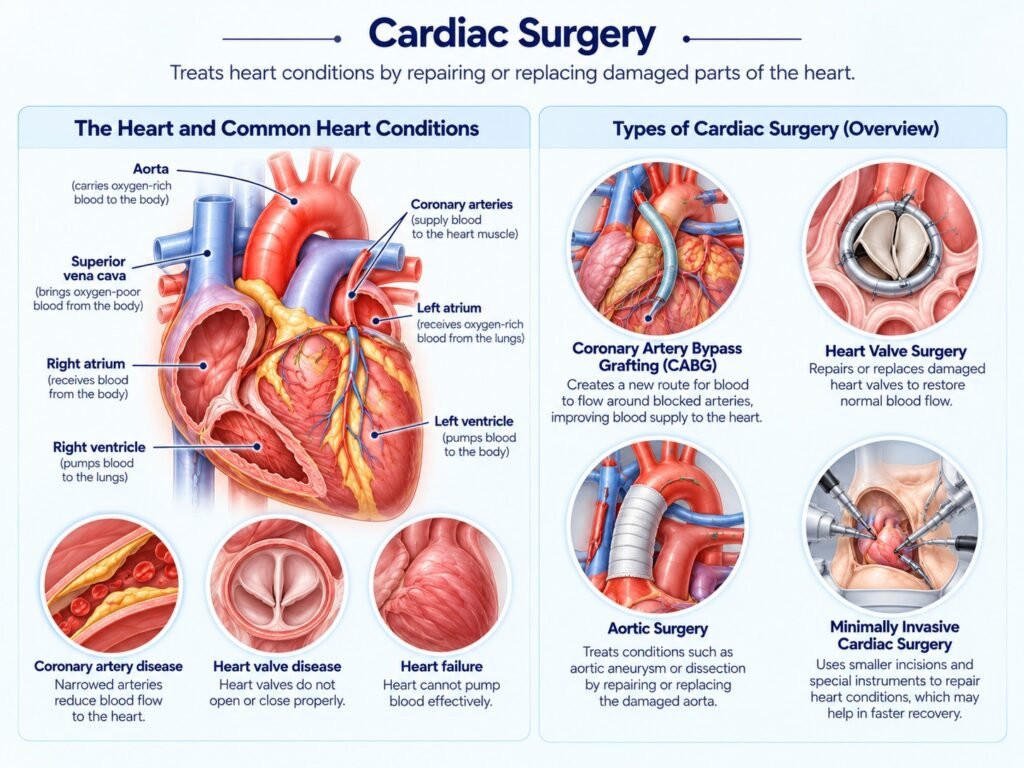
Most patients tell us they want a team that decides together. In Germany, a Heart Team (a surgeon, a cardiologist and often an imaging specialist) reviews your scans before recommending an operation. The 2025 European valve guidelines go further and say that complex cases should be referred to high-volume centers with specialist Heart Teams. A cardiac surgeon from the University of Leipzig co-chaired that guideline panel.
Transparency matters too. German heart surgery departments report their numbers and in-hospital deaths to a national registry every year. It’s a voluntary system, yet it captures nearly all heart operations in the country.
Big heart centers also run international patient offices. At one major Berlin center, the team sends an official invitation letter for the embassy, issues a written cost estimate and takes your records by email. You can see which units we work with on our page for heart hospitals in Germany.
Germany’s national heart surgery registry reports about 97.8% in-hospital survival after isolated bypass surgery in 2024, and 97.2% after isolated valve procedures. These figures aren’t risk-adjusted, so your own result depends on your age, heart function and other health conditions.
The bypass figure has been steady. Survival was 97.5% in 2022, 97.6% in 2023 and 97.8% in 2024.
“In-hospital survival” means the patient left the hospital alive. It doesn’t tell you how you’ll feel in five or ten years. Emergency operations and sicker patients also pull the average down, while planned surgery in healthier patients pushes it up.
So ask your surgeon for your personal risk estimate. A good team will explain it and show you how it was calculated.
Your Heart Team, which includes a heart surgeon and a cardiologist, decides which treatment fits you. Bypass surgery, stenting, valve surgery and TAVI each suit different anatomy, ages and risk levels. The choice depends on how many arteries are blocked, which valve is damaged and your overall health.
For blocked arteries, the 2018 European guideline says the Heart Team should make the call between bypass and stenting. It also puts weight on how completely each option can restore blood flow.
For valves, the 2025 guideline lowered the age at which TAVI is recommended from 75 to 70 for suitable patients with a certain type of aortic stenosis. The same guideline keeps surgery as the preferred choice for primary mitral regurgitation. Age alone no longer settles the question, so bring your angiogram, echo and CT reports for review.
Radiation to the chest can harm the heart years later. This matters for survivors of lymphoma, breast, esophageal and lung cancer. Radiation-associated heart disease can affect the valves, the heart arteries and the sac around the heart.
A large study looked at 173 survivors who needed heart surgery about 18 years after radiation. In the first 30 days they did about as well as other patients. Over roughly seven years of follow-up, though, they were nearly twice as likely to die as similar patients who hadn’t had radiation.
That result isn’t a reason to avoid surgery. It’s a reason to choose a team that knows your cancer history and plans around it. Our oncology and cardiac teams can review your records together, and we can also arrange cancer treatment in Germany or follow-up radiation therapy in Germany if you need it.
The cost of cardiac surgery in Germany depends on the procedure, time in intensive care and on the ward, implants and any complications. International patients usually pay as self-pay patients, and many hospitals ask for the estimate to be paid before admission.
At the Berlin center mentioned above, the cost estimate is paid by bank transfer in advance and doesn’t include translation. Patients from abroad are generally treated as self-pay. Some international insurers cooperate with German hospitals if they agree to the planned surgery.
We don’t publish one flat price because two bypass patients can need different grafts and different hospital stays. Before you accept any estimate, ask what it covers: tests, surgery, intensive care, ward days, medicines and follow-up. Also ask what happens if you need extra days. You can read more in our treatment cost guides, or send your reports and we’ll reply within 4 hours.
Here’s how it usually works for international patients.
Share your reports. Send your angiogram, echo, CT scans and discharge summaries. We pass them to suitable surgeons and return an expert opinion within 4 hours.
Review your plan and estimate. You get a written plan, so you can compare it with other opinions before you decide.
Arrange your visa. The hospital’s invitation letter supports your application. A Schengen visa covers stays of up to three months, and a national visa applies if treatment will take longer.
Have your surgery. After a bypass, most people spend about a week in hospital, with one or two days in intensive care first.
Start rehab. In a trial of 158 patients, supervised exercise rehab that began two weeks after surgery was as safe as rehab at six weeks. Your surgeon will tell you when it’s safe to fly home.
A dedicated case manager stays with you at every step, and our team speaks 11+ languages. See how Cancer Rounds works or browse the top hospitals in Germany we partner with.
Three points are worth remembering. German heart surgery registry data show strong survival rates, but your own risk depends on your health. The right operation is decided by a Heart Team, so a second opinion on your scans is worth having. And planning your records, estimate and visa early makes the trip far smoother.
If you’re ready to take the next step, get your expert opinion in 4 hours or talk to a heart surgery specialist about a personalised treatment plan. Not ready yet? Ask for a callback, enquire about procedure costs or start a WhatsApp chat with our team. A frightening diagnosis becomes easier to face once you have a clear plan and someone beside you.
Cardiac surgery repairs or replaces parts of the heart or its vessels. German departments perform bypass surgery, valve repair and replacement, aortic surgery, heart transplants and other procedures. In 2024, 348 isolated heart transplants were reported.
Candidates are people whose heart arteries or valves are damaged enough that medicine or stenting won’t be enough. A Heart Team decides, using your scans and overall health. TAVI is now recommended from age 70 for suitable patients with aortic stenosis, so some people can avoid open surgery.
Your surgeon will estimate operation time once they’ve seen your scans. After bypass surgery, most people reach most normal activities in about 6 weeks and fully recover in 2 to 3 months. Supervised rehab can safely start as early as two weeks after surgery.
In 2024, in-hospital survival was 97.8% after isolated bypass surgery and 97.2% after isolated valve procedures. These numbers aren’t risk-adjusted. Ask your surgeon how your own risk compares.
Possible problems include wound infection, bleeding, irregular heartbeat, kidney problems, memory changes, and rarely a heart attack or stroke. Rhythm and kidney problems usually improve within a few days. Your surgeon will explain your personal risks before the operation.
The price depends on the operation, intensive care and ward days, implants and complications. International patients are usually self-pay, and some hospitals want the estimate paid before admission. See our treatment cost guides or send your reports for a written estimate.
Yes. Hospitals with international offices send an invitation letter for your visa application. A Schengen visa allows up to three months, and a national visa is needed for longer treatment. Cancer Rounds helps with records, estimates and travel planning.
Published By
.webp)
Global Patient Care, Redefined
The CancerRounds Medical Content Team specialises in creating accurate, clear and patient-focused healthcare content. Our content is written by medically trained writers, medically reviewed, and based on reputable medical sources to support informed healthcare decisions.
Get expert guidance instantly
Share a few details and our medical team gets back to you within 4 hours with the next steps.
Tell us what you are facing and our medical team will guide you to the right doctors, hospitals and treatment.
Free Review, No Commitment
Free assessment with no pressure to proceed.
Trusted by 100,000+ Patients
Across 125+ countries worldwide
500+ Top Partner Hospitals
Globally accredited medical facilities
5000+ Expert Specialists
Senior doctors across major specialties.
Making quality healthcare accessible to patients worldwide
Everything you need to know about choosing the right hospital, doctor and treatment plan.