
Endometrial cancer treatment in Germany usually starts with surgery to remove the uterus. Radiotherapy, chemotherapy, or immunotherapy may follow, based on your stage and tumor type. Costs for international patients typically run from €12,000 to €45,000. Early-stage disease has a 5-year survival rate near 95% in US data. Share your reports with CancerRounds to get a hospital match and a written quote before you travel.
Reply in 4 hours · Plan and quote in 2 days · 100% confidential
A diagnosis of endometrial cancer can bring a lot of questions at once. What treatment do you need? How soon? Is travel worth it? Endometrial cancer treatment in Germany is a real option for many women, and most have a good outlook. US SEER data show that about two in three cases are found while the cancer is still inside the uterus. At that stage, the 5-year relative survival rate is about 95%.
Germany is a strong choice for this cancer. Its gynecologic cancer centers are audited by the German Cancer Society (DKG), and each case goes to a multidisciplinary tumor board. Doctors also follow the 2025 European guidelines, which use molecular testing to decide how much treatment each woman needs.
This guide covers how doctors diagnose and stage endometrial cancer, which treatments German hospitals offer, what they cost, and which hospitals to consider. It also lists the steps for international patients, from sending your reports to flying home. We explain medical terms as we go, so families can follow along too.
Endometrial cancer begins in the endometrium, the lining of the uterus. The Merck Manual notes that it’s more common in high-income countries, where obesity rates are higher.
Abnormal vaginal bleeding is the most common early sign. That includes bleeding after menopause and bleeding between periods. The Merck Manual reports that roughly 6 to 19 in every 100 women with postmenopausal bleeding have endometrial cancer. So any bleeding after menopause needs a prompt check, even if it’s light.
A UK consultant gynecologic surgeon lists these main risk factors:
If you have any of these and notice unusual bleeding, ask for an endometrial biopsy. It’s a quick tissue sample that gives a clear answer.
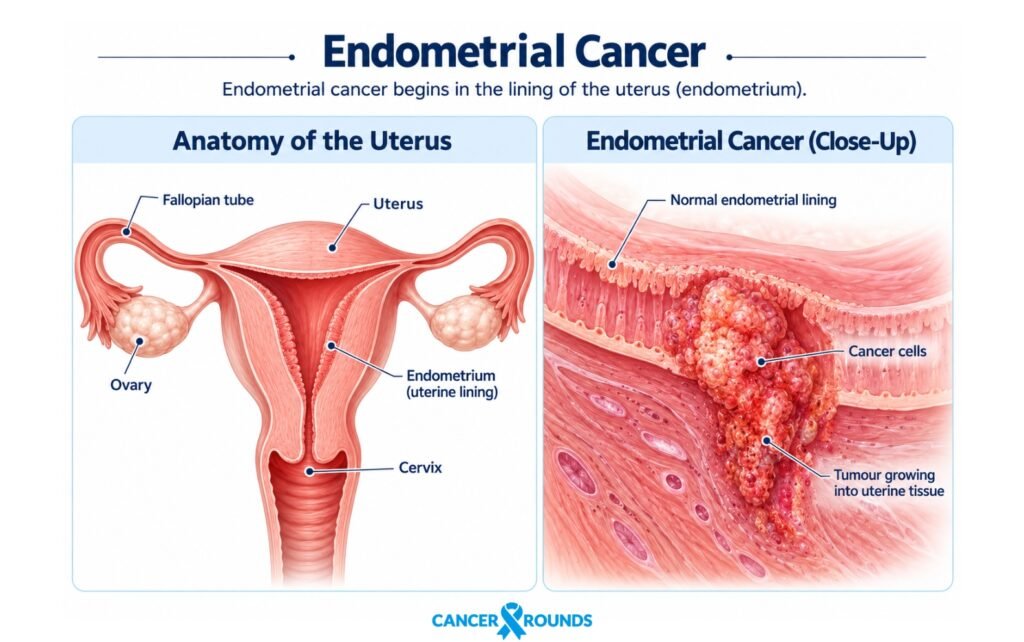
Germany offers DKG-certified gynecologic cancer centers, tumor boards that plan each case as a team, minimally invasive surgery, and care that follows the 2025 European guidelines. Many hospitals also run international patient offices that handle records, scheduling, and interpreters. A large German study linked certified centers to better survival in stage I disease.
Certified centers. The DKG certifies cancer centers that meet set quality standards. A German study of more than 38,000 women with uterine cancer compared certified and non-certified hospitals. In insurance data, 5-year overall survival was 66.7% at certified centers and 65.0% elsewhere. In stage I disease, treatment at a certified center was linked to a lower risk of death (hazard ratio 0.78). These figures cover all ages and stages, so they look lower than the cancer-specific rates later in this guide.
Guideline-based care. The 2025 ESGO-ESTRO-ESP guidelines were reviewed by 225 independent practitioners and three patient representatives from six world regions. They build on FIGO 2023 staging, which now includes tumor biology.
Support for international patients. CancerRounds assigns a dedicated case manager, offers support in 11+ languages, and has teams in 20 cities. Someone coordinates your records, visa letters, and travel with you. If you’re still comparing diagnoses, our guide to gynecologic cancer treatment in Germany covers all five types.
Doctors in Germany diagnose endometrial cancer with an endometrial biopsy or hysteroscopy, then use MRI or CT to check how far it has spread. Pathologists also test the tumor’s molecular profile. FIGO 2023 staging combines these findings, and a tumor board then agrees on your treatment plan.
Most women start with a transvaginal ultrasound. Hysteroscopy uses a thin camera to look inside the uterus and take a tissue sample. PET-CT is added when doctors need a closer look at lymph nodes or distant organs.
Pathologists then sort the tumor into one of four molecular groups: POLE-mutated, mismatch repair deficient (dMMR), p53 abnormal, or no specific molecular profile (NSMP). The 2025 guidelines use this class alongside tumor type and spread. Why does it matter? About 20% to 29% of endometrial cancers are dMMR or MSI-H, and that result decides who can receive certain immunotherapy drugs. A dMMR result can also lead to genetic counseling for Lynch syndrome.
Last, your case goes to a tumor board. Gynecologic oncologists, pathologists, radiologists, and radiation and medical oncologists agree on one plan together.
Your plan depends on your stage, tumor grade, molecular group, general health, and whether you hope to have children. Most women need more than one type of treatment.
Surgery is the main treatment. The standard operation removes the uterus and cervix (hysterectomy) along with both ovaries and fallopian tubes. According to the ESHRE guideline summary, this is the standard surgical approach.
German centers use minimally invasive surgery whenever it’s safe. Heidelberg University Hospital, for example, states that it offers minimally invasive surgery when possible. Robotic-assisted surgery is also used for hysterectomy and staging in endometrial cancer, as a published review of gynecologic robotics notes.
Lymph node staging has changed. The ESGO-ESTRO-ESP guidelines favor sentinel lymph node biopsy over removing many nodes in low and intermediate-risk disease. The surgeon injects a green dye called indocyanine green near the cervix. Then only the first nodes the dye reaches are removed. A 2025 review found that systematic node removal doesn’t improve survival in early-stage disease and adds complications.
Radiotherapy lowers the chance of cancer returning in selected women after surgery. Vaginal brachytherapy places a radiation source inside the vagina for a few short sessions. The PORTEC-2 trial followed 427 women with high-intermediate risk disease. Brachytherapy controlled vaginal recurrence as well as pelvic external beam radiotherapy, with fewer bowel side effects.
Higher-risk or advanced cases may need external beam radiotherapy to the pelvis. You can read more about radiotherapy in Germany on our site.
Chemotherapy is used for high-risk or advanced disease. It may follow surgery, or it may be the first treatment when cancer has spread. The usual drug pair is carboplatin and paclitaxel, given every three weeks in the large immunotherapy trials.
Immunotherapy has changed care for advanced and recurrent disease. In the RUBY trial, women with dMMR or MSI-H tumors who received dostarlimab plus chemotherapy went a median of 30 months without progression. Those on chemotherapy alone went 8 months, according to the National Cancer Institute.
In 2024, the FDA approved durvalumab (for dMMR tumors) and pembrolizumab with chemotherapy. It also widened the dostarlimab approval to all advanced cases. The European Union has approved dostarlimab with chemotherapy for dMMR or MSI-H primary advanced or recurrent cancer. Your oncologist will match a drug to your biomarker results. Learn more about immunotherapy in Germany before your consultation.
Hormone therapy, usually with progestins, can control some low-grade cancers. Doctors consider it for women who want to keep fertility or can’t safely have surgery.
Standard surgery ends the chance of pregnancy. For carefully selected younger women, the ESGO/ESHRE/ESGE guideline (48 recommendations) describes fertility-sparing treatment as a temporary option. Most women under 40 with endometrial cancer don’t qualify, because their tumor type isn’t suitable or they’ve finished their families, according to a 2023 commentary. If this matters to you, tell your team before any decision is made.
Technologies You May See in German Centers
Endometrial cancer treatment in Germany typically costs between €12,000 and €45,000 for international self-paying patients. The final price depends on your stage, the type of surgery, any radiotherapy or drug treatment, and your hospital stay. Hospitals give a written quote after reviewing your records.
Treatment component | Approximate cost (EUR) | What affects it |
Hysterectomy (open surgery) | €8,000 to €13,500 | Hospital, surgeon, length of stay |
Laparoscopic hysterectomy | €10,500 to €17,500 | Added staging, such as sentinel nodes |
Robotic-assisted hysterectomy | €22,000 to €30,500 | Robotic equipment and hospital |
Radiotherapy course | €8,000 to €21,000 | Brachytherapy or external beam, number of sessions |
Chemotherapy | From about €1,000 per cycle | Number of cycles, drug combination |
PET-CT scan | About €2,000 | Need for repeat imaging |
Immunotherapy and molecular tests | Quoted case by case | Drug, number of cycles, test panel |
Estimated total, standard pathways | €12,000 to €45,000 | Stage and treatments combined |
These are rounded planning estimates based on published international-patient price lists and CancerRounds estimates. If you need surgery, radiotherapy, and drug therapy together, the total can pass the upper end of this range.
What can raise the cost:
Insurance and payment. Most international patients pay themselves. Many hospitals ask for an advance payment or a financial guarantee before treatment begins. Some private insurers reimburse part of the bill, so ask for pre-approval and keep itemized invoices. You can compare more figures on our page about cancer treatment costs in Germany.
Leading options include Charité in Berlin, Heidelberg University Hospital, LMU Klinikum in Munich, UKE in Hamburg, and Düsseldorf University Hospital. All run gynecologic oncology services, and several hold DKG certification. The best fit depends on your stage, molecular results, and the treatments you need.
Hospital | City | Relevant expertise for endometrial cancer |
Charité – Universitätsmedizin Berlin | Berlin | One of Europe’s largest university hospitals, with a Department of Gynecology and Center for Oncological Surgery. Gynecologic cancers are treated with surgery, radiation oncology, and tumor board planning. |
Heidelberg University Hospital | Heidelberg | DKG-certified Gynecological Cancer Center at the University Women’s Hospital. Offers minimally invasive surgery when possible, plus drug therapy, and works closely with the National Center for Tumor Diseases for research. |
LMU Klinikum | Munich | Gynecology and radiation oncology teams work together and run brachytherapy in-house. They also host professional education on endometrial and cervical cancer standards. Minimally invasive options are available for selected patients. |
University Medical Center Hamburg-Eppendorf (UKE) | Hamburg | Gynecological Cancer Center certified by the DKG since 2009. A supraregional center for surgical and drug-based gynecologic oncology, offering minimally invasive and radical surgery, with a dedicated International Office. |
University Hospital Düsseldorf | Düsseldorf | DKG-certified Gynecological Cancer Center with interdisciplinary treatment concepts. New findings are brought into patient care early. |
These hospitals are listed for information only and are not a ranking. Robotic surgery, clinical trials, and newer drugs depend on your case and the hospital’s current programs.
A good first question to any hospital is whether its gynecologic cancer center is DKG-certified. Ask too whether it has an international office and whether it gives a written estimate before admission. CancerRounds checks current availability for you. You can also browse cancer hospitals in Germany or meet gynecologic specialists in Germany before you decide.
The exact schedule varies by hospital and stage. This is the usual order of steps with CancerRounds.
Step | What happens |
1. Share your reports | You send biopsy and pathology reports, MRI or CT scans, and any molecular test results. |
2. Case review | Our medical team replies within about 4 hours. A plan and quote follow within about 2 days. |
3. Hospital match | We match you with a German center and request a written treatment plan and cost estimate. |
4. Travel planning | We help with visa invitation letters, accommodation, and interpreter services. |
5. Arrival and final tests | You meet your gynecologic oncologist and repeat any blood tests or imaging that are needed. |
6. Surgery | Your surgeon performs the planned operation. Minimally invasive surgery often means a shorter hospital stay. |
7. Pathology and tumor board | Final pathology results guide whether you need radiotherapy, chemotherapy, or immunotherapy. |
8. Follow-up plan | You get a medical summary and a follow-up schedule. Your German team coordinates with your local oncologist. |
Some drug treatment, such as chemotherapy cycles, can sometimes continue at home if your German team agrees on a plan with your local doctor. Your case manager stays in contact through every step.
In US data, the 5-year relative survival rate is about 95% when endometrial cancer is confined to the uterus. It falls to about 70% once cancer reaches nearby lymph nodes or tissues, and to about 19% when it has spread to distant organs. Finding it early makes the biggest difference.
Stage at diagnosis (SEER) | 5-year relative survival | Share of cases at diagnosis |
Localized (inside the uterus) | 95.1% | 67% |
Regional (nearby nodes or tissues) | 70% | 18% |
Distant (spread to other organs) | 19.4% | 11% |
Source: SEER data for 2015 to 2021, as summarized by BMJ Best Practice. About 4% of cases are unstaged.
Relative survival compares women with endometrial cancer to women in the general population. The American Cancer Society notes that SEER stages aren’t the same as FIGO stages, so your own numbers may differ. Molecular type also shapes the outlook, which is why testing matters.
Most recurrences happen within three years of treatment, and most cause symptoms, according to BMJ Best Practice. That’s why follow-up is closest in those first years. For advanced disease, adding immunotherapy to chemotherapy has lengthened the time without progression, especially in dMMR tumors.
Recovery depends on your surgery type, your health, and any extra treatment. As a rough guide, many women return to light daily activity within 2 to 4 weeks after minimally invasive surgery. Open surgery can take 6 to 12 weeks. Your surgeon will give your exact timeline and tell you when it’s safe to fly.
Follow-up usually includes:
Schedules vary by risk group. One published protocol used visits every three months for two years, then every six months.
Surgery that removes both ovaries brings on menopause right away. Vaginal dryness and other vaginal changes can also follow brachytherapy, as the PORTEC-2 trial noted. Many centers offer menopause care, sexual health counseling, pelvic floor rehabilitation, and psycho-oncology support. Ask about these early, not after problems start.
Before you leave Germany, your team gives you a medical summary and a follow-up plan. Share both with your local oncologist, so your care stays connected.
Endometrial cancer is often found early, and early treatment works well. Three points matter most. Your stage and molecular type shape the plan. Surgery cures many early cases, while immunotherapy has widened options for advanced disease. And a DKG-certified center with a tumor board gives you a full team, not just a surgeon.
If you’re weighing treatment abroad, get your reports reviewed first. CancerRounds will match you with a German gynecologic oncology center, request a written quote, and plan your trip. Book a Consultation to get a personalized treatment plan, or ask for a callback or a cost estimate. You can also start a WhatsApp chat with our team. A clear plan is the first step, and we can help you build it.
1. Can advanced endometrial cancer be treated in Germany?
Yes. Advanced or recurrent disease is treated with chemotherapy, radiotherapy, surgery in selected cases, and immunotherapy based on biomarker results. In the RUBY trial, dostarlimab plus chemotherapy extended time without progression in dMMR or MSI-H tumors. Your tumor board sets the plan after reviewing your stage and molecular profile.
2. Who should consider endometrial cancer treatment in Germany?
Women with a biopsy-confirmed diagnosis who want an expert second opinion are good candidates. So are women with advanced or recurrent disease who may benefit from molecular testing and immunotherapy. Doctors need your pathology and imaging reports before they can confirm a plan.
3. How long does treatment take?
It depends on your stage and plan. Surgery needs a hospital stay and short recovery before you fly home, and your team sets that date. In major trials, pelvic external beam radiotherapy used 23 sessions, while vaginal brachytherapy used three. Chemotherapy with immunotherapy is given every 3 weeks for 6 doses in the standard protocol.
4. What are the success rates for endometrial cancer treatment?
In US SEER data, 5-year relative survival is about 95% for localized disease, 70% for regional disease, and 19% for distant disease. Rates depend on stage, tumor type, and molecular profile. A German study also linked care at DKG-certified centers to better survival in stage I disease.
5. What are the risks and side effects?
Surgery carries risks such as bleeding and infection, and removing many lymph nodes raises complication risk. That’s why sentinel node biopsy is preferred when it’s safe. Pelvic radiotherapy causes more bowel side effects than vaginal brachytherapy, and vaginal changes can follow either. Your team will explain drug side effects before you start.
6. How much does endometrial cancer treatment cost in Germany?
Typical costs for international patients run from €12,000 to €45,000. The total depends on stage, surgery type, radiotherapy, drug therapy, and hospital stay. Robotic surgery and immunotherapy drugs raise the price, so ask for a written quote before you travel.
7. Can international patients get endometrial cancer treatment in Germany?
Yes. Most international patients pay themselves, and hospitals review your records before you travel. CancerRounds adds a dedicated case manager, support in 11+ languages, visa letters, and help with accommodation and follow-up coordination.
8. Can I keep my fertility with endometrial cancer?
Sometimes. The ESGO/ESHRE/ESGE guideline describes fertility-sparing treatment as a temporary option for carefully selected women, usually with hormone therapy and close monitoring. Most women under 40 with this cancer don’t qualify. Tell your team about your goals early, so they can check whether it’s safe for you.
Published By
.webp)
Global Patient Care, Redefined
The CancerRounds Medical Content Team specialises in creating accurate, clear and patient-focused healthcare content. Our content is written by medically trained writers, medically reviewed, and based on reputable medical sources to support informed healthcare decisions.
Get expert guidance instantly
Share a few details and our medical team gets back to you within 4 hours with the next steps.
Tell us what you are facing and our medical team will guide you to the right doctors, hospitals and treatment.
Free Review, No Commitment
Free assessment with no pressure to proceed.
Trusted by 100,000+ Patients
Across 125+ countries worldwide
500+ Top Partner Hospitals
Globally accredited medical facilities
5000+ Expert Specialists
Senior doctors across major specialties.
Making quality healthcare accessible to patients worldwide
Everything you need to know about choosing the right hospital, doctor and treatment plan.