
Shoulder replacement surgery in Germany swaps a badly damaged shoulder joint for a metal and plastic implant. It's mainly for severe arthritis, major rotator cuff damage, or serious fractures when other treatment hasn't helped. Estimated costs run from USD 7,000 to 25,000, and full recovery takes months.
Reply in 4 hours · Plan and quote in 2 days · 100% confidential
Shoulder pain that wakes you at night, stops you lifting a kettle, or makes dressing a struggle is hard to live with. If rest, medicines, injections, and physiotherapy haven’t helped, your surgeon may bring up shoulder replacement surgery in Germany as an option, especially if you’re comparing care and costs across countries.
Germany performs a lot of these operations, and the choices have shifted fast. A study of national hospital data found that reverse replacement made up 68.6% of shoulder replacements for primary arthritis in 2022, up from 39% in 2012. That’s why the type of implant matters before you decide anything else.
This page covers the types of shoulder replacement, who needs one, estimated costs, recovery, and risks. It also shows how international patients can plan a safe trip. Every claim is tied to a medical source. We also stay honest about one thing: no single implant or hospital suits everyone. Your scans and your rotator cuff point to the right choice.
Shoulder replacement surgery removes the damaged parts of your shoulder joint and replaces them with metal and plastic implants. You’re asleep under general anesthesia, usually with a nerve block to control pain. The operation takes about two hours, and most people stay in hospital for two to three nights.
Your shoulder is a ball-and-socket joint. The ball is the top of your upper arm bone. The socket sits on your shoulder blade. Arthritis or injury wears away the smooth surfaces, so bone rubs on bone and every movement hurts.
Before surgery, expect a chest X-ray, blood tests, and a heart tracing (ECG), plus scans of the shoulder. The surgeon then makes a cut at the front of the shoulder, removes the damaged bone, and fits the new parts. This differs from keyhole (arthroscopic) surgery, which repairs tissue but keeps your own joint.
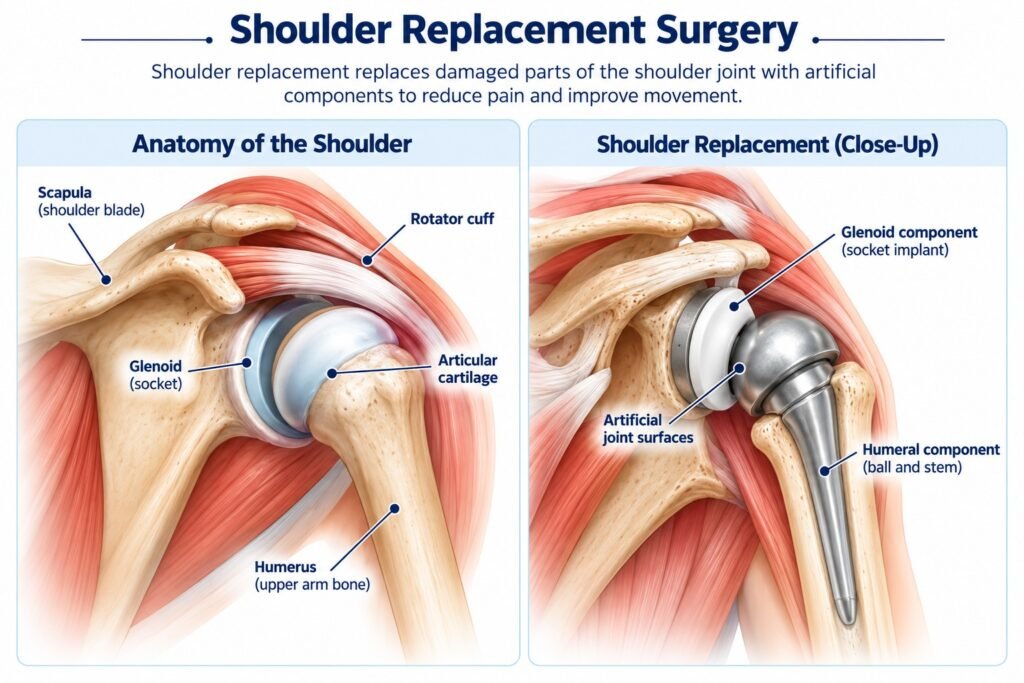
Surgeons use three main types. The right one depends on your bone and your rotator cuff (the group of tendons that hold the arm in the socket).
A reverse implant relies on the deltoid instead of the rotator cuff, which is why it helps when the cuff no longer works. In German data, the average patient getting a reverse implant was about 77, compared with 67 for an anatomic one. Partial replacement has faded: the same study recorded a 71% drop in hemiarthroplasty between 2012 and 2022.
Neither choice is best for everyone. Your surgeon decides after reviewing your scans and testing how well your cuff works.
You may need a shoulder replacement when severe arthritis, a badly broken shoulder, or an irreparable rotator cuff tear causes constant pain and limits daily life. It’s usually considered only after medicines, injections, and physiotherapy haven’t helped.
The most common reasons are osteoarthritis, rheumatoid arthritis, and avascular necrosis (bone damage from poor blood supply). A completely torn cuff that can’t be repaired, or cuff tear arthropathy, usually points toward a reverse implant. Night pain, trouble reaching or dressing, and weakness are common warning signs.
Some people try regenerative orthopedic treatment first. It suits selected tendon and cartilage problems. Severe joint damage still tends to need a replacement.
Shoulder replacement surgery in Germany typically costs between USD 7,000 and USD 25,000, with an average near USD 14,000, based on 2026 estimates. The final price depends on the implant, hospital, room category, and length of stay. Always ask for a written, itemized quote.
Several things push the price up. Room type, case severity, an extended stay, and complications all add cost. Treat every figure as an estimate, not an offer. Ask each hospital to state the currency, the date, and exactly what’s covered.
Most people wear a sling for four to six weeks, start guided physiotherapy early, and regain basic daily function by about 8 to 12 weeks. Strength and comfort keep improving for up to a year. Driving usually waits until you’re out of the sling and your surgeon says it’s safe.
Typical timelines include gentle exercises in weeks 1 to 2, light activities by weeks 2 to 6, and normal function by weeks 8 to 12. After a total replacement, a lifelong 30-pound lifting limit usually applies. Full recovery can take up to one year.
Physiotherapy is essential, and timing differs by implant. After an anatomic replacement, structured therapy starts one to two weeks after surgery. After a reverse replacement, it starts around six weeks. Ask your surgeon when you can safely fly home, and book physiotherapy near home before you leave.
Every major operation carries risk. After shoulder replacement, the main concerns are loosening or wear of the implant, rotator cuff wear, and nerve damage. Infection and dislocation can also happen.
Reviews report complication rates of about 15% to 24% after reverse replacement. The rate depends heavily on why surgery was needed, and it can approach 40% when the implant revises an earlier operation. Early dislocation is a particular risk if you fall or skip the sling.
Surgeon experience matters. One study summary noted that more experienced surgeons have fewer complications. So ask how many shoulder replacements your surgeon performs each year.
A little groundwork makes the trip smoother. Here’s the order we suggest:
Gather your records. Collect your diagnosis, X-rays, MRI or CT scans, medicine list, and any past shoulder surgery details.
Get a surgeon’s opinion first. Ask which implant type fits your cuff and bone, and request an itemized estimate before you book flights.
Pick a city and hospital. Berlin, Munich, and Frankfurt are common starting points. Browse orthopedic hospitals in Germany, including those in Berlin and Munich, and confirm the hospital has a dedicated shoulder team.
Sort visa and travel early. Check Germany’s visa rules for your country and allow time for paperwork.
Plan the stay and follow-up. Ask when you can fly, and arrange physiotherapy at home.
Cancer Rounds is backed by the Vaidam Health group, which has helped over 100,000 patients from 125+ countries. You get a dedicated case manager and support in 11+ languages from first enquiry to your return home.
Shoulder replacement can end years of pain, but a good result starts with the right implant and the right surgeon. Three points to keep:
The type (anatomic, reverse, or partial) depends on your rotator cuff and bone.
Costs run roughly USD 7,000 to 25,000, so insist on an itemized quote.
Recovery takes months, and physiotherapy decides how well your new joint works.
Ready for the next step? Book a consultation, and we’ll arrange a specialist review of your scans, a personalised treatment plan, and a cost estimate. Not ready yet? Request a callback, ask about procedure costs, or start a WhatsApp chat with our team. You don’t have to make this decision alone.
Estimates run from USD 7,000 to USD 25,000, with an average near USD 14,000. The price depends on the implant, hospital, room type, and length of stay. At Cancerrounds, you can look at treatment cost guides for other procedures and destinations.
The operation usually takes about two hours, and estimates range from one to three hours depending on the case. Expect a hospital stay of two to three nights. Complex cases can take longer.
A total (anatomic) replacement copies your natural anatomy, so your rotator cuff needs to work normally. A reverse replacement switches the ball and socket so the deltoid muscle does the work of a damaged cuff. Your surgeon chooses based on cuff function and bone quality.
Ten-year survival is about 92% to 95% for total, about 94% for reverse, and 86% to 90% for partial replacements. Implants can loosen or wear over time, which may mean revision surgery.
Yes. Share your diagnosis, scans, medicines, and past surgeries so a surgeon can review your case first. We then help with your itemized estimate, visa paperwork, and travel planning, with a case manager and support in 11+ languages. Confirm the hospital’s follow-up plan before you fly home.
Reverse replacement may suit you if you have an irreparable rotator cuff tear or cuff tear arthropathy, or a failed earlier shoulder replacement. A surgeon confirms eligibility after an exam and imaging.
Published By
.webp)
Global Patient Care, Redefined
The CancerRounds Medical Content Team specialises in creating accurate, clear and patient-focused healthcare content. Our content is written by medically trained writers, medically reviewed, and based on reputable medical sources to support informed healthcare decisions.
Get expert guidance instantly
Share a few details and our medical team gets back to you within 4 hours with the next steps.

Tell us what you are facing and our medical team will guide you to the right doctors, hospitals and treatment.
Free Review, No Commitment
Free assessment with no pressure to proceed.
Trusted by 100,000+ Patients
Across 125+ countries worldwide
500+ Top Partner Hospitals
Globally accredited medical facilities
5000+ Expert Specialists
Senior doctors across major specialties.
Making quality healthcare accessible to patients worldwide
Everything you need to know about choosing the right hospital, doctor and treatment plan.