
Neuroendocrine tumour treatment in Germany depends on where the tumour started, how fast it grows, and whether it has spread. Options include surgery, hormone-blocking injections, targeted medicines, chemotherapy, liver-directed treatments and Lutetium-177 PRRT (a form of targeted radiation). Specialist teams plan each case together. Share your reports with a Cancer Rounds case manager to get a personalised plan and cost estimate.
Reply in 4 hours · Plan and quote in 2 days · 100% confidential
A neuroendocrine tumour (NET) diagnosis raises a lot of questions. What type is it? Can it be removed? Is there something more targeted than standard chemotherapy? Neuroendocrine tumour treatment in Germany is built around those exact questions, with specialist centres that review each case as a team before suggesting a plan.
NETs often grow slowly, so you usually have time to ask questions and compare options. The best plan depends on the tumour’s location, grade (how fast the cells grow), stage and whether it has spread. Treatment can include surgery, medication, targeted therapy and PRRT.
This guide explains each option in plain language, so you can walk into your first consultation prepared.
A neuroendocrine tumour grows from hormone-producing cells, most often in the digestive tract, lungs, or pancreas. Doctors grade it as G1, G2, or G3 based on how quickly the cells divide. Grade and origin decide which treatments are likely to work.
Grade is measured partly by the Ki-67 index, a lab test showing the share of cells that are actively dividing. A lower number usually means slower growth.
Doctors also separate two groups. Well-differentiated NETs look more like normal cells and tend to grow slowly. Poorly differentiated neuroendocrine carcinomas (NECs) look very different from normal cells and behave more aggressively. They’re treated differently, usually with platinum-based chemotherapy.
Some NETs are “functioning,” meaning they release hormones that cause symptoms like flushing or diarrhoea. Others are “non-functioning” and may cause no symptoms until they grow or spread.
Diagnosis usually combines a biopsy (a small tissue sample), Ki-67 testing, CT or MRI scans, and a special scan called Ga-68 DOTATATE PET/CT. This scan shows whether the tumour has somatostatin receptors, which decides if PRRT is possible. An FDG PET/CT may be added for faster-growing tumours.
After the tests, a multidisciplinary tumour board meets. That’s a group of specialists, such as surgeons, oncologists, nuclear medicine doctors and pathologists, who agree on one plan together. Heidelberg’s NCT and Ulm’s Comprehensive Cancer Centre both describe this team approach for NET patients.
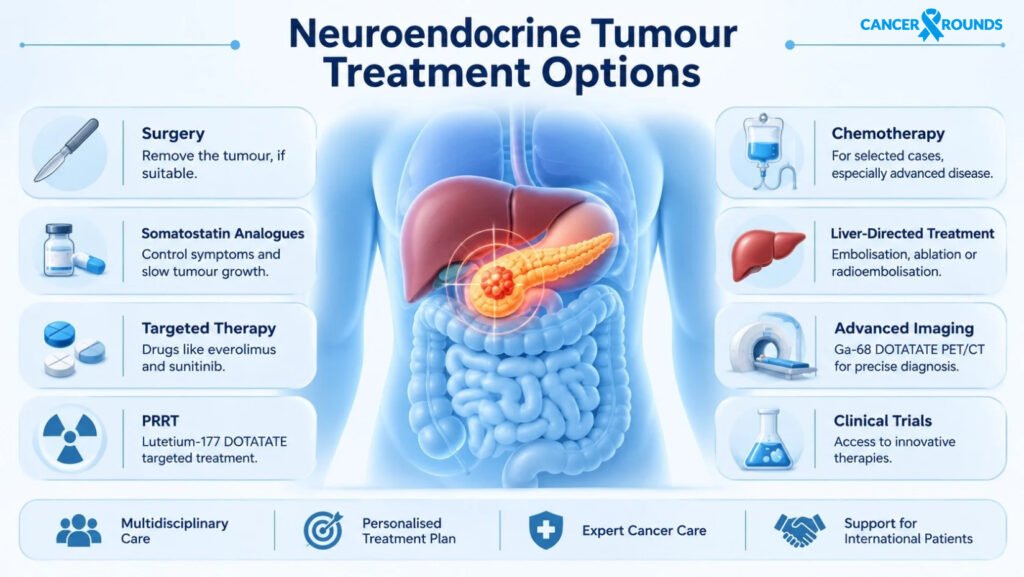
Neuroendocrine tumour treatment in Germany includes surgery, somatostatin analogues, PRRT, targeted drugs, chemotherapy and liver-directed treatments. Which ones fit you depends on tumour grade, size, location, spread and your overall health. A tumour board matches the options to your case.
Pancreatic NETs are a different disease from the far more common pancreatic adenocarcinoma. They usually grow more slowly and respond to different treatments. That’s why a pancreatic NET shouldn’t be handled like standard pancreatic cancer care.
Surgery is often the first choice when the tumour can be removed, using procedures such as a Whipple operation or a distal pancreatectomy. If it can’t be removed, doctors can choose between targeted drugs, chemotherapy and PRRT, based on grade and receptor status.
Functioning tumours, such as insulinomas, need extra steps to control hormone levels before and after treatment.
PRRT delivers radiation straight to tumour cells. A radioactive drug, Lutetium-177 DOTATATE, attaches to somatostatin receptors on the tumour and treats it from the inside. You need a positive receptor scan to qualify, and healthy kidney function and blood counts.
Treatment is usually given as about four infusions, spaced roughly 8 to 12 weeks apart. You’ll follow radiation-safety steps for a short time after each one, and your team will check blood counts and kidney function throughout.
Research supports its role. In the NETTER-2 trial, first-line Lutetium-177 DOTATATE with octreotide extended progression-free survival in patients with grade 2 or 3 advanced gastroenteropancreatic NETs.
Germany has several hospitals experienced in diagnosing and treating neuroendocrine tumours (NETs). Patients may need a combination of surgery, medication, targeted treatment or specialised therapies such as PRRT, depending on the type and stage of the tumour. The following is a list of top hospitals for neuroendocrine tumour treatment in Germany.
1. NCT Heidelberg (National Center for Tumor Diseases)
2. LMU Klinikum, Munich (GEP-NET Centre)
3. University Hospital Ulm (Comprehensive Cancer Centre)
4. University Hospital Tübingen (ENETS Centre of Excellence)
Neuroendocrine tumour treatment in Germany usually costs from about €8,000 for a single procedure to €25,000 to €80,000 for a full PRRT course, plus scans and follow-up. The final amount depends on your diagnosis, your treatment plan and the hospital.
The ranges below come from our cancer treatment costs in Germany guide. They’re estimates for planning, not quotes.
A single cycle is not the whole bill. PRRT is usually given in about four cycles, and you’ll also need scans, blood tests, and follow-up. Ask the hospital for a written estimate that lists what’s included and what isn’t.
Good preparation saves time once you arrive. Gather your pathology reports, biopsy results, scan images and a summary of any past treatment. Confirm the treatment schedule, expected stay and follow-up plan with the hospital before you book travel.
International patients usually need a medical visa, so start early. Our guide on applying for a medical visa walks through the steps. You can also read about top German oncology hospitals to see what to look for: NET-focused team expertise, nuclear medicine and PRRT access, pancreatic surgery experience and clinical trial access.
Follow-up matters after you return home. Agree in advance how scans and reports will be shared with your local doctor.
Neuroendocrine tumour treatment in Germany isn’t one-size-fits-all. Your tumour’s grade, location and receptor status shape the plan. Specialist tumour boards weigh surgery, medicines and PRRT together. And clear cost estimates and records make planning easier.
If you or a loved one is facing this diagnosis, you don’t have to figure it out alone. Share your reports with the Cancer Rounds team, and a dedicated case manager will help you get a personalised treatment plan and cost estimate from suitable German centres. You can also request a callback or start a WhatsApp chat if you’d like to talk first.
Yes. Several German centres offer PRRT with Lutetium-177 for selected patients, including nuclear medicine departments such as Helios Berlin-Buch. You’ll need a positive somatostatin receptor scan and suitable kidney function and blood counts. Your specialist team confirms eligibility before treatment is planned.
It depends on the diagnosis, the treatment plan and the hospital. Surgery, PRRT cycles, medicines and follow-up are priced differently, so a personal estimate works best. See our German cancer treatment cost guide for what affects the price.
Often, yes. When a pancreatic NET hasn’t spread and can be removed safely, surgery is a main treatment option. The type of operation depends on where the tumour sits in the pancreas. Your tumour board will decide whether surgery or another approach fits best.
Metastatic NETs can often be controlled for long periods. Options include somatostatin analogues, PRRT, targeted drugs, chemotherapy and liver-directed treatments when the liver is involved. The right mix depends on grade, receptor status and how far the disease has spread.
A NET is well differentiated, so its cells look closer to normal and it usually grows slowly. A NEC is poorly differentiated and tends to grow and spread faster. NECs are usually treated with platinum-based chemotherapy, while NETs have a wider range of options.
Published By
.webp)
Global Patient Care, Redefined
The CancerRounds Medical Content Team specialises in creating accurate, clear and patient-focused healthcare content. Our content is written by medically trained writers, medically reviewed, and based on reputable medical sources to support informed healthcare decisions.
Get expert guidance instantly
Share a few details and our medical team gets back to you within 4 hours with the next steps.

Tell us what you are facing and our medical team will guide you to the right doctors, hospitals and treatment.
Free Review, No Commitment
Free assessment with no pressure to proceed.
Trusted by 100,000+ Patients
Across 125+ countries worldwide
500+ Top Partner Hospitals
Globally accredited medical facilities
5000+ Expert Specialists
Senior doctors across major specialties.
Making quality healthcare accessible to patients worldwide
Everything you need to know about choosing the right hospital, doctor and treatment plan.