
New cancer treatments in 2026 have made big headlines: a new pill for pancreatic cancer and two promising cancer vaccines. If you or someone you love has cancer, it’s natural to wonder whether any of these could help. The answer depends on the type of cancer, how advanced it is and the country where you live.
Confused about treatment options?
Get a free second opinion from our oncologists
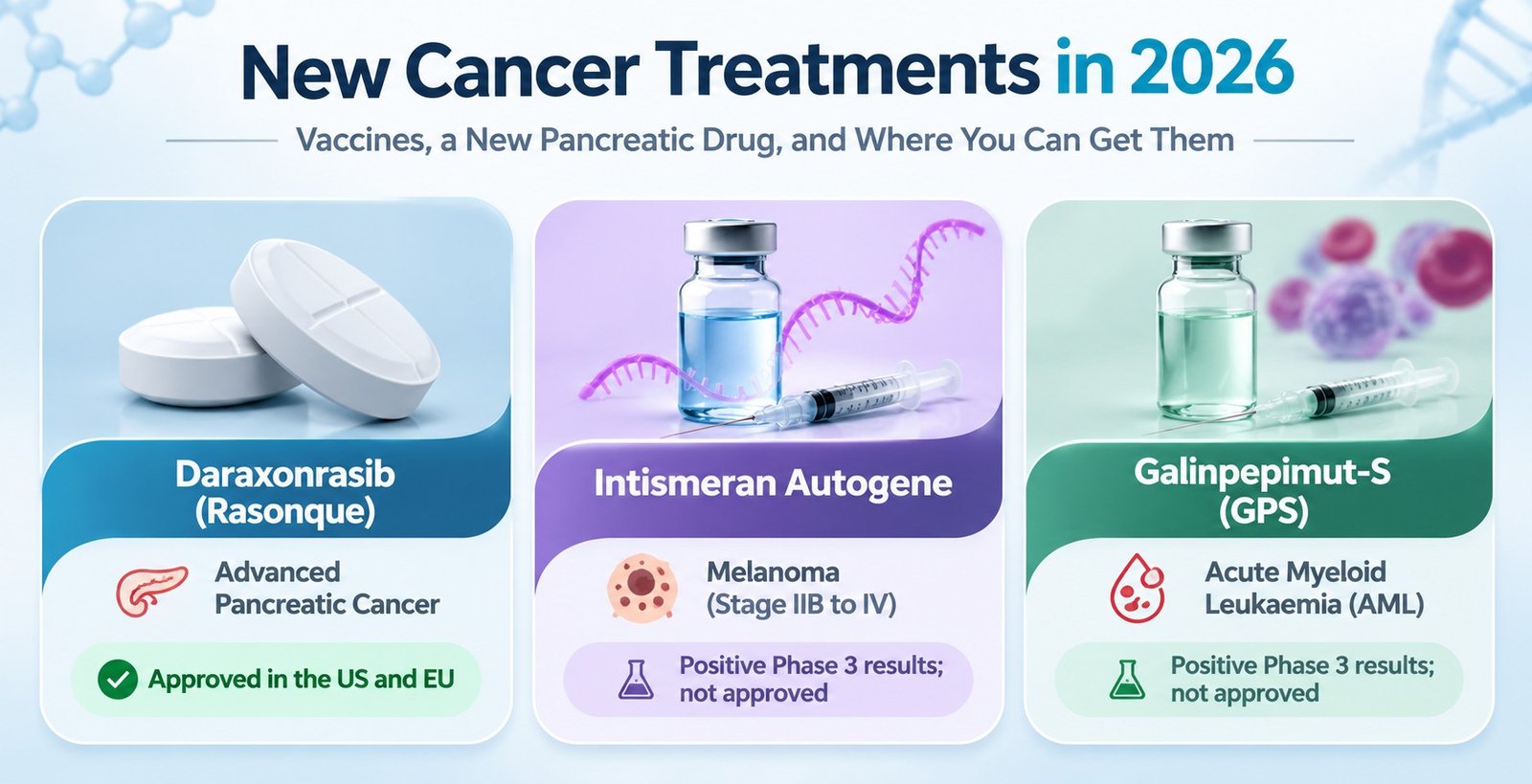
One new cancer drug and two cancer vaccines stand out in 2026. Daraxonrasib, a daily pill for advanced pancreatic cancer, is approved in the US and the EU. A personalised mRNA vaccine for melanoma and a vaccine for a type of leukaemia both had positive late-stage trial results but aren’t approved anywhere yet.
Each one works in a different way and helps a different group of patients. Here’s the short version.
| Treatment | Cancer type | How it works | Status on 25 Nov 2026 |
| Daraxonrasib (Rasonque) | Advanced pancreatic cancer, after earlier treatment | A daily pill that blocks RAS, a protein that tells cancer cells to grow | Approved in the US (26 Aug 2026) and the EU (16 Nov 2026) |
| Intismeran autogene | Melanoma (stage IIB to IV) after surgery | A personalised mRNA vaccine, given with an immunotherapy drug | Positive Phase 3 results; not approved |
| Galinpepimut-S (GPS) | Acute myeloid leukaemia in second or later remission, when a transplant isn’t possible | A vaccine that trains the immune system to spot a protein called WT1 | Positive Phase 3 topline results; not approved |
News about new treatments can sound bigger or smaller than it really is. You don’t need a medical degree to read it well. These four ideas are enough, and each one comes back in the sections below.
Phases (how far along a treatment is). Phase 1 and 2 trials are small and mostly check safety. Phase 3 trials are the big test: hundreds of patients, and the new treatment is compared with today’s standard care. Regulators rely mostly on Phase 3 results.
Early headline results (called “topline”). When a trial ends, the company shares a first summary. Independent experts haven’t checked the full data yet. Think of it as a good first sign, not the final word.
Percent vs real people. A headline like “42% lower risk” compares two groups. It doesn’t tell you how many people it helped. So we also show it as “out of 100 people”, which is easier to picture.
Median survival (the middle point). If 100 people are lined up by how long they lived, the median is where the 50th person falls. It isn’t a promise for any one patient. Some people live much longer, and some less.
Cancer treatment vaccines teach your immune system to find and attack cancer cells that are already in your body. They’re different from preventive vaccines, such as the HPV shot, which stop infections that can lead to cancer. Most cancer treatment vaccines are still experimental.
Preventive cancer vaccines protect healthy people from viruses that can cause cancer. The HPV vaccine and the hepatitis B vaccine are the two approved examples. They lower the risk of cervical and liver cancer.
Treatment vaccines are different. The National Cancer Institute explains that they’re meant for people who already have cancer, and they work against cancer cells, not against a virus. Only a few are approved. They include sipuleucel-T for advanced prostate cancer, BCG for early bladder cancer, and T-VEC for melanoma that can’t be removed.
Cancer cells carry gene changes called mutations. Some mutations create new proteins that healthy cells don’t have. These are called neoantigens. Because they’re unique to the tumour, the immune system can learn to attack them and leave healthy tissue alone.
Each vaccine is built from the patient’s own tumour. The steps look like this:
Every dose is made for one person, so making and delivering them is complicated. Samples must reach the lab, be sequenced, become a vaccine, and travel back to the patient.
Drugs such as pembrolizumab block a mechanism cancer uses to hide from the immune system. A vaccine shows the immune system what to look for. That’s why doctors often pair them. In the melanoma trial, everyone got pembrolizumab, and some also got the vaccine.
Now that you know the basics, let’s look at each treatment one by one. They’re for three different cancers, and they’re at three different stages:
The vaccine is called intismeran autogene (also known as V940 or mRNA-4157). Moderna and Merck make it. In 2026, it became the first personalised mRNA cancer vaccine to succeed in a Phase 3 trial. It isn’t approved yet.
The trial, called INTerpath-001, enrolled 1,137 adults whose melanoma had been fully removed by surgery. Their cancer was stage IIB to IV, which carries a high risk of coming back. Two out of every three people got the vaccine plus pembrolizumab. The rest got a placebo plus pembrolizumab.
After about two years of follow-up, the numbers looked like this:
The companies call this a 42% lower risk of recurrence or death. Both ways of saying it are true. The 42% compares risk between the two groups. The “12 in 100” shows what it means for real people. It also shows that most people in both groups did well.
Pembrolizumab started right away. The vaccine started only after it was made, which takes time. So in the first six months, both groups did about the same. After six months, a planned extra analysis showed a 58% lower risk. That is a side analysis, not the main result, so doctors will study it closely.
Serious (grade 3 to 5) treatment-related side effects were similar in both groups: 14.2% with the vaccine and 13.4% without. Fever (52.2% vs 8.2%), pain at the injection site (51.0% vs 9.5%) and tiredness (38.5% vs 29.7%) were more common with the vaccine. No new safety problems appeared.
Moderna says it’s working on an FDA filing and expects the vaccine to be commercially available in 2027. Its plant in Massachusetts can make several thousand doses ahead of that filing. The companies are also running nine trials, including three Phase 3 trials in lung cancer.
Colon cancer results are expected in 2027 and pancreatic cancer results in 2031.
If you or a loved one has melanoma, ask your care team about the right follow-up plan.
Daraxonrasib (brand name Rasonque) is a once-daily tablet from Revolution Medicines. It’s the first medicine of its kind approved for pancreatic cancer.
Pancreatic cancer often causes few symptoms early on. About 80% of patients are diagnosed after it has spread to nearby tissue or other organs. For cancer that has spread, the five-year survival rate in the US is about 3%.
RAS is a protein that works like a switch. It tells cells when to grow. In more than 90% of pancreatic cancers, a change in the KRAS gene (part of the RAS family) keeps that switch stuck on. For decades, researchers couldn’t find a drug to block it.
Daraxonrasib is a “molecular glue.” It binds RAS to another protein inside the cell, called cyclophilin A. That stops RAS from sending growth signals. It works on several forms of RAS, so it doesn’t need one specific mutation.
The RASolute 302 trial enrolled 500 adults whose cancer had grown after one earlier treatment. Half got daraxonrasib. Half got chemotherapy chosen by their doctor. Here are the results for everyone in the trial:
| Daraxonrasib | Chemotherapy | |
| Median overall survival | 13.2 months | 6.7 months |
| Median time before the cancer grew | 7.2 months | 3.6 months |
| Tumours that shrank | 30% of patients | 11% of patients |
That’s about 6.5 months more survival at the median, and a 60% lower risk of death. Patients on the pill also went longer before their overall health and pain got worse: 5.7 months vs 2.6 months for health, and 9.2 months vs 3.8 months for pain.
You may see 6.6 months for the chemotherapy group in some reports. That figure covers the 92% of patients whose tumour had a RAS G12 mutation. The 6.7-month figure covers everyone. Both show the same big gap. The trial was open-label, which means patients and doctors knew who got which treatment.
The US approval doesn’t require a companion test for RAS mutations. Your doctor may still order tumour testing to look for other options.
In pancreatic cancer trials, skin problems happened in 86% of patients, mouth sores in 57%, and diarrhoea in 63%. Many were mild or moderate. Serious reactions happened in 30%, and 2.9% stopped the drug because of side effects.
Rare but serious problems include a hole in the gut wall (0.9%) and lung inflammation (2.4%). Each had one death reported. Doctors usually advise steroid cream, moisturiser, sunscreen and sometimes antibiotics from the first dose to protect the skin. The drug can harm an unborn baby. It can also interact with other medicines, so tell your doctor about everything you take.
In November, researchers shared early results for daraxonrasib plus chemotherapy as a first treatment. In 61 patients, tumours shrank in 60.7%, and the disease was controlled in 90.2%. The median time before the cancer grew was 12.8 months.
“Disease control” includes tumours that stayed the same size. It doesn’t mean cure. There was also no comparison group, so we can’t say yet whether the combination helps people live longer. A Phase 3 trial called RASolute 303 is testing exactly that. Until it reports, this use isn’t approved.
The US list price is $39,800 for 30 days. Indian press reports put that at nearly Rs 38 lakh a month. Insurance and support programmes change what US patients pay. Doctors writing in The Lancet warned that at this price, many patients around the world may not get access.
If you or a family member has this diagnosis, you can read more about pancreatic cancer treatment options and how a second opinion works.
Galinpepimut-S, or GPS, is an experimental vaccine from SELLAS Life Sciences for acute myeloid leukaemia (AML), a fast-growing blood cancer. In November, the company announced that it met its main goal in a Phase 3 trial. It isn’t approved anywhere.
The REGAL trial enrolled 126 adults. Their AML had come back, and further treatment had brought it into a second or later remission. Remission means doctors can’t find signs of leukaemia. None of these patients could have a stem cell transplant. The trial team says people in this group face poor outcomes and need new options.
This is a narrow group. The results don’t apply to people with newly diagnosed AML or to those who can have a transplant.
GPS targets WT1, a protein that many blood cancer cells carry in large amounts. The vaccine contains four pieces of WT1. They train immune T cells to find and attack cells that carry it.
Half the patients got GPS. The other half got the best available treatment chosen by their doctor, such as watching and waiting, a drug that slows leukaemia, or low-dose chemotherapy.
Not REGAL. A public listing shows it as active but not recruiting. That listing was last updated in September 2025, so check the official trial record for the latest status. If you have acute myeloid leukemia (AML), talk to a specialist about leukaemia treatment options that fit your remission stage.
As of 25 November 2026, we found approvals for only one of these treatments: daraxonrasib, in the US and the EU. Neither vaccine is approved in any country. Approval in one country doesn’t mean the drug is sold in another, because each country has its own regulator, pricing talks and launch timeline.
Here’s what we found, country by country.
| Country or region | Daraxonrasib (pancreatic cancer) | Melanoma vaccine (intismeran) | Leukaemia vaccine (GPS) |
| United States | Approved 26 Aug 2026; on sale by prescription | Not approved; company working on FDA filing | Not approved; REGAL trial not recruiting |
| European Union (including Germany), plus Iceland, Norway and Liechtenstein | Approved 16 Nov 2026; access depends on each country’s pricing decisions | Not approved; trial sites for advanced melanoma include Germany, France, Italy, Spain and others | Not approved; REGAL sites included Germany, France, Spain, Greece, Hungary and Poland |
| United Kingdom | No approval found; separate regulator | Not approved | Not approved |
| India | No approval found; no filing announced as of October | Not approved; India isn’t among the countries listed for the advanced melanoma trial | Not approved; five Indian sites took part in REGAL, which isn’t recruiting |
| Turkey, UAE, Saudi Arabia, Thailand | No approval found | Not approved | Not approved |
| Canada and Japan | Their regulators took part in or watched the FDA review; approval not confirmed | Not approved; Canada has advanced melanoma trial sites | Not approved |
“No approval found” means we searched regulators’ announcements and the manufacturer’s updates. A newer approval may exist that we haven’t seen. Status changes fast, so ask your doctor to confirm before you plan anything.
Even after approval, a drug has to be priced and paid for. In the EU, timing of access varies by country and depends on national pricing and reimbursement steps. A joint EU assessment report was due in December to help speed that up. In India, a drug must be approved by the country’s regulator before it can be sold there.
There are three legitimate routes. All of them go through doctors and regulators.
You can’t buy your way into any of these. If someone offers a shortcut, be careful.
Yes, many patients travel for a second opinion, an approved treatment or a registered clinical trial. But no one should pay for an unapproved vaccine, and travel isn’t right for every patient. A specialist should confirm what fits your exact diagnosis before you book anything.
Cancer Rounds is a cancer-focused medical travel platform supported by the Vaidam Health network. The network has helped over 100,000 patients from 125+ countries. It works with 500+ accredited hospitals and 8,000+ doctors across 10+ destinations, including India, Turkey, Germany, Thailand, and the UAE.
A dedicated case manager can:
We can’t promise access to any single drug. What we can do is check the facts for your case before you spend time or money. Start with a free case review.
Some patients are too unwell to travel. Others may get the same care at home. For fast-moving cancers, delays between tests and treatment can hurt. A specialist should weigh this with you.
Three things matter most. First, “promising” isn’t the same as “approved,” and neither means a treatment is available where you live. Second, ask for absolute numbers: out of 100 people like me, how many benefit? Third, only a specialist who knows your exact diagnosis can say if a new option fits.
New cancer treatments in 2026 give real reasons for hope. The pancreatic pill is a first. The vaccines may open a new path. Your next step is simple: get your reports in front of the right specialist.
Get a free case review and a Cancer Rounds case manager will check what’s available for your diagnosis. Not ready yet? Request a callback, ask about costs, or message us on WhatsApp.
Status of treatments and trials was checked on 25 November 2026 and may change. This article is for education only and isn’t medical advice. Talk to a qualified oncologist about your diagnosis and treatment options.
Daraxonrasib is the headline approval. The FDA approved it on 26 August and the European Commission on 16 November for advanced pancreatic cancer after earlier treatment. The melanoma and leukaemia vaccines in this guide aren’t approved yet.
No. Intismeran autogene isn’t approved anywhere. In a Phase 3 trial, it lowered the risk of melanoma coming back in people whose stage IIB to IV melanoma had been fully removed. Moderna says it’s working on an FDA filing and expects the vaccine to be available in 2027.
A cancer vaccine is one type of immunotherapy. Drugs such as pembrolizumab block a trick cancer uses to hide from the immune system. A vaccine shows the immune system what to attack. Doctors often combine them, as in the melanoma trial.
The most common side effects are rash, diarrhoea, mouth sores, nausea and tiredness. Rare but serious problems include a hole in the gut wall and lung inflammation. Doctors usually start skin-protecting steps from the first dose, and they can lower the dose if side effects are hard to manage.
It’s on sale in the US by prescription and approved in the EU and EEA, where access depends on each country’s pricing decisions. We found no approval in the UK, India, Turkey, the UAE, Saudi Arabia or Thailand as of 25 November 2026. Some patients get it through company programmes in certain countries before approval.
Daraxonrasib lists at $39,800 for 30 days in the US. We found no announced price for either vaccine. Your total cost depends on your diagnosis, the hospital and the country. See our cancer treatment cost page for typical ranges.
Cancer Rounds can’t promise any single drug. A case manager reviews your reports, checks approval and trial status in each country, and arranges a specialist opinion. Access to unapproved treatments is possible only through registered trials or doctor-led programmes.
.webp)
Get expert guidance instantly
Tell us about your condition and we will help you find the right care.
Get expert guidance instantly
Share a few details and our medical team gets back to you within 4 hours with the next steps.

Tell us what you are facing and our medical team will guide you to the right doctors, hospitals and treatment.
Free Review, No Commitment
Free assessment with no pressure to proceed.
Trusted by 100,000+ Patients
Across 125+ countries worldwide
500+ Top Partner Hospitals
Globally accredited medical facilities
5000+ Expert Specialists
Senior doctors across major specialties.
Making quality healthcare accessible to patients worldwide
Everything you need to know about choosing the right hospital, doctor and treatment plan.